A market square laid out for fairs in 1383, a Piarist college that taught the whole basin for two centuries, and a coalfield that has just stopped — the three things Prievidza has to explain itself with.Trhové námestie vymerané pre jarmoky v roku 1383, piaristické kolégium, ktoré dve storočia učilo celú kotlinu, a uhoľná panva, ktorá práve skončila — tri veci, ktorými sa Prievidza vysvetľuje.
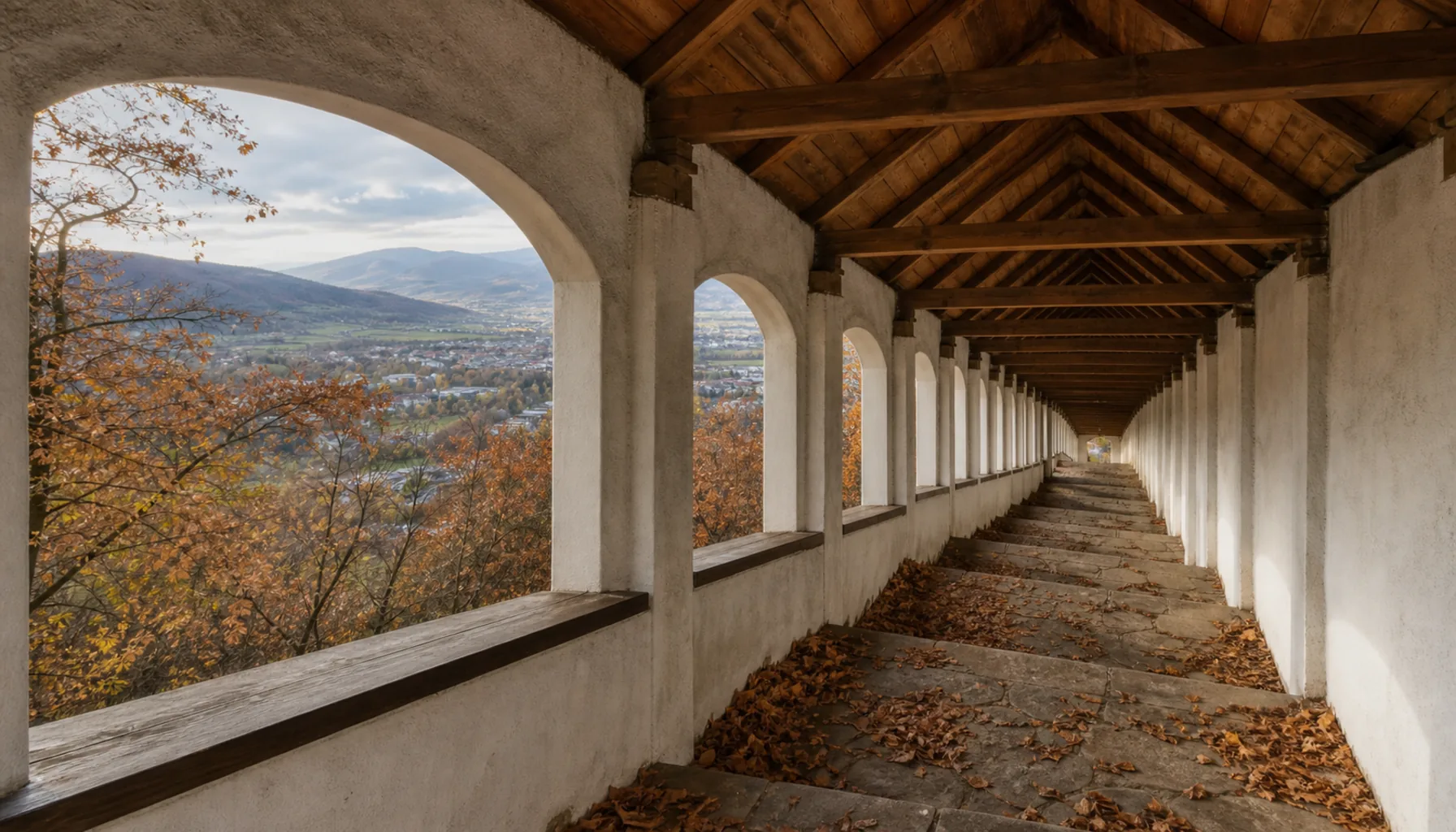
The covered stairway climbing Prievidza's Marian hill to the pilgrimage church, with the Upper Nitra basin opening out behind it.Kryté schodisko vystupujúce na Mariánsky vŕšok v Prievidzi k pútnickému kostolu; za ním sa otvára hornonitrianska kotlina.
The year in PrievidzaRok v Prievidzi
The long wide square is the shape of a privilege. On 26 January 1383 a charter issued in the name of Queen Mary gave Prievidza the rights that make a town out of a village: markets, its own mayor and its own priest, mills, fishing, free sale of what its craftsmen made, and tolls. The square was laid out so that fairs could stand in the middle of it, and market and fair days are still what it is for. The town's summer and Christmas programmes stand on the same ground.Dlhé široké námestie je tvarom jednej výsady. Listina vydaná 26. januára 1383 v mene kráľovnej Márie dala Prievidzi práva, ktoré robia z dediny mesto: trhy, vlastného richtára a vlastného farára, mlyny, rybolov, voľný predaj remeselníckych výrobkov a mýto. Námestie bolo vymerané tak, aby jarmoky mohli stáť uprostred neho, a trhové a jarmočné dni sú tým, načo dodnes slúži. Letný aj vianočný program mesta stoja na tej istej pôde.
Above the town rises the Marian hill, with a pilgrimage church reached by a covered stairway; pilgrimage days bring their own crowds on their own calendar. Dates for all of this are announced locally rather than nationally, so check the town's own listings before you travel for a particular weekend. Bojnice, whose built-up area touches Prievidza's, runs a much heavier visitor calendar around its château, its spa and its zoo, and has its own pages here.Nad mestom sa dvíha Mariánsky vŕšok s pútnickým kostolom, ku ktorému vedie krytné schodisko; púte prinášajú vlastné zástupy podľa vlastného kalendára. Termíny sa oznamujú miestne, nie celoštátne — pred cestou za konkrétnym víkendom si teda overte oznamy mesta. Bojnice, ktorých zástavba sa dotýka prievidzskej, majú okolo zámku, kúpeľov a zoo oveľa hustejší návštevnícky kalendár a majú tu vlastné stránky.
Where culture livesKde žije kultúra
The Piarists came to Prievidza in 1666 at the invitation of the Pálffys, who by then held the Bojnice estate, and their college turned a market town into the school town of the whole upper Nitra: for two centuries, a bright boy from a village in this basin was sent here. That is the deepest cultural fact about the place — not a collection or a theatre, but two hundred years of being where the basin educated its children.Piaristi prišli do Prievidze v roku 1666 na pozvanie Pálfiovcov, ktorí vtedy držali bojnické panstvo, a ich kolégium premenilo trhové mesto na školské mesto celej hornej Nitry: dve storočia sem posielali nadaného chlapca z ktorejkoľvek dediny tejto kotliny. To je najhlbší kultúrny fakt o tomto mieste — nie zbierka ani divadlo, ale dvesto rokov v úlohe miesta, kde kotlina vzdelávala svoje deti.
Today the town keeps the provision you would expect of a district centre of its size: a cultural centre with a hall and a programme, a library, exhibition space, a cinema, a school of art for children, choirs and folk groups. We name none of them individually, because premises and programmes change faster than a page like this does, and the town's own noticeboards are the reliable source.Dnes mesto drží ponuku, akú by ste od okresného centra jeho veľkosti čakali: kultúrne centrum so sálou a programom, knižnicu, výstavné priestory, kino, základnú umeleckú školu, zbory a folklórne súbory. Jednotlivo ich nemenujeme, lebo priestory a programy sa menia rýchlejšie než takáto stránka, a spoľahlivým zdrojom sú oznamy samotného mesta.
The buildings that carry itBudovy, ktoré ju nesú
The Piarist Church of the Holy Trinity and the college beside it stand on the square and are the best architecture in Prievidza: begun to an Italian design and finished in the middle of the eighteenth century. The town archive is thinner than it should be because Prievidza burned in 1673 in the kuruc wars — the long revolts against Habsburg rule, not Ottoman raids — and part of its archive burned with it. That was only seven years after the teaching order arrived, so the school and the fire belong to the same generation.Piaristický Kostol Najsvätejšej Trojice a kolégium vedľa neho stoja na námestí a sú najlepšou architektúrou v Prievidzi: začaté podľa talianskeho návrhu a dokončené v polovici osemnásteho storočia. Mestský archív je chudobnejší, než by mal byť, pretože Prievidza v roku 1673 zhorela počas kuruckých vojen — dlhých povstaní proti habsburskej vláde, nie tureckých nájazdov — a časť archívu zhorela s ňou. Bolo to iba sedem rokov po príchode učiteľskej rehole, takže škola a požiar patria tej istej generácii.
The square is the town's one genuinely historic space and everything else radiates from it. Around it stand the housing estates built from the 1960s for the people the coalfield pulled in, when Prievidza went from about five thousand inhabitants to more than fifty thousand — the fastest change in its history, and one decided somewhere else. The covered stairway up the Marian hill gives the best view of how the whole basin is put together, ringed by the Vtáčnik and the Strážov Hills.Námestie je jediným naozaj historickým priestorom mesta a všetko ostatné z neho vyžaruje. Okolo neho stoja sídliská stavané od šesťdesiatych rokov pre ľudí, ktorých pritiahla uhoľná panva, keď Prievidza vyrástla z asi piatich tisíc obyvateľov na viac než päťdesiattisíc — najrýchlejšia zmena v jej dejinách, o ktorej sa rozhodlo inde. Krytné schodisko na Mariánsky vŕšok ponúka najlepší pohľad na to, ako je celá kotlina poskladaná, obopnutá Vtáčnikom a Strážovskými vrchmi.
After the coalPo uhlí
For a century the district's identity was brown coal: dug at Handlová, Nováky and Cígeľ, burned in the power station at Nováky, administered from Prievidza. Industrial mining had begun at Handlová in 1909, and on 15 February 1913 the railway was pushed east to reach it — the moment the coal of this basin could leave the basin, and the moment the town where the lines met became the place the whole coalfield did its business.Celé storočie bolo identitou okresu hnedé uhlie: ťažené v Handlovej, Novákoch a na Cígli, spaľované v novláckej elektrárni a spravované z Prievidze. Priemyselná ťažba sa v Handlovej začala v roku 1909 a 15. februára 1913 sem dorazila železnica — chvíľa, keď uhlie tejto kotliny mohlo kotlinu opustiť, a chvíľa, keď sa mesto na križovatke tratí stalo miestom, kde celá panva vybavovala svoje veci.
It ended on 20 December 2023, when the last coal was cut at the Nováky mine and brown-coal mining in Slovakia stopped. What a district does with a hundred years of that is a live question here. A state transformation programme pays for retraining and an industrial park, but the remembering itself sits mostly in the pit towns' own halls and clubs rather than in any collection in Prievidza, and it is worth asking about locally rather than assuming there is a museum for it.Skončilo sa to 20. decembra 2023, keď v novláckej bani vyrúbali posledné uhlie a ťažba hnedého uhlia na Slovensku sa zastavila. Čo si okres počne so sto rokmi takejto histórie, je tu živá otázka. Štátny transformačný program platí rekvalifikácie a priemyselný park, ale samotné spomínanie sídli väčšinou v kultúrnych domoch a kluboch baníckych miest, nie v nejakej zbierke v Prievidzi — a je lepšie sa naň spýtať na mieste než predpokladať, že preň existuje múzeum.