Považská Bystrica · The upper VáhPovažská Bystrica · Horné Považie
Culture in Považská BystricaKultúra v Považskej Bystrici
A town whose old centre was demolished for the works that fed it, so its culture sits in the ruin strung along the ridge above, in the machines it once built, and in a hall programme rather than in monuments.Mesto, ktorého staré centrum ustúpilo závodu, čo ho živil — jeho kultúra preto sídli v zrúcanine roztiahnutej po hrebeni nad ním, v strojoch, ktoré kedysi vyrábalo, a v programe jednej sály, nie v pamiatkach.
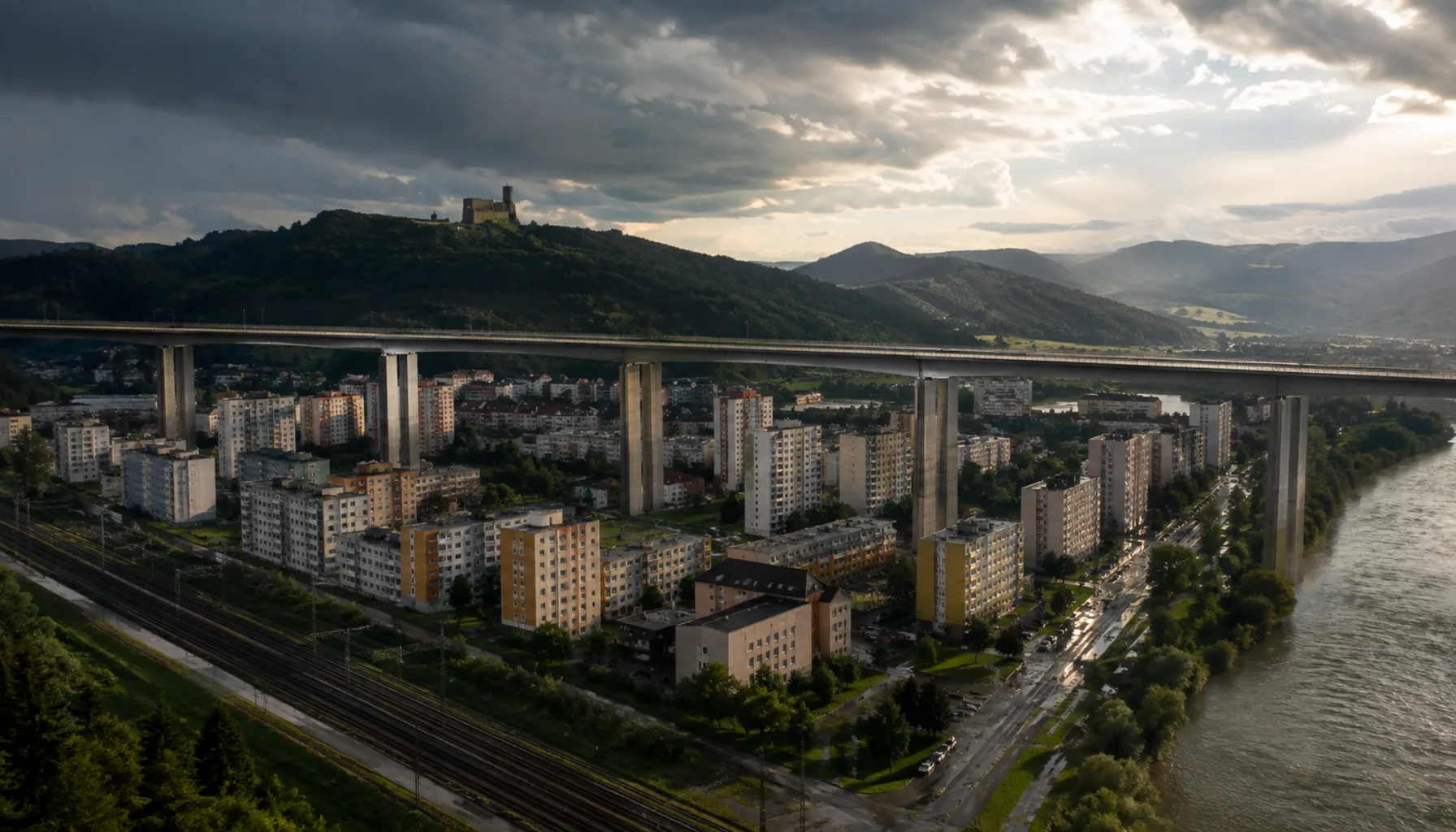
The D1 motorway viaduct crossing the centre of Považská Bystrica on its piers, with the castle ridge on the skyline behind it.Diaľničný viadukt D1 na pilieroch ponad centrum Považskej Bystrice; v pozadí na obzore hrebeň s hradom.
The year in Považská BystricaRok v Považskej Bystrici
This is a working town and it keeps a working town's calendar: a season in the cultural centre, town days in summer, a market before Christmas, and the events people come down out of the housing estates for. Nothing in it is a national fixture, and the town does not pretend otherwise. Programmes are announced locally and change from year to year, so check the town's own listings before you travel for a particular date.Toto je pracovné mesto a drží sa kalendára pracovného mesta: sezóna v kultúrnom centre, mestské dni v lete, trh pred Vianocami a podujatia, kvôli ktorým ľudia zídu zo sídlisk. Nič z toho nie je celoslovenská stálica a mesto nepredstiera opak. Programy sa oznamujú miestne a rok od roka sa menia — pred cestou za konkrétnym termínom si teda overte oznamy mesta.
What draws a crowd reliably is the country above the town. Marked trails start at the edge of the estates and climb into the Javorníky to the north-east and the Strážov Hills to the south, and the Manín gorge near Považská Teplá, a short drive east, is one of the narrowest in Slovakia — a road threading between limestone walls a few metres apart, with climbing routes on the crags above.Spoľahlivo priláka dav krajina nad mestom. Značkované chodníky začínajú na okraji sídlisk a stúpajú do Javorníkov na severovýchode a do Strážovských vrchov na juhu, a Manínska tiesňava pri Považskej Teplej, kúsok autom na východ, je jednou z najužších na Slovensku — cesta pretkaná medzi vápencovými stenami vzdialenými pár metrov, s lezeckými cestami na bralách nad ňou.
Where culture livesKde žije kultúra
The centre is a study in twentieth-century planning rather than a place of monuments, and it is honest about that. Between 1950 and 1980 most of the old town was demolished and replaced with blocks of flats for the fifteen thousand people the engineering works employed at its height. The cultural provision lives in buildings from those decades: a cultural centre with a hall and a programme, a library, a school of art for children, choirs and folk groups. We do not name them individually, because premises and programmes change faster than a page like this does.Centrum je skôr štúdiou plánovania dvadsiateho storočia než miestom pamiatok — a mesto to priznáva. V rokoch 1950 až 1980 bola väčšina starého mesta zbúraná a nahradená panelovými domami pre pätnásťtisíc ľudí, ktorých strojárske závody v čase najväčšieho rozmachu zamestnávali. Kultúrna ponuka žije v budovách z tých desaťročí: kultúrne centrum so sálou a programom, knižnica, základná umelecká škola, zbory a folklórne súbory. Jednotlivo ich nemenujeme, lebo priestory a programy sa menia rýchlejšie než takáto stránka.
The memory the town carries best is industrial. Považské strojárne made ball bearings, machine tools and aircraft engines, but what Czechoslovakia remembers are the two-wheelers: Manet, Tatran, Jawa and the Babetta moped that half the country learned to ride. That is a real inheritance, and in a town that lost its old centre it is a large part of what people mean when they say where they are from.Pamäť, ktorú mesto nesie najlepšie, je priemyselná. Považské strojárne vyrábali guľkové ložiská, obrábacie stroje a letecké motory, ale Československo si pamätá dvojkolesové stroje: Manet, Tatran, Jawa a mopeds Babetta, na ktorej sa pol krajiny učilo jazdiť. To je skutočné dedičstvo a v meste, ktoré prišlo o staré jadro, je veľkou časťou toho, čo ľudia myslia, keď hovoria, odkiaľ sú.
The buildings that carry itBudovy, ktoré ju nesú
The castle on the ridge above Považské Podhradie is not a compact keep but a string of walls, gates and courtyards following a long narrow crest. It first appears in writing in 1316 as Bystrický hrad. A fire gutted it in 1543 and the Podmanický brothers rebuilt it larger with an outer bailey — the sprawl walkers cross today — and in 1698 the emperor ordered it destroyed so that no rebel could use it again. Local memory blames the Turks for the ruin, and local memory is wrong.Hrad na hrebeni nad Považským Podhradím nie je kompaktná pevnosť, ale reťaz múrov, brán a nádvorí sledujúca dlhý úzky chrbát. Prvýkrát sa písomne objavuje v roku 1316 ako Bystrický hrad. V roku 1543 ho vyhorel požiar, Podmanickovci ho prestavali väčší a pridali predhradie — rozľahlosť, ktorou dnes turisti prechádzajú — a v roku 1698 dal cisár hrad zbúrať, aby ho už žiadny povstalec nemohol použiť. Miestna pamäť pripisuje zrúcaninu Turkom a miestna pamäť sa mýli.
Down in the valley stands the Renaissance mansion the Balassa family moved into in 1631, when they gave up on the ridge; the lords of Považské Podhradie lived there from then on. And over the middle of the modern town strides the D1 viaduct, more than a kilometre long on piers standing between the housing blocks, opened on 30 and 31 May 2010. It took the transit traffic out of the streets and put a concrete deck over the centre in exchange, and it is the most argued-about structure in the region.Dolu v údolí stojí renesančný kaštieľ, do ktorého sa Balašovci presťahovali v roku 1631, keď to na hrebeni vzdali; páni Považského Podhradia tam odvtedy sídlili. A ponad stred dnešného mesta sa tiahne diaľničný viadukt D1 dlhý vyše kilometra, na pilieroch stojacich medzi panelákmi, otvorený 30. a 31. mája 2010. Vzal z ulíc tranzitnú dopravu a na oplátku položil nad centrum betónovú dosku — je to najviac diskutovaná stavba v celom kraji.
A charter in the language people spokeListina v jazyku, ktorým sa tu hovorilo
In 1506 the Podmanický chancery issued the Articuli Podmanickyani, setting out what the lord owed his subjects and what they owed him. What makes it matter is not the content but the language: it was written in the everyday speech of the people here rather than in Latin, which is why historians still read it. For a valley whose written record is otherwise entirely in the language of clerks, that is the earliest surviving thing the place says in its own voice.V roku 1506 vydala podmanickovská kancelária Articuli Podmanickyani, ktoré stanovili, čo dlží pán svojim poddaným a čo oni jemu. Dôležitý nie je obsah, ale jazyk: napísané boli každodennou rečou tunajších ľudí, nie latinsky, a práve preto ich historici dodnes čítajú. Pre údolie, ktorého písomný záznam je inak celý v jazyku pisárov, je to najstaršia zachovaná vec, ktorú toto miesto povie vlastným hlasom.
The town has had its own institutions taken away twice. In 1886 the Hungarian government simply revoked the municipal privileges Považská Bystrica had held since the Middle Ages — the market and self-government rights — and nothing replaced them until 1946, in a different state altogether. Set that beside the demolitions of the 1950s and the thinness of the old centre stops being a puzzle.Mestu dvakrát zobrali jeho vlastné inštitúcie. V roku 1886 uhorská vláda jednoducho zrušila mestské výsady, ktoré Považská Bystrica držala od stredoveku — trhové a samosprávne práva — a až do roku 1946, už v celkom inom štáte, ich nič nenahradilo. Postavte to vedľa búrania v päťdesiatych rokoch a chudobnosť starého jadra prestane byť záhadou.