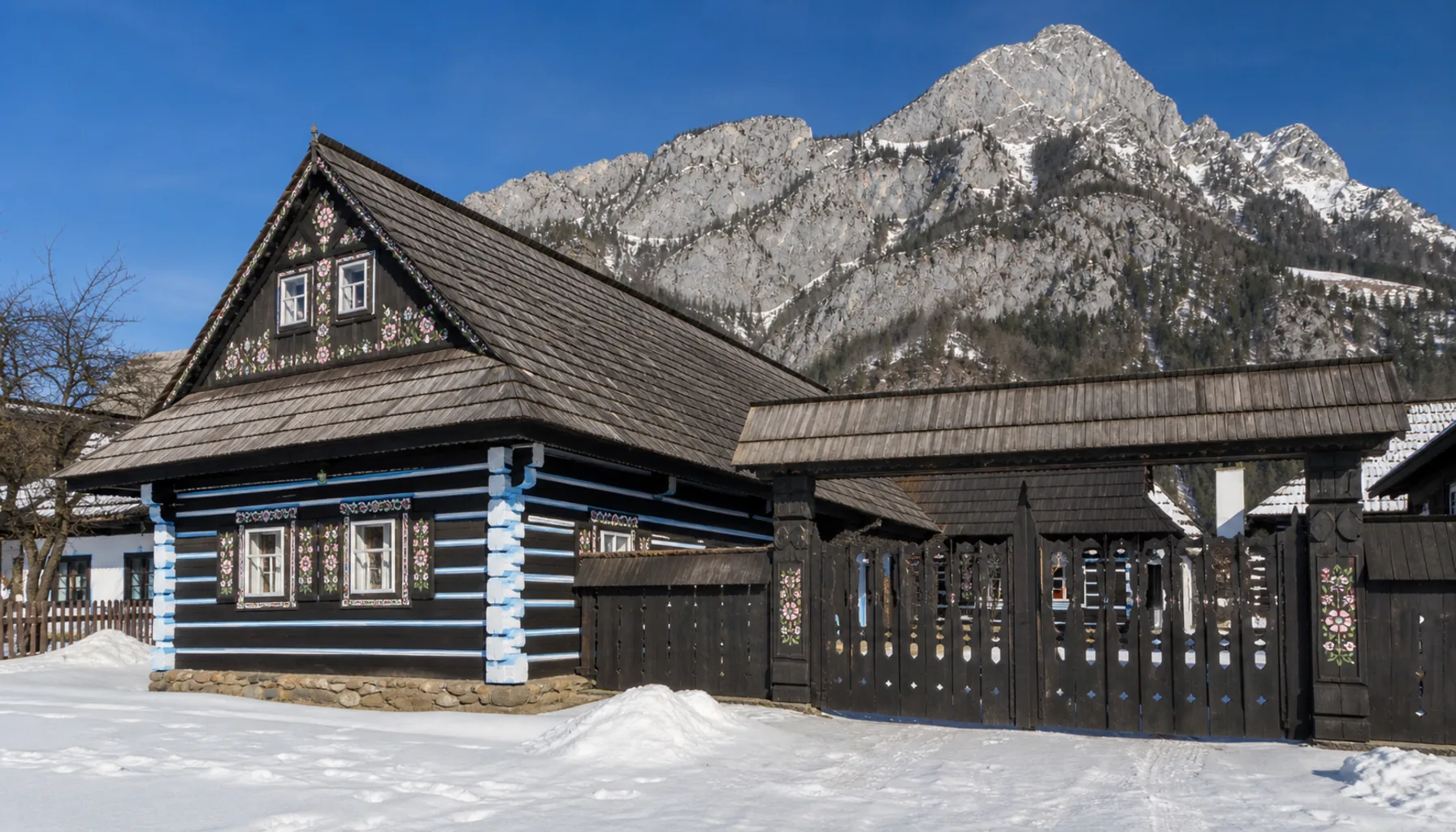
A Goral village of painted timber farmsteads strung along the pass road to the Polish border, under the limestone wall of the Belianske Tatry, and protected as a reserve of folk architecture where it stands.Goralská obec maľovaných dreveníc natiahnutá popri ceste cez sedlo k poľskej hranici, pod vápencovou stenou Belianskych Tatier, chránená ako pamiatková rezervácia ľudovej architektúry priamo tam, kde stojí.
A Ždiar farmstead gate, its log walls striped with limewashed jointsBrána ždiarskej usadlosti so stenami pruhovanými vybielenými škárami
Where it standsKde leží
Ždiar lies on the road that climbs out of Tatranská Kotlina, crosses the saddle behind the Belianske Tatry and drops to the Polish border at Lysá Poľana. The limestone wall of the Belianske Tatry closes the village on the south; the gentler wooded ridges of the Spišská Magura rise to the north. The houses follow the road and the stream for a long way rather than gathering round a square.Ždiar leží na ceste, ktorá stúpa z Tatranskej Kotliny, prechádza sedlom za Belianskymi Tatrami a klesá k poľskej hranici na Lysej Poľane. Z juhu obec uzatvára vápencová stena Belianskych Tatier, zo severu sa dvíhajú miernejšie zalesnené hrebene Spišskej Magury. Domy sa tiahnu popri ceste a potoku na dlhom úseku, namiesto toho, aby sa zbiehali okolo námestia.
The village lies inside the Tatra National Park and is the last settlement of any size before the frontier.Obec leží vnútri Tatranského národného parku a je poslednou väčšou osadou pred hranicou.
Why it is herePrečo práve tu
Ždiar is Goral, settled in the sixteenth and seventeenth centuries by shepherding colonists moving along the ranges from the north. The dialect, the costume and many of the surnames belong to the Polish side of the mountains rather than to Spiš in the basin below.Ždiar je goralský, osídlili ho v 16. a 17. storočí pastierski kolonisti postupujúci po pohoriach zo severu. Nárečie, kroj aj mnohé priezviská patria skôr poľskej strane hôr než Spišu v kotline pod nimi.
Grain barely ripened at this height, so the household lived off sheep and cattle on the high pasture, off the forest, off potatoes and off carting over the pass. The road to Poland has always been part of the village economy.Obilie v tejto výške sotva dozrievalo, a tak gazdovstvo žilo z oviec a dobytka na vysokých pasienkoch, z lesa, zo zemiakov a z furmanky cez sedlo. Cesta do Poľska bola vždy súčasťou obecnej ekonomiky.
Building went on in timber long after brick took over in the valley towns, so when the road became a tourist route in the twentieth century enough of the old village still stood to be worth protecting. The core was declared a reserve of folk architecture in the 1970s.Stavalo sa tu z dreva ešte dlho po tom, čo v mestách v kotline prevládla tehla, a tak keď sa cesta v 20. storočí stala turistickou trasou, stálo starej dediny ešte dosť na to, aby sa oplatilo ju chrániť. Jadro vyhlásili v 70. rokoch za pamiatkovú rezerváciu ľudovej architektúry.
What you actually seeČo naozaj uvidíte
The Ždiar farmstead is a closed courtyard: two low log houses facing each other across a yard, linked by outbuildings and entered through a gate, so what the street sees is a wall and a doorway rather than a front. The logs are dark and the joints between them are limewashed white or pale blue, so the walls read as stripes from a distance; painted patterns run round the windows and across the gable boards.Ždiarska usadlosť je uzavretý dvor: dve nízke zrubové drevenice oproti sebe cez dvor, spojené hospodárskymi stavbami a prístupné cez bránu, takže ulica vidí stenu a vráta, nie priečelie. Brvná sú tmavé a škáry medzi nimi vybielené nabielo alebo svetlomodro, takže steny z diaľky pôsobia ako pruhy; maľované vzory obiehajú okná a prechádzajú po štítových doskách.
Not everything along the road is old; new building has filled the gaps between the farmsteads. At least one house is kept as a small private folk museum, its rooms furnished as they were used, but opening depends on the family rather than on posted hours.Nie všetko popri ceste je staré; medzery medzi usadlosťami vyplnila nová zástavba. Aspoň jeden dom slúži ako malé súkromné múzeum ľudového bývania so zariadenými izbami, no otváranie závisí od rodiny, nie od vyvesených hodín.
Behind the houses the Belianske Tatry stand as one grey wall, among the best backdrops in the range. Above the village the ski meadow of Strednica catches the sun, and over the shoulder on the Magura side lies Bachledova dolina with its walkway through the treetops.Za domami stoja Belianske Tatry ako jediná sivá stena, jedna z najkrajších kulís pohoria. Nad obcou chytá slnko lyžiarska lúka Strednica a za plecom na magurskej strane leží Bachledova dolina s chodníkom korunami stromov.
Living village, not a museumŽivá obec, nie skanzen
Ždiar is lived in, farmed, and has been letting rooms to visitors for generations. Reserve status protects the houses; it does not open them. The courtyards are working yards in private hands, so look from the road and ask before walking in through a gate.Ždiar sa obýva, hospodári sa v ňom a izby návštevníkom prenajíma už po generácie. Pamiatková ochrana domy chráni, neotvára ich. Dvory sú pracovné a súkromné, takže sa pozerajte z cesty a pred vstupom cez bránu sa spýtajte.
The wall behind the village is scenery rather than hiking country. Most of the Belianske Tatry are closed to walkers for nature protection; one seasonal route runs up Monkova dolina to Kopské sedlo, and even that is not open all year. Everyday walking from Ždiar is on the Magura side, where the view back at the Tatras is the reason to go.Stena za obcou je kulisa, nie turistický terén. Väčšina Belianskych Tatier je z dôvodu ochrany prírody pre turistov zavretá; jedna sezónna trasa vedie Monkovou dolinou do Kopského sedla a ani tá nie je otvorená celý rok. Bežne sa zo Ždiaru chodí na magurskú stranu, kde je dôvodom na výstup pohľad späť na Tatry.
Getting thereAko sa tam dostať
Buses run from Poprad north through Tatranská Kotlina and over the saddle to Ždiar and on to Tatranská Javorina, the same road that carries traffic towards Zakopane. There is no railway; the nearest station is Poprad-Tatry. In winter the pass road is the only way in from the south.Autobusy premávajú z Popradu na sever cez Tatranskú Kotlinu a cez sedlo do Ždiaru a ďalej do Tatranskej Javoriny — tá istá cesta vedie dopravu smerom na Zakopané. Železnica sem nevedie, najbližšia stanica je Poprad-Tatry. V zime je cesta cez sedlo jedinou prístupovou trasou z juhu.
Explore ŽdiarObjavujte Ždiar
Every part of this place with a page of its own.Každá časť tohto miesta, ktorá má vlastnú stránku.