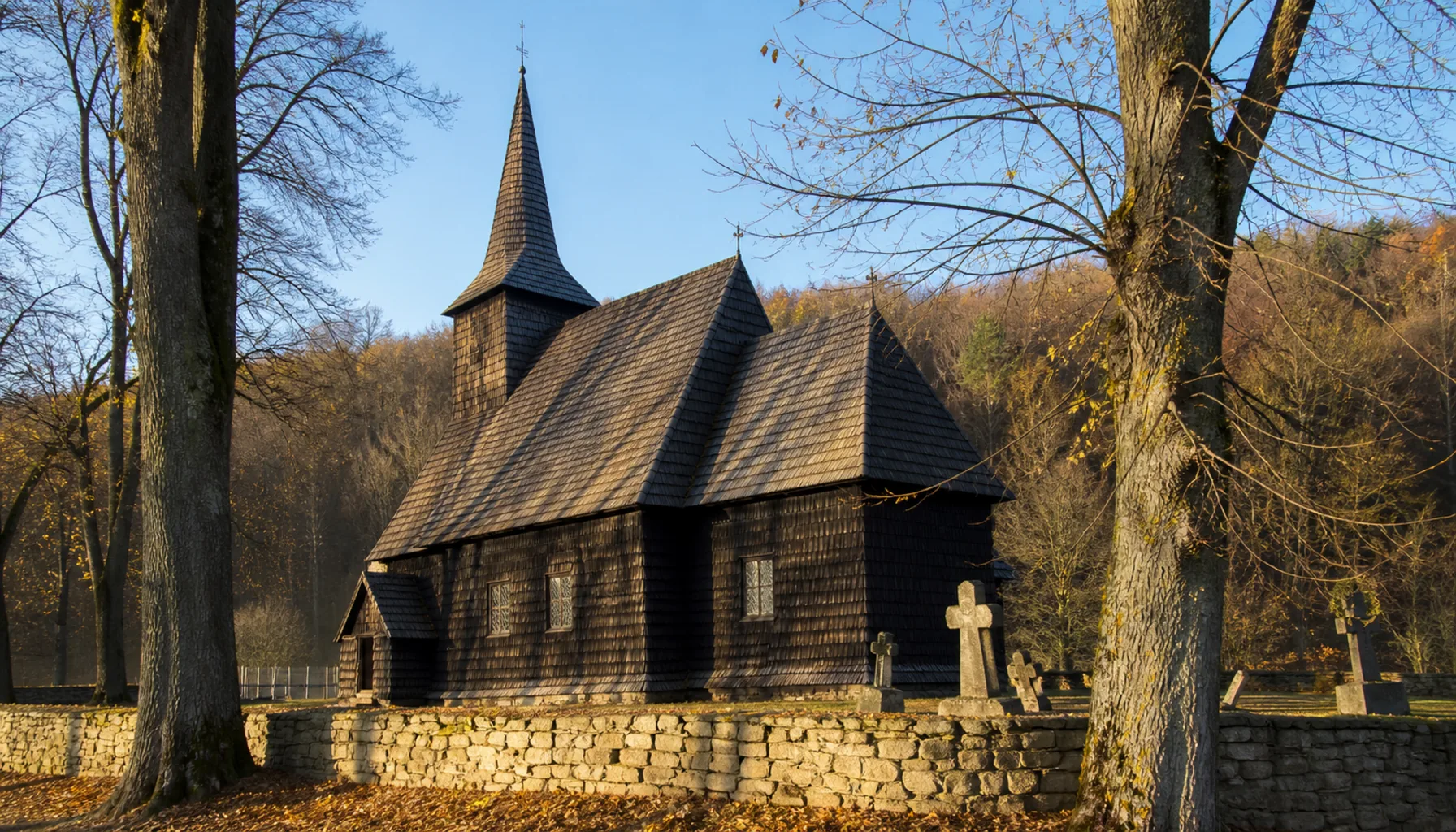
A farming village in the hills south-west of Bardejov whose churchyard holds the oldest wooden church in Slovakia: a Gothic building of jointed logs under a steep shingle roof, painted inside in 1665 and on the World Heritage List since 2008.Roľnícka obec v kopcoch juhozápadne od Bardejova, ktorej cintorín ukrýva najstarší drevený kostol na Slovensku: gotickú zrubovú stavbu pod strmou šindľovou strechou, vnútri vymaľovanú v roku 1665 a od roku 2008 zapísanú v svetovom dedičstve.
The Gothic wooden church of St Francis of Assisi in its walled churchyard at HervartovGotický drevený Kostol svätého Františka z Assisi v ohradenom areáli v Hervartove
Where it standsKde leží
Hervartov lies in a shallow side valley in the hills roughly ten kilometres south-west of Bardejov, in Šariš. Wooded ridges close it on both sides, the fields are small and sloping, and the road in is a spur — the village is not on the way to anywhere.Hervartov leží v plytkej bočnej doline v kopcoch asi desať kilometrov juhozápadne od Bardejova, v Šariši. Z oboch strán ho uzatvárajú zalesnené chrbty, polia sú malé a svahovité a cesta doň je len odbočka — obec neleží na ceste nikam.
Bardejov, its spa quarter and the Polish border lie to the north. The hills all around hold the densest surviving group of wooden churches in the country; Hervartov stands at its southern edge and is the oldest of them.Na sever leží Bardejov, jeho kúpeľná časť a poľská hranica. V okolitých kopcoch sa zachovala najhustejšia skupina drevených kostolov v krajine; Hervartov stojí na jej južnom okraji a je z nich najstarší.
Why it is herePrečo práve tu
The village was founded during the medieval settlement of these hills and is first recorded in the fourteenth century; its name is generally taken from a German personal name, and German colonists are usually credited with the founding. It stayed a small farming village and never became anything else.Obec vznikla pri stredovekom osídľovaní týchto kopcov a prvý raz sa spomína v 14. storočí; jej meno sa zvyčajne odvodzuje od nemeckého osobného mena a založenie sa pripisuje nemeckým kolonistom. Zostala malou roľníckou dedinou a nikdy sa z nej nestalo nič iné.
The church of St Francis of Assisi was raised in the second half of the fifteenth century, Roman Catholic and Gothic in everything but its material; the timber is usually described as yew and larch. Its walls were painted in 1665, and those paintings are what make it more than an architectural survival.Kostol svätého Františka z Assisi postavili v druhej polovici 15. storočia — rímskokatolícky a gotický vo všetkom okrem materiálu; drevo sa zvyčajne určuje ako tisové a smrekovcové. Steny vymaľovali v roku 1665 a práve tie maľby z neho robia viac než len stavebnú pamiatku.
Of some three hundred wooden churches once standing on Slovak territory, around sixty are left. The one at Hervartov is the oldest of them, and in 2008 it was inscribed on the World Heritage List together with eight other timber buildings belonging to three different confessions.Z približne tristo drevených kostolov, ktoré kedysi stáli na slovenskom území, ich zostáva okolo šesťdesiat. Hervartovský je z nich najstarší a v roku 2008 ho spolu s ôsmimi ďalšími drevenými stavbami troch rôznych konfesií zapísali do zoznamu svetového dedičstva.
What you actually seeČo naozaj uvidíte
From outside it is a compact, dark, closed building: log walls sheathed in board and shingle and weathered nearly black, a steep shingle roof, and a small tower with a shingled spire over the west end. A low stone wall and old trees enclose it. The windows are few and small, and the whole thing reads defensively rather than devotionally.Zvonku je to kompaktná, tmavá a uzavretá stavba: zrubové steny obité doskami a šindľom, zvetrané takmer do čierna, strmá šindľová strecha a nad západným koncom vežička so šindľovou helmicou. Okolo nej je nízky kamenný múr a staré stromy. Okien je málo a sú malé — celok pôsobí skôr obranne než sviatočne.
Inside there is one low space, a nave and a narrower chancel, and the 1665 painting on the boarded walls: Adam and Eve at the tree, St George and the dragon, and figures of saints. The altar and the fittings are late Gothic and later. It is small and dark, and twenty minutes is a proper visit.Vnútri je jeden nízky priestor — loď a užšie presbytérium — a na doskových stenách maľba z roku 1665: Adam a Eva pri strome, svätý Juraj s drakom a postavy svätcov. Oltár a zariadenie sú neskorogotické a mladšie. Priestor je malý a tmavý a dvadsať minút je plnohodnotná návšteva.
Living village, not a museumŽivá obec, nie skanzen
Hervartov is an ordinary working village and the church belongs to the parish, which still uses it for services. It is kept locked. Visits are made with a keyholder or a guide, in season and normally by arrangement in advance; there is a charge, and photography inside is usually restricted. Nobody should count on walking in off the road.Hervartov je bežná fungujúca obec a kostol patrí farnosti, ktorá ho stále používa na bohoslužby. Býva zamknutý. Vstupuje sa s kľúčnikom alebo sprievodcom, v sezóne a spravidla po dohovore vopred; platí sa vstupné a fotografovanie vnútri býva obmedzené. Na to, že sa dnu dostanete rovno z cesty, sa spoliehať nedá.
The churchyard around it is in use and the houses along the lane are people's homes. The building has been repaired over and over, because shingle has to be renewed every generation or two; much of what you see on the outside is far younger than the frame beneath it.Cintorín okolo neho sa používa a domy v uličke sú obývané. Stavbu opravovali znova a znova, lebo šindeľ treba obnoviť každú generáciu či dve; veľa z toho, čo zvonku vidno, je oveľa mladšie než zrub pod ním.
Getting thereAko sa tam dostať
There is no railway. Buses run from Bardejov and are infrequent; by car it is a signposted turn off the road leading south-west out of the town, and the last few kilometres are narrow valley road.Železnica sem nevedie. Autobusy z Bardejova premávajú zriedka; autom ide o značenú odbočku z cesty vedúcej z mesta na juhozápad a posledné kilometre sú úzkou dolinou.
Explore HervartovObjavujte Hervartov
Every part of this place with a page of its own.Každá časť tohto miesta, ktorá má vlastnú stránku.