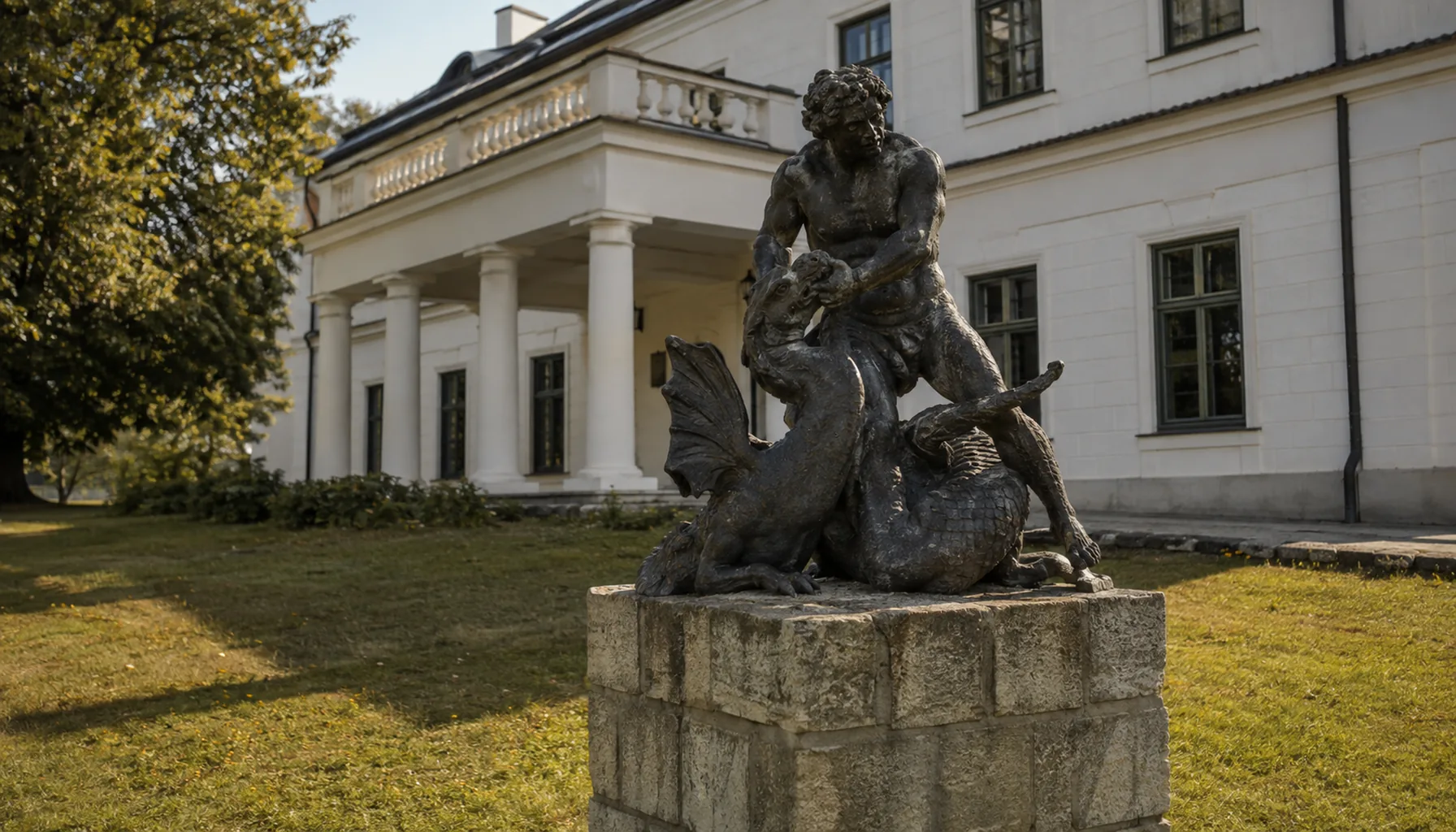
A classicist manor house in a park, a cast-iron Hercules cast in the town's own foundry, and housing estates full of people whose home villages lie under a reservoir.Klasicistický kaštieľ v parku, liatinový Herkules odliaty v miestnej zlievarni a sídliská plné ľudí, ktorých rodné dediny ležia pod vodnou nádržou.
The cast-iron Hercules and dragon in Snina's town park, cast at the local ironworks and now the town's emblem, in front of the classicist manor house.Liatinový Herkules s drakom v sninskom parku — odliaty v miestnych železiarňach a dnes symbol mesta — pred klasicistickým kaštieľom.
The year in SninaRok v Snine
Snina has kept a calendar of its own since 1839, when it won the right to hold four fairs a year; for a market town at the end of a valley, the fair days were the year. What it keeps now is the ordinary calendar of an eastern district seat - market days, a town celebration in summer, school and club events at the cultural centre, and the feast days of two rites, which between them fill more of the year here than they would further west. We name none of it individually, because programmes and premises change faster than a page like this does; the town's own listings are the reliable source.Snina má vlastný kalendár od roku 1839, keď získala právo na štyri jarmoky do roka; pre trhové mestečko na konci doliny boli práve jarmočné dni rokom. Dnes si drží obyčajný kalendár okresného sídla na východe - trhové dni, letné mestské slávnosti, školské a záujmové podujatia v kultúrnom dome a sviatky dvoch obradov, ktoré tu spolu zaplnia viac roka než by zaplnili západnejšie. Nič z toho tu nemenujeme podrobne, lebo programy a priestory sa menia rýchlejšie než takáto stránka; spoľahlivým zdrojom sú mestské oznamy.
The other half of the year belongs to the country east of the town. The Sninské rybníky and the climb to Sninský kameň fill the summer, and Poloniny National Park, declared in 1997, brings walkers up the valleys from spring onwards. Since 2010, when the same country became Slovakia's first dark-sky park, clear autumn and winter nights have been a reason to travel here rather than a reason to stay indoors - there is no town near enough to spoil the sky.Druhá polovica roka patrí krajine na východ od mesta. Sninské rybníky a výstup na Sninský kameň zapĺňajú leto a Národný park Poloniny, vyhlásený v roku 1997, priťahuje turistov do dolín už od jari. Odkedy sa to isté územie stalo v roku 2010 prvým parkom tmavej oblohy na Slovensku, jasné jesenné a zimné noci sú dôvodom sem pricestovať, a nie dôvodom zostať doma - niet tu mesta dosť blízko na to, aby oblohu pokazilo.
Where culture livesKde žije kultúra
The institutions are those of a town of this size: a cultural centre with a hall and a programme, a library, amateur choirs and folk groups, and a school of art for children. The manor house in the town park is the one historic public building, and the park around it is where the town gathers. Anything more specific is better checked locally - a district on the edge of the country does not keep a large permanent apparatus, and what it does keep, it keeps modestly.Inštitúcie sú tie, aké má mesto tejto veľkosti: kultúrny dom so sálou a programom, knižnica, ochotnícke zbory a folklórne skupiny a základná umelecká škola pre deti. Kaštieľ v mestskom parku je jedinou historickou verejnou budovou a park okolo neho je miestom, kde sa mesto stretáva. Čokoľvek konkrétnejšie si radšej overte na mieste - okres na okraji krajiny neudržiava veľký stály aparát a to, čo udržiava, robí skromne.
Much of the district's culture is not in Snina at all. It is in the villages up the Ulič valley and on the roads beyond Stakčín: log-built churches, painted icon screens, Cyrillic lettering on old gravestones. That eastern-rite culture is older here than any building - a monastery of Basilian monks is recorded at Snina in 1487, the first written proof of the Rusyn settlement of these high valleys. The wooden churches along those roads are among the least visited in Slovakia, and several are opened by a keyholder rather than standing open, so ask in the village.Veľká časť kultúry okresu nie je v Snine. Je v dedinách hore Uličskou dolinou a na cestách za Stakčínom: zrubové kostolíky, maľované ikonostasy, cyrilika na starých náhrobkoch. Táto východná obradová kultúra je tu staršia než ktorákoľvek budova - kláštor baziliánov je v Snine doložený už v roku 1487 a je prvým písomným dokladom rusínskeho osídlenia týchto vysokých dolín. Drevené kostoly pri tých cestách patria k najmenej navštevovaným na Slovensku a viaceré otvára kostolník, nie sú trvale prístupné, preto sa treba v dedine spýtať.
The buildings that carry itBudovy, ktoré ju nesú
The manor house is the oldest thing of note in Snina. Countess Terézia van Dernáth had it built in masonry in 1781 to replace a wooden one, and it was later rebuilt in the plain classicist form it has now. In front of it stands the town's emblem: a cast-iron Hercules wrestling the dragon, cast in 1841 in the foundry that Jozef Rholl had added to his ironworks in the valley above the town. The works closed in 1873 and the plant has gone; the statue is what is left of it.Kaštieľ je najstaršou pozoruhodnou stavbou v Snine. Grófka Terézia van Dernáth ho dala v roku 1781 postaviť z muriva namiesto starého dreveného a neskôr ho prestavali do jednoduchej klasicistickej podoby, akú má dnes. Pred ním stojí znak mesta: liatinový Herkules zápasiaci s drakom, odliaty v roku 1841 v zlievarni, ktorú Jozef Rholl pridal k svojim železiarňam v doline nad mestom. Železiarne v roku 1873 zanikli a po prevádzke nezostalo nič; socha je to, čo po nich ostalo.
Everything else in the centre is younger, and the reason is the Vihorlat engineering works, begun in 1949 and in production from 1951, which turned a market town into a factory town and ringed it with housing estates. Two small military cemeteries survive close to Snina from the Carpathian fighting of the winter of 1914/15, when the front ran along the ridges that close this valley on the north and east. They are easy to walk to and just as easy to miss.Všetko ostatné v centre je mladšie a dôvodom je strojársky závod Vihorlat, ktorý sa začal stavať v roku 1949 a od roku 1951 vyrábal: z trhového mesta urobil továrenské mesto a obklopil ho sídliskami. Neďaleko Sniny sa zachovali dva malé vojenské cintoríny z karpatských bojov zimy 1914/15, keď front prechádzal hrebeňmi, ktoré uzatvárajú túto dolinu zo severu a východu. Dá sa k nim ľahko dôjsť a rovnako ľahko ich prehliadnuť.
The valley that was emptiedDolina, ktorú vysťahovali
Seven Rusyn villages - Dara, Ostrožnica, Ruské, Smolník, Starina, Veľká Poľana and Zvala - were emptied of their people in the 1970s so that the head of the Cirocha valley could be dammed for drinking water. The Starina dam was built between 1981 and 1988, and the catchment above the water has been closed to the public ever since. Most of the families were resettled into the new blocks in Snina, which is why the town's estates are full of people whose home village no longer exists.Sedem rusínskych dedín - Dara, Ostrožnica, Ruské, Smolník, Starina, Veľká Poľana a Zvala - v sedemdesiatych rokoch vysťahovali, aby sa horný tok Cirochy dal prehradiť na pitnú vodu. Priehrada Starina sa stavala v rokoch 1981 až 1988 a povodie nad vodou je odvtedy verejnosti uzavreté. Väčšinu rodín presťahovali do nových sninských blokov, a preto sú miestne sídliská plné ľudí, ktorých rodná dedina už neexistuje.
Some of the wooden churches were moved and survive elsewhere; the graveyards and the villages did not. It is worth knowing what had happened to those parishes shortly before: in 1950 the state dissolved the Greek Catholic Church and handed its buildings to the Orthodox Church, and although the Church was allowed to exist again in 1968, the argument over who owns which building outlasted communism in several villages. A resettled congregation in Snina carries both of those histories at once.Niektoré drevené kostoly preniesli a zachovali sa inde; cintoríny a dediny nie. Oplatí sa vedieť, čo sa tým farnostiam stalo krátko predtým: v roku 1950 štát zrušil gréckokatolícku cirkev a jej budovy odovzdal pravoslávnej cirkvi, a hoci cirkev smela od roku 1968 znova existovať, spor o to, komu ktorá budova patrí, v niektorých dedinách prežil aj komunizmus. Presídlená farnosť v Snine nesie obe tieto dejiny naraz.