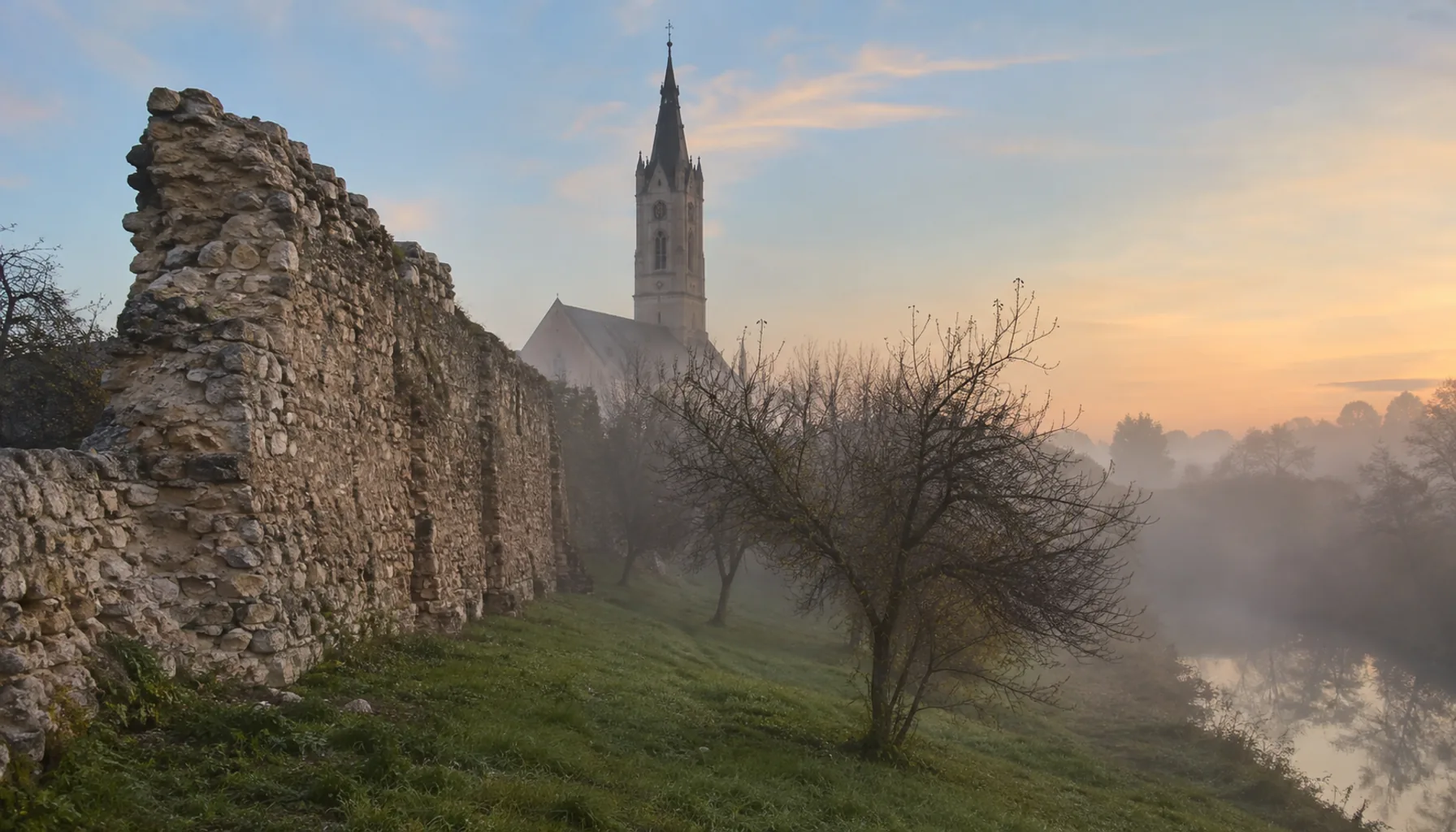
Sabinov · Torysa valleySabinov · údolie Torysy
One of the five royal towns of upper Hungary, with a Gothic church standing free in its square, a school older than most of the buildings around it, and a famous altar that is no longer here.Jedno z piatich kráľovských miest horného Uhorska, s gotickým kostolom voľne stojacim uprostred námestia, so školou staršou než väčšina domov okolo a so slávnym oltárom, ktorý tu už nie je.
Sabinov can date its own birthday. On 28 January 1299 King Andrew III granted the town, together with Prešov and Veľký Šariš, the bundle of liberties known as the Spiš rights: the right to elect its own judge and its own parish priest, its own court, and freedom from taxes, tolls, customs duty and military service. Read that list again and it is a settlement buying its way out of being somebody's property. In 1405 King Sigismund raised Sabinov to a free royal town, and by the end of that century it had joined the Pentapolitana, the league of the five royal towns of upper Hungary.Sabinov si vie datovať vlastné narodeniny. Dňa 28. januára 1299 udelil kráľ Ondrej III. mestu spolu s Prešovom a Veľkým Šarišom súbor slobôd známy ako spišské práva: právo voliť si vlastného richtára aj vlastného farára, vlastný súd a oslobodenie od daní, mýt, ciel a vojenskej služby. Prečítajte si ten zoznam ešte raz — je to osada, ktorá sa vykupuje z toho, aby bola niečím majetkom. V roku 1405 povýšil kráľ Žigmund Sabinov na slobodné kráľovské mesto a do konca toho storočia sa pripojil k Pentapolitane, zväzu piatich kráľovských miest horného Uhorska.
The calendar those rights created was a market calendar, and what is left of it is the calendar of a small town twenty kilometres from a city: church feasts, school events, a summer town celebration, and whatever the cultural centre and the museum programme between them. We give no dates and no names, because in a place this size they are set season by season and the town's own listings are the reliable source. Sabinov works better as a base than as a destination: the Torysa valley runs north into Spiš, and the ruin of Šariš Castle stands half an hour to the south.Kalendár, ktorý tieto práva vytvorili, bol trhový, a to, čo z neho zostalo, je kalendár malého mesta dvadsať kilometrov od krajského sídla: cirkevné sviatky, školské podujatia, letné mestské slávnosti a to, čo medzi sebou naprogramujú kultúrne stredisko a múzeum. Dátumy ani názvy neuvádzame, lebo v sídle tejto veľkosti sa určujú sezónu po sezóne a spoľahlivým zdrojom sú oznamy mesta. Sabinov funguje lepšie ako východisko než ako cieľ: údolie Torysy vedie na sever na Spiš a pol hodiny na juh stojí zrúcanina Šarišského hradu.
The town museum is in the right building. From October 1740 the Piarists — a teaching order whose whole purpose was free schooling for boys who could not otherwise have had it — ran a gymnasium in Sabinov, and in 1784 the school moved into a house of its own. That house is the museum today. In a town that had lost more than half its people to plague in 1709, a working school was the most valuable thing it owned, and the gymnasium is a large part of why anyone outside the valley had heard of the place.Mestské múzeum sídli v tej správnej budove. Od októbra 1740 viedli v Sabinove gymnázium piaristi — učiteľská rehoľa, ktorej celým zmyslom bolo bezplatné školstvo pre chlapcov, ktorí by sa inak neučili — a v roku 1784 sa škola presťahovala do vlastného domu. Práve v ňom je dnes múzeum. V meste, ktoré v roku 1709 stratilo na mor viac než polovicu obyvateľov, bola fungujúca škola tým najcennejším, čo malo, a gymnázium je veľkou časťou dôvodu, prečo o meste niekto mimo doliny vôbec vedel.
Teaching had been the town's strength before that as well. The five towns of the Pentapolitana adopted the Reformation together in the sixteenth century, and Sabinov's Lutheran school became known well beyond its own district, with a Renaissance lyceum built for it in 1530. What runs now is what a town of this size runs: a cultural centre with a hall and a programme, a library, art schools for children, amateur choirs and folk groups. We name none of them individually, because premises and programmes change faster than a page like this can be rewritten.Škola bola silnou stránkou mesta aj predtým. Päť miest Pentapolitany prijalo v 16. storočí reformáciu spoločne a sabinovská evanjelická škola sa stala známou ďaleko za hranicami okolia; v roku 1530 pre ňu postavili renesančné lýceum. Dnes tu beží to, čo beží v meste tejto veľkosti: kultúrne stredisko so sálou a programom, knižnica, umelecké školy pre deti, amatérske zbory a folklórne skupiny. Menovite ich neuvádzame, lebo priestory a programy sa menia rýchlejšie, než sa dá takáto stránka prepísať.
The Church of St John the Baptist stands free in the middle of the square, and it stands there because of a fire. In 1461 the parish church burned out so fiercely that the bells melted in the tower; the town rebuilt it between 1484 and 1518, larger and in late Gothic, and that is the building there now. The free-standing bell tower beside it was finished in 1657 in the plain, heavily corniced manner known as the east Slovak Renaissance, and the bell hanging inside was already nearly two hundred years old, cast in 1470. The Renaissance house next to the church held the town school.Kostol svätého Jána Krstiteľa stojí voľne uprostred námestia a stojí tam pre požiar. V roku 1461 farský kostol vyhorel tak prudko, že sa vo veži roztavili zvony; mesto ho v rokoch 1484 až 1518 postavilo nanovo, väčší a neskorogotický, a to je stavba, ktorá tam je dnes. Voľne stojaca zvonica vedľa neho bola dokončená v roku 1657 v striedmej, ťažko rímsovanej podobe známej ako východoslovenská renesancia a zvon v nej mal vtedy už takmer dvesto rokov, odliaty bol v roku 1470. V renesančnom dome pri kostole sídlila mestská škola.
The church's greatest treasure is not in it. The late Gothic winged altar from the workshop of Master Paul of Levoča went to a museum in Budapest in the nineteenth century, and what stands in the church is the altar as it was reconstructed in the 1970s — worth knowing before you go, and worth seeing anyway. Around it the square is the point: a long widening street of low burgher houses with the church free in the middle of it, the same plan as Prešov and Bardejov at a quarter of the scale, and sections of the medieval wall still standing at the edge of the old centre.Najväčší poklad kostola v ňom nie je. Neskorogotický krídlový oltár z dielne Majstra Pavla z Levoče sa v 19. storočí dostal do múzea v Budapešti a v kostole stojí oltár tak, ako ho v sedemdesiatych rokoch zrekonštruovali — dobre to vedieť vopred a aj tak sa oplatí ísť. Podstatné je však námestie okolo neho: dlhá rozšírená ulica nízkych meštianskych domov s kostolom voľne uprostred, ten istý pôdorys ako v Prešove a Bardejove v štvrtinovej mierke, a na okraji starého jadra stále stojace úseky stredovekých hradieb.
A geographical dictionary of 1851 describes what the town actually was by then: 2,590 Slovak inhabitants, still ringed by its stone wall, growing a great deal of flax, weaving good linen, trading in wine and distilling brandy from grain and plums. Three years earlier the young men of Sabinov had joined the Hungarian revolution with enthusiasm, and Lajos Kossuth, who led it, is said to have called the place faithful Szeben, using its Hungarian name.Zemepisný slovník z roku 1851 opisuje, čím mesto vtedy naozaj bolo: 2 590 slovenských obyvateľov, stále obohnaných kamenným múrom, veľa pestovaného ľanu, dobré tkané plátno, obchod s vínom a pálenie destilátov z obilia a sliviek. Tri roky predtým sa sabinovskí mladíci s nadšením pridali k uhorskej revolúcii a Lajos Kossuth, ktorý ju viedol, mesto vraj nazval verným Szebenom, jeho maďarským menom.
Then the railway changed the arithmetic. On 30 May 1870 it was decided to build a line from Prešov north over the watershed to Tarnów in Galicia, through Sabinov, Lipany and Plaveč; the Hungarian section as far as Orlov was finished on 3 April 1873 and opened to traffic on 1 May, and through trains to Galicia ran from 18 August 1876. The valley's timber, flax and grain suddenly had somewhere to go. The censuses of the same decades show the other face of the age: the number of people here returning Hungarian as their mother tongue rose sharply between 1880 and 1910, a shift produced by the pressure of Magyarisation rather than by anyone moving house.Potom prepočty zmenila železnica. Dňa 30. mája 1870 padlo rozhodnutie postaviť trať z Prešova na sever cez rozvodie do Tarnówa v Haliči, cez Sabinov, Lipany a Plaveč; uhorský úsek po Orlov dokončili 3. apríla 1873 a do prevádzky ho dali 1. mája, priame vlaky do Haliče chodili od 18. augusta 1876. Drevo, ľan a obilie z doliny mali zrazu kam ísť. Sčítania z tých istých desaťročí ukazujú druhú tvár doby: počet ľudí, ktorí tu uvádzali maďarčinu ako materinský jazyk, medzi rokmi 1880 a 1910 prudko stúpol — posun spôsobený tlakom maďarizácie, nie tým, že by sa niekto sťahoval.
Sixteen videos for Culture in Sabinov.Šestnásť videí — Kultúra v Sabinove.