Kežmarok · Spiš under the TatrasKežmarok · Spiš pod Tatrami
A wooden church built under laws meant to humiliate it, a castle inside the town rather than above it, and a school library that long outgrew its school.Drevený kostol postavený podľa zákonov, ktoré ho mali pokoriť, hrad v meste namiesto nad mestom a školská knižnica, ktorá dávno prerástla svoju školu.
Kežmarok won the right to two annual fairs in 1419, and in 1435 something better: the right of storage, which obliged passing merchants to stop here, unload and offer their goods for sale. Levoča claimed the same right, and the quarrel between the two Spiš towns ran for well over a century — lawsuits, embargoes, ambushes and forged charters. A market calendar was worth fighting that hard for, because in a town living on cloth, crafts and through traffic it was the entire economy.Kežmarok získal právo na dva výročné jarmoky v roku 1419 a v roku 1435 čosi lepšie: právo skladu, ktoré nútilo prechádzajúcich kupcov zastaviť sa tu, vyložiť tovar a ponúknuť ho na predaj. To isté právo si nárokovala Levoča a spor dvoch spišských miest sa ťahal vyše storočia — súdy, embargá, prepady a falšované listiny. Trhový kalendár stál za taký boj, lebo v meste, ktoré žilo zo súkna, remesiel a prechádzajúceho tovaru, bol celým hospodárstvom.
The town still fills its streets in summer. A European folk-craft market takes over the centre for several days each year — workshops, stalls and demonstrations rather than a stage and a fairground — and around it the castle, the museum and the churches run a season that carries most of the town's visitors through the warm months. We give no dates: they are set year by year, opening arrangements at the monuments change, and the town's and the museum's own listings are the place to check.V lete si mesto ulice stále zapĺňa. Európsky trh ľudových remesiel na niekoľko dní zaberie centrum — dielne, stánky a ukážky práce namiesto pódia a lunaparku — a okolo neho vedú hrad, múzeum a kostoly sezónu, ktorá cez teplé mesiace prevedie väčšinu návštevníkov mesta. Dátumy neuvádzame: určujú sa rok po roku, otváracie režimy pamiatok sa menia a overiť sa to dá v oznamoch mesta a múzea.
The castle at the end of the main street holds the town museum. It is an unusual castle — a walled quadrangle built inside the town rather than a fortress on a hill above it, with a Renaissance chapel in its courtyard — and an unusual museum, because the burghers bought the building outright in 1702 after two centuries of trying to be rid of the lords who lived in it. The collections are the town's own history: the crafts, the guilds and the burgher household.Na konci hlavnej ulice stojí hrad a v ňom mestské múzeum. Je to nezvyčajný hrad — opevnený štvorcový areál postavený v meste, nie pevnosť na kopci nad ním, s renesančnou kaplnkou na nádvorí — a nezvyčajné múzeum, lebo meštania si budovu v roku 1702 rovno kúpili po dvoch storočiach snáh zbaviť sa pánov, ktorí v nej sedeli. Zbierky sú vlastnými dejinami mesta: remeslá, cechy a meštianska domácnosť.
Both Protestant churches and the lyceum library are open to visitors too, which for a town this size means that most of its culture is in buildings you can walk into. Alongside them run the ordinary institutions: a cultural centre with a hall and a programme, a library, art schools for children and the amateur companies that go with them. We name none of them individually, because programmes and premises change faster than a page like this can be rewritten.Oba evanjelické kostoly aj lyceálna knižnica sú prístupné návštevníkom, takže v meste tejto veľkosti je väčšina kultúry v budovách, do ktorých sa dá vojsť. Popri nich fungujú obyčajné inštitúcie: kultúrne stredisko so sálou a programom, knižnica, umelecké školy pre deti a amatérske súbory, ktoré k nim patria. Menovite ich neuvádzame, lebo programy aj priestory sa menia rýchlejšie, než sa dá takáto stránka prepísať.
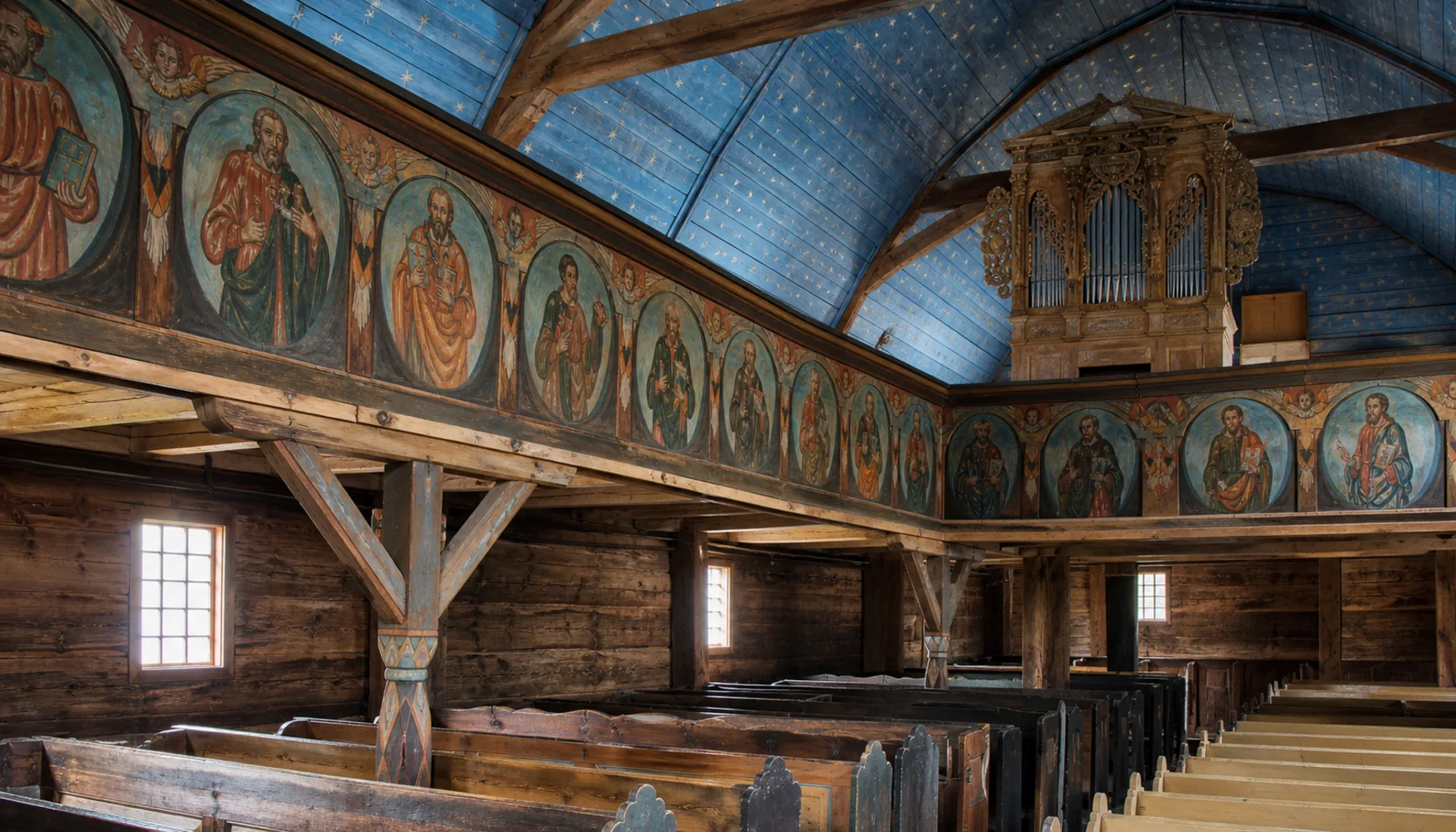
The wooden articular church of 1717 is the building Kežmarok is known for, and it looks the way it does because of a law. At the Diet of Sopron in 1681 the emperor let Protestants in royal Hungary build again, but only outside the walls, only of wood, without a tower, and finished inside a single year. The Lutherans built to those rules: a hall on the plan of a Greek cross by Juraj Müttermann of Poprad, pegged together without a metal nail, big enough for well over a thousand people. The whole shell inside is painted — a blue heaven with the twelve apostles and the four evangelists — and the organ of 1717–20 by Vavrinec Čajkovský has pipes made of wood.Drevený artikulárny kostol z roku 1717 je stavbou, pre ktorú je Kežmarok známy, a vyzerá tak, ako vyzerá, kvôli zákonu. Na šopronskom sneme v roku 1681 cisár evanjelikom v kráľovskom Uhorsku znova povolil stavať, ale len za hradbami, len z dreva, bez veže a s dokončením do jedného roka. Luteráni stavali presne podľa toho: sála na pôdoryse gréckeho kríža podľa návrhu Juraja Müttermanna z Popradu, spájaná kolíkmi bez jediného kovového klinca, s priestorom pre vyše tisíc ľudí. Celý vnútrajšok je vymaľovaný — modré nebo s dvanástimi apoštolmi a štyrmi evanjelistami — a organ z rokov 1717 – 20 od Vavrinca Čajkovského má drevené píšťaly.
The rest of the evidence stands within a few hundred metres. The free-standing Renaissance bell tower of 1591 beside the medieval church is reckoned the oldest of its kind in Slovakia; the New Evangelical Church of 1894, Byzantine and Romantic to designs by Theophil Hansen, holds the mausoleum of Imrich Thököly, born in the castle in 1657 and later the leader of the last great anti-Habsburg rising in Hungary. The castle itself burned in 1787. The wooden church, put up under rules designed to keep its congregation small, did not.Zvyšok dôkazov stojí v okruhu pár stoviek metrov. Renesančná zvonica z roku 1591, voľne stojaca pri stredovekom kostole, sa pokladá za najstaršiu svojho druhu na Slovensku; Nový evanjelický kostol z roku 1894, byzantsko-romantický podľa návrhov Theophila Hansena, ukrýva mauzóleum Imricha Thökölyho, ktorý sa v roku 1657 narodil na hrade a neskôr viedol posledné veľké protihabsburské povstanie v Uhorsku. Samotný hrad v roku 1787 vyhorel. Drevený kostol, postavený podľa pravidiel, ktoré mali jeho cirkev udržať malú, nie.
Who built all this is written into the mix. Kežmarok grew out of a Slav village and a settlement of German-speaking craftsmen and traders that merged in the thirteenth century, and it was German-speaking in its majority for seven centuries, Lutheran from the sixteenth. That community was gone within two years of the end of the Second World War, and the houses were taken by families from other parts of Slovakia. The buildings stayed, and under communism the castle, the wooden church and the library were treated as monuments rather than cleared away. UNESCO inscribed the articular church in 2008 with the other wooden churches of the Slovak Carpathians.Kto to všetko postavil, je zapísané v zložení mesta. Kežmarok vyrástol zo slovanskej dediny a osady nemecky hovoriacich remeselníkov a kupcov, ktoré v 13. storočí splynuli, a sedem storočí bol z väčšiny nemecký, od 16. storočia luteránsky. Tá komunita zmizla do dvoch rokov po skončení druhej svetovej vojny a domy obsadili rodiny z iných častí Slovenska. Budovy zostali a za socializmu sa s hradom, dreveným kostolom aj knižnicou zaobchádzalo ako s pamiatkami, namiesto toho, aby sa zbúrali. Artikulárny kostol zapísalo UNESCO v roku 2008 spolu s ostatnými drevenými chrámami slovenských Karpát.
The Lutheran lyceum made Kežmarok a school town far beyond its size, and the library outgrew the school that built it: over a hundred and fifty thousand volumes, and one of the largest surviving school libraries in Central Europe. Pavol Országh Hviezdoslav, the poet who did more than anyone to prove that literary Slovak could carry serious verse, was a pupil here.Evanjelické lýceum urobilo z Kežmarku školské mesto ďaleko nad jeho veľkosť a knižnica prerástla školu, ktorá ju založila: vyše stopäťdesiattisíc zväzkov a jedna z najväčších zachovaných školských knižníc v strednej Európe. Bol tu žiakom aj Pavol Országh Hviezdoslav, básnik, ktorý viac než ktokoľvek iný dokázal, že spisovná slovenčina unesie veľkú poéziu.
A school library on that scale explains a good deal about the place. It is part of why the Hungarian Carpathian Association, the first tourist organisation in the kingdom, was founded in Kežmarok in 1873 rather than in a village under the peaks, and why the Tatras began to be treated as a destination instead of an obstacle. The town lost the argument that mattered commercially — the main railway from Košice to Bohumín ran through Poprad, and the smaller neighbour quietly became the bigger town — but the library is still here, open to researchers and to visitors.Školská knižnica takého rozsahu vysvetľuje o meste veľa. Sčasti aj preto vznikol Uhorský karpatský spolok, prvá turistická organizácia v krajine, práve v Kežmarku v roku 1873, a nie v dedine pod štítmi, a preto sa Tatry začali brať ako cieľ cesty, nie ako prekážka. Spor, ktorý rozhodoval o obchode, mesto prehralo — hlavná trať z Košíc do Bohumína viedla cez Poprad a menší sused sa potichu stal väčším mestom — ale knižnica je tu stále a je prístupná bádateľom aj návštevníkom.
Sixteen videos for Culture in Kežmarok.Šestnásť videí — Kultúra v Kežmarku.