Hanušovce nad Topľou · Topľa valleyHanušovce nad Topľou · údolie Tople
Culture in Hanušovce nad TopľouKultúra v Hanušovciach nad Topľou
Two manor houses, a church whose roof timbers can be dated to the year, an archaeological park worked as a live site, and a railway viaduct arching over the whole town.Dva kaštiele, kostol, ktorého krov sa dá datovať na rok presne, archeopark fungujúci ako živé pracovisko a železničný viadukt klenúci sa nad celým mestom.
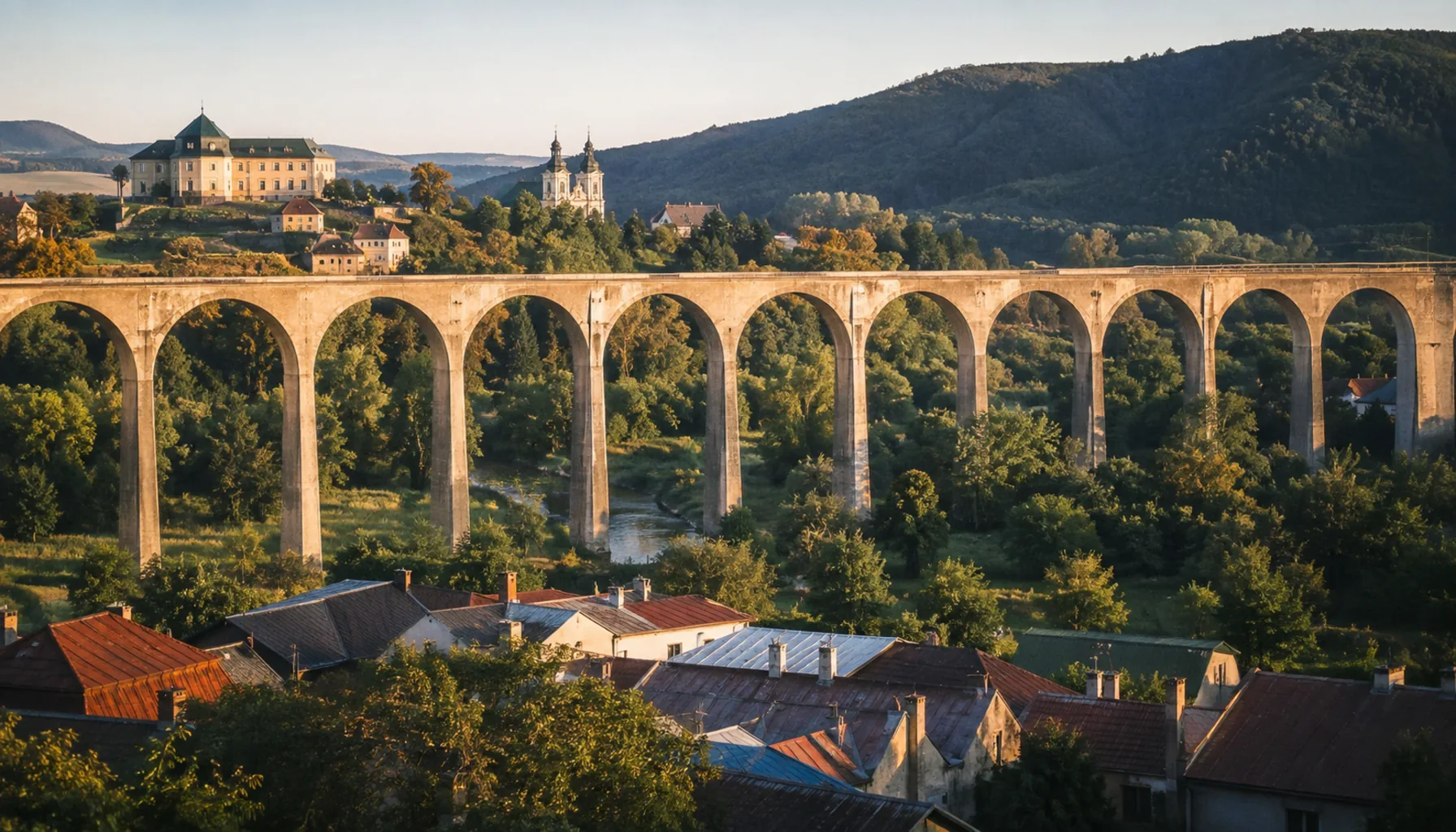
The railway viaduct built in the early 1940s striding across the valley above the roofs of Hanušovce nad Topľou.Železničný viadukt postavený začiatkom štyridsiatych rokov sa klenie nad strechami Hanušoviec nad Topľou.
The year in HanušovceRok v Hanušovciach
Hanušovce were a market town before they were anything else, and the market year is documented. By the end of the sixteenth century the town held the right to three annual fairs, on church dates: Whitsun, the feast of Saints Cosmas and Damian, and All Saints. In 1635, in the middle of a century of revolt in which this valley was fought over, taxed by both sides and burned more than once, it won three more. The market outlasted the wars when almost nothing else did.Hanušovce boli trhovým mestečkom skôr než čímkoľvek iným a trhový rok je tu doložený. Do konca 16. storočia získalo mesto právo na tri výročné jarmoky na cirkevné termíny: Turíce, sviatok svätých Kozmu a Damiána a Sviatok všetkých svätých. V roku 1635, uprostred storočia povstaní, keď sa o toto údolie bojovalo, obe strany ho zdaňovali a viackrát vyhorelo, pribudli ďalšie tri. Trh prežil vojny vtedy, keď takmer nič iné neprežilo.
The modern calendar is built around the museum instead. The archaeological park in the manor grounds works through the warm season as a live demonstration site — prehistoric and early historic houses rebuilt at full size by the methods that raised the originals — and school parties keep it busy from spring onward. Beyond that the town keeps the calendar a place of under four thousand people keeps: church feasts, school events, a summer celebration, whatever the cultural centre programmes. We give no dates; the museum's own listings and the town's are the reliable source, and the park's season depends on the weather in any case.Dnešný kalendár sa točí okolo múzea. Archeopark v areáli kaštieľa funguje počas teplej časti roka ako živé pracovisko — praveké a včasnohistorické domy postavené v plnej veľkosti tými istými postupmi ako originály — a od jari ho zamestnávajú školské výpravy. Popri tom si mesto vedie kalendár, aký si vedie sídlo s necelými štyrmi tisícmi obyvateľov: cirkevné sviatky, školské podujatia, letné slávnosti, to, čo naprogramuje kultúrne stredisko. Dátumy neuvádzame; spoľahlivým zdrojom sú vlastné oznamy múzea a mesta a sezóna archeoparku aj tak závisí od počasia.
Where culture livesKde žije kultúra
Culture in Hanušovce has an address: the Great Manor. It was restored in the 1970s — the reason the building survived at all — and again from 2003, and it holds the regional museum, whose core collection is the archaeology of the Topľa valley. The ground here has been dug more thoroughly than most in eastern Slovakia: settlement layers run from the Neolithic through the Bronze Age into the Roman period, at a crossing that was never a city and never empty either. The Small Manor nearby, restored in 2015, belongs to the same museum.Kultúra má v Hanušovciach adresu: Veľký kaštieľ. Obnovili ho v sedemdesiatych rokoch — preto budova vôbec prežila — a znova od roku 2003, a sídli v ňom vlastivedné múzeum, ktorého jadrom je archeológia údolia Tople. Tunajšia pôda je prekopaná dôkladnejšie než väčšina na východnom Slovensku: sídliskové vrstvy idú od neolitu cez dobu bronzovú až po dobu rímsku, na brode, ktorý nikdy nebol mestom, ale ani prázdny. Neďaleký Malý kaštieľ, obnovený v roku 2015, patrí tomu istému múzeu.
The older institutions explain the town's habits. From 1630 to 1717 Hanušovce had a humanist grammar school teaching Latin and the new learning of the age — serious schooling for a place this small, and Protestant, because the parish church was Lutheran from the Reformation until it was handed back to the Catholics in 1717. In 1934 the town built a Sokolovňa, the hall of the Sokol gymnastic movement, which meant sport, drill, lectures and amateur theatre in one room; a new burgher school followed in 1935. The cultural centre, the library and the schools carry that work now, unnamed here because programmes change faster than a page does.Staršie inštitúcie vysvetľujú návyky mesta. V rokoch 1630 až 1717 tu fungovala humanistická latinská škola — na také malé mesto vážne vzdelanie, a protestantské, lebo farský kostol bol od reformácie luteránsky, kým ho v roku 1717 nevrátili katolíkom. V roku 1934 postavilo mesto sokolovňu, sálu telocvičného hnutia Sokol, čo znamenalo šport, cvičenie, prednášky aj ochotnícke divadlo v jednej miestnosti; v roku 1935 pribudla nová meštianska škola. Túto prácu dnes robí kultúrne stredisko, knižnica a školy; menovite ich neuvádzame, lebo programy sa menia rýchlejšie než takáto stránka.
The buildings that carry itBudovy, ktoré ju nesú
The parish church of the Assumption is the oldest building in the town, one of the generation of stone churches raised here after the Mongol invasion. Nave, sanctuary and tower all come from a single campaign of building in the second half of the thirteenth century, and late-Romanesque carved faces are still set into the brackets carrying the vault ribs. The most exact evidence is in the roof: the timbers that held the builders' scaffolding are still up there, and tree-ring dating puts them just after 1295. The interior was made Baroque in 1742, and a bell tower went up beside the church the same year.Farský kostol Nanebovzatia Panny Márie je najstaršou stavbou v meste, jedným z kamenných kostolov, ktoré sa tu stavali po vpáde Mongolov. Loď, svätyňa aj veža pochádzajú z jednej stavebnej etapy v druhej polovici 13. storočia a v konzolách nesúcich rebrá klenby sú dodnes osadené neskororománske kamenné tváre. Najpresnejší dôkaz je v krove: trámy, ktoré držali stavebné lešenie, sú tam stále a dendrochronológia ich kladie tesne po roku 1295. Interiér zbarokizovali v roku 1742 a v tom istom roku pribudla vedľa kostola zvonica.
Two manor houses in a town this size is unusual. The smaller was built in 1564 by the landlord Ján Šóoš — two storeys on a rectangular plan, a round tower added at the southern corner early in the next century — and his family held it for about eighty years. The larger began as a Renaissance house with four corner towers, probably in the seventeenth century, and was rebuilt in Baroque by the Dessewffy family in the first half of the eighteenth: mansard roof, bell-capped corner towers, heavy stucco, a park. Under socialism rows of prefabricated blocks replaced the old single-storey houses around them, leaving the raised ground with both manors, the church and the bell tower standing above the new town.Dva kaštiele v meste tejto veľkosti sú nezvyčajné. Menší dal v roku 1564 postaviť zemepán Ján Šóoš — dve podlažia na obdĺžnikovom pôdoryse, na začiatku nasledujúceho storočia k nemu pribudla okrúhla veža na južnom nároží — a jeho rod ho držal asi osemdesiat rokov. Väčší vznikol pravdepodobne v 17. storočí ako renesančná stavba so štyrmi nárožnými vežami a v prvej polovici 18. storočia ho Dessewffyovci prestavali do baroka: manzardová strecha, nárožné veže so zvonovitými prilbami, ťažká štuka, park. Za socializmu nahradili staré prízemné domy okolo nich rady panelových bytoviek a vyvýšená terasa s oboma kaštieľmi, kostolom a zvonicou zostala stáť nad novým mestom.
The viaductsViadukty
The railway is the other thing people come to look at, and it is here for a political reason. The First Vienna Award of November 1938 took southern Slovakia, and with it the line that had joined the East Slovak Lowland to the rest of the country; the only way to put the lowland back on the network was to build a new line through these hills. The missing section from Kapušany to Strážske was completed on 5 September 1943 and needed four huge viaducts, raised between 1941 and 1943 — at Pavlovce, at Hrabovec, at Hlibovec, and at Hanušovce itself.Druhou vecou, na ktorú sa sem chodí pozerať, je železnica, a stojí tu z politického dôvodu. Prvá viedenská arbitráž z novembra 1938 odobrala južné Slovensko a s ním aj trať, ktorá spájala Východoslovenskú nížinu so zvyškom krajiny; jediným spôsobom, ako nížinu vrátiť do siete, bolo postaviť novú trať cez tieto kopce. Chýbajúci úsek z Kapušian do Strážskeho dokončili 5. septembra 1943 a vyžiadal si štyri obrovské viadukty, postavené v rokoch 1941 až 1943 — v Pavlovciach, v Hrabovci, na Hlibovci a v samotných Hanušovciach.
The Hanušovce viaduct arches directly over the town, forty metres high and more than four hundred metres long, among the largest railway bridges in the country. It is better seen than travelled: from the train you are simply on it; from the road and the field paths below you can see what it is. Walking out to it costs nothing, and it makes the same point the manor makes from the other end of the town's history — a small place on a good route ends up carrying things far larger than itself.Hanušovský viadukt sa klenie priamo nad mestom, je vysoký štyridsať metrov a dlhší než štyristo, a patrí k najväčším železničným mostom v krajine. Lepšie sa naň pozerá, než sa po ňom ide: z vlaku ste jednoducho na ňom; z cesty a poľných chodníkov pod ním vidíte, čo to je. Cesta k nemu nič nestojí a hovorí to isté, čo z druhého konca dejín mesta hovorí kaštieľ — malé miesto na dobrej trase nakoniec unesie veci oveľa väčšie, než je samo.