Bardejov · Šariš and the Low BeskidsBardejov · Šariš a Nízke Beskydy
Eleven late-Gothic winged altars still standing in one church, a free-standing Renaissance town hall and a wall circuit nobody pulled down: the town kept its fifteenth century because it could not afford to replace it.Jedenásť neskorogotických krídlových oltárov stojacich v jednom kostole, samostatne stojaca renesančná radnica a nezbúraný okruh hradieb: mesto si udržalo svoje pätnáste storočie preto, že nemalo z čoho ho nahradiť.
The square has been a place of assembly for six hundred years, and the reason is a set of charters. In 1352 King Louis I allowed Bardejov an eight-day annual fair on top of the weekly market it already held, in 1365 it won the right to try and hang criminals itself, and in 1376 the same king made it a free royal town, answering directly to the crown, electing its own council and paying one agreed sum instead of whatever a local noble felt like demanding. In 1402 King Sigismund added the staple right: merchants passing through had to unload and offer their goods for sale here before travelling on.Námestie je zhromaždiskom už šesťsto rokov a dôvodom je séria listín. V roku 1352 povolil kráľ Ľudovít I. Bardejovu osemdňový výročný jarmok popri týždennom trhu, ktorý už mal, v roku 1365 získalo mesto právo súdiť a vešať zločincov a v roku 1376 ho ten istý kráľ povýšil na slobodné kráľovské mesto, ktoré sa zodpovedalo priamo kráľovi, volilo si vlastnú radu a platilo jednu dohodnutú sumu namiesto toho, čo si práve zaumienil miestny šľachtic. V roku 1402 pridal kráľ Žigmund právo skladu: kupci prechádzajúci mestom museli vyložiť tovar a ponúknuť ho tu na predaj skôr, než šli ďalej.
The modern year has two halves that barely touch. In the old town it is the calendar of a heritage centre: markets and events on the square, an Advent programme, concerts in the basilica when the parish allows them, and the tower open for climbing in season for the view over the roofs and the walls. Up the valley at Bardejovské Kúpele the year is a spa year, running on courses of treatment and on the park, which has its own rhythm and its own visitors.Dnešný rok má dve polovice, ktoré sa takmer nedotýkajú. V starom meste je to kalendár pamiatkového centra: trhy a podujatia na námestí, adventný program, koncerty v bazilike, keď to farnosť dovolí, a v sezóne prístupná veža s výhľadom na strechy a hradby. Hore dolinou v Bardejovských Kúpeľoch je rok kúpeľný, beží na liečebných pobytoch a na parku a má vlastný rytmus aj vlastných návštevníkov.
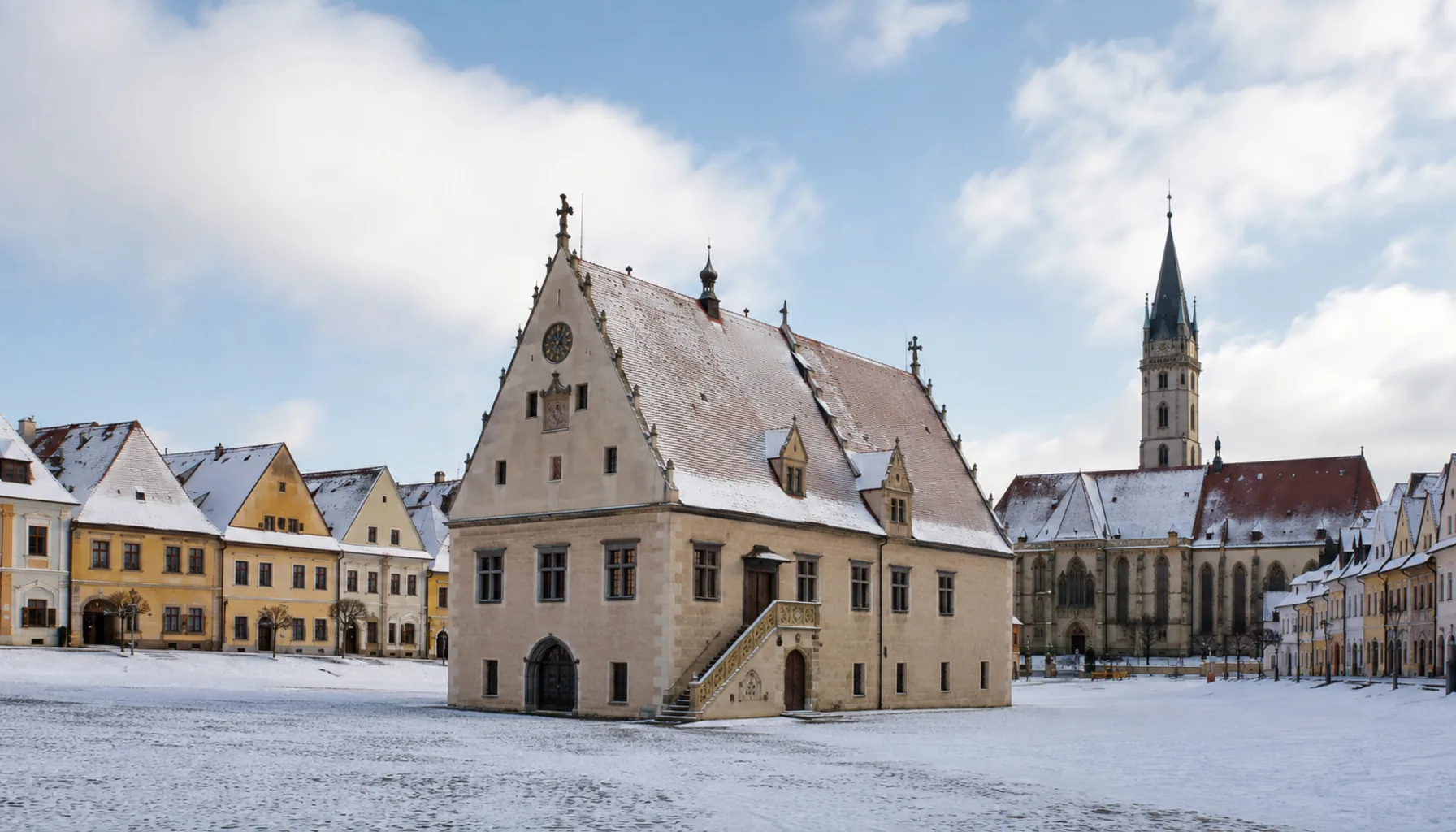
The Basilica of St Giles at the head of the square holds eleven late-Gothic winged altars, which is an unusual survival, since most towns lost theirs to fire, to Baroque refitting or to sale. Bardejov kept them for an unglamorous reason: once its golden age ended it was poor and out of the way, and nobody had the money to replace them. The great church itself was finished in 1464.Bazilika svätého Egídia v čele námestia má jedenásť neskorogotických krídlových oltárov, čo je nezvyčajné, lebo väčšina miest o svoje prišla pri požiaroch, barokových prestavbách alebo predaji. Bardejov si ich udržal z neefektného dôvodu: keď sa jeho zlatý vek skončil, bol chudobný a mimo hlavných ciest a nikto nemal peniaze na to, aby ich vymenil. Samotný veľký kostol dokončili v roku 1464.
The town hall standing free in the middle of the square went up from 1505, begun by a master called Alexander and finished by masters Alexius and John of Prešov; its lower half is Gothic and its upper half Renaissance, because taste changed while it was being built, and it is usually called the first Renaissance building in Slovakia. Part of the Šariš Museum is inside it, which means the town's principal collection sits in the town's principal building, exactly where it belongs.Radnica stojaca samostatne uprostred námestia rástla od roku 1505, začal ju majster Alexander a dokončili majstri Alexius a Ján z Prešova; jej spodná polovica je gotická a horná renesančná, lebo počas stavby sa zmenil vkus, a zvyčajne sa označuje za prvú renesančnú stavbu na Slovensku. Sídli v nej časť Šarišského múzea, čo znamená, že hlavná zbierka mesta je v hlavnej budove mesta, presne tam, kam patrí.
Bardejovské Kúpele adds a nineteenth-century spa park with drinking springs and the oldest open-air museum in Slovakia: Šariš farmsteads and two wooden churches moved here from the villages. The hills around the town hold one of the densest concentrations of wooden churches in the country, and the one at Hervartov, a short drive south-west, is the oldest to survive. Beside all this sit the ordinary institutions of a district town, a cultural centre, a library and a school of art for children, which we do not name individually because premises and programmes change faster than a page like this does.Bardejovské Kúpele k tomu pridávajú kúpeľný park z devätnásteho storočia s pitnými prameňmi a najstaršie múzeum v prírode na Slovensku: šarišské usadlosti a dva drevené kostoly prenesené sem z dedín. V kopcoch okolo mesta je jedna z najhustejších koncentrácií drevených chrámov v krajine a ten v Hervartove, kúsok na juhozápad, je najstarší zachovaný. Popri tom všetkom stoja bežné inštitúcie okresného mesta, kultúrne stredisko, knižnica a základná umelecká škola, ktoré menovite neuvádzame, lebo priestory a programy sa menia rýchlejšie ako takáto stránka.
The walls came first. Between 1405 and 1407 a builder from Nuremberg turned the gate tower into a small fortified castle with its own garrison, and the wall circuit went up around the whole town; it can be followed almost the whole way round today, with its bastions and gates.Najprv boli hradby. V rokoch 1405 až 1407 premenil staviteľ z Norimberga bránovú vežu na malý opevnený hrad s vlastnou posádkou a okolo celého mesta vyrástol hradbový okruh; dnes sa dá s baštami a bránami obísť takmer celý.
Three centuries of decline followed, in which little was built here and less was pulled down, and then the twentieth century made two decisions that mattered. In 1950 the historic core was declared a protected town reserve, among the first in the country, which meant the new blocks of flats and the factories went up outside the old town instead of on top of it. Through the 1970s and 1980s the square was restored house by house, and in 1986 Bardejov was awarded the European Gold Medal in Hamburg for that work, the first town in Czechoslovakia to receive it. On 20 November 2000 UNESCO inscribed the historic centre on the World Heritage List.Nasledovali tri storočia úpadku, počas ktorých sa tu málo stavalo a ešte menej búralo, a potom urobilo dvadsiate storočie dve rozhodnutia, na ktorých záležalo. V roku 1950 vyhlásili historické jadro za mestskú pamiatkovú rezerváciu, medzi prvými v krajine, čo znamenalo, že nové paneláky a fabriky vyrástli mimo starého mesta, a nie naň. Počas sedemdesiatych a osemdesiatych rokov obnovili námestie dom po dome a v roku 1986 dostal Bardejov za túto prácu v Hamburgu Európsku zlatú medailu ako prvé mesto v Československu. Dvadsiateho novembra 2000 zapísalo UNESCO historické centrum do zoznamu svetového dedičstva.
The Reformation reached Bardejov in the generation that built the town hall, and the town became Lutheran. Its schoolmaster, Leonard Stöckel, was born here, studied in Wittenberg under Melanchthon, came home in 1539 to run the town school and made it the best in Upper Hungary; in 1549 he wrote the Confessio Pentapolitana, the statement of belief of the five allied royal towns. Bardejov had bound itself to Košice, Levoča, Prešov and Sabinov in that league, the Pentapolitana, and a shared confession is what a league of towns produces when it takes itself seriously.Reformácia dorazila do Bardejova v generácii, ktorá stavala radnicu, a mesto sa stalo evanjelickým. Jeho rektor Leonard Stöckel sa tu narodil, študoval vo Wittenbergu u Melanchthona, v roku 1539 sa vrátil domov viesť mestskú školu a urobil z nej najlepšiu v Hornom Uhorsku; v roku 1549 napísal Confessio Pentapolitana, vyznanie viery piatich spojených kráľovských miest. Bardejov sa v tomto zväze, Pentapolitane, spojil s Košicami, Levočou, Prešovom a Sabinovom, a spoločné vyznanie je to, čo zväz miest vytvorí, keď sa berie vážne.
The springs a few kilometres up the valley are named in a charter of 1247, when Béla IV settled a boundary quarrel, and from roughly the 1720s they were turned into a proper spa. Emperor Joseph II came, so did Marie Louise, later Napoleon's wife, and so did the Russian tsar Alexander I. By the middle of the nineteenth century close to a thousand families a season were taking the waters, the composer Béla Kéler kept a house there from 1850 until his death in 1882, and when a fire destroyed much of the resort in 1856 it was simply rebuilt on a larger scale.Pramene pár kilometrov hore dolinou spomína listina z roku 1247, ktorou Belo IV. urovnal spor o hranice, a zhruba od dvadsiatych rokov osemnásteho storočia z nich urobili riadne kúpele. Prišiel cisár Jozef II., prišla aj Mária Lujza, neskoršia Napoleonova manželka, aj ruský cár Alexander I. V polovici devätnásteho storočia sa tu liečilo takmer tisíc rodín za sezónu, skladateľ Béla Kéler tu mal dom od roku 1850 až do svojej smrti v roku 1882, a keď v roku 1856 zničil veľkú časť kúpeľov požiar, jednoducho ich postavili nanovo a väčšie.
Sixteen videos for Culture in Bardejov.Šestnásť videí — Kultúra v Bardejove.