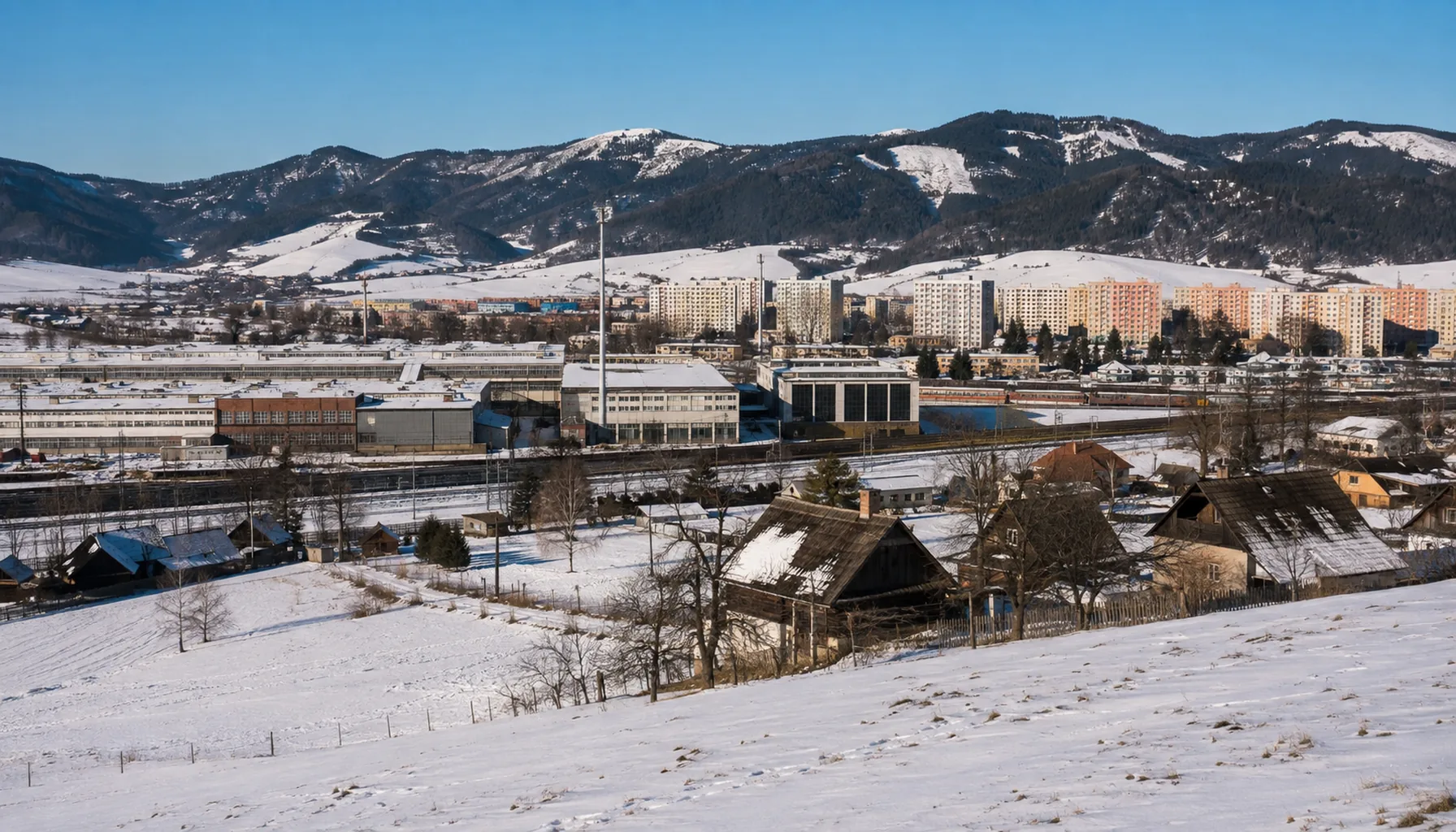
Nižná · Orava valleyNižná · Oravská dolina
A place that made televisions for forty years and is still officially a village, with the best-preserved group of Orava log cottages in the country in the next settlement downstream.Obec, ktorá štyridsať rokov vyrábala televízory a úradne je stále dedinou, so susednou osadou po prúde, kde stojí najlepšie zachovaná skupina oravských zrubov v krajine.
Nižná is a working place rather than a sightseeing one, and its calendar has always followed work rather than fairs. It never held market rights of its own: it was the lower village of a bigger neighbour, appearing in writing in 1395 still under a form of the name Tvrdošín and only getting a name of its own by 1420, as Nissne Wes, the lower village. Everything here belonged to Orava Castle, and its people were the castle's subjects.Nižná je pracovné miesto, nie miesto na prezeranie, a jej kalendár vždy sledoval prácu, nie jarmoky. Nikdy nemala vlastné trhové právo: bola dolnou dedinou väčšieho suseda, v písomnostiach sa objavuje v roku 1395 ešte pod podobou mena Tvrdošín a vlastné meno má až od roku 1420, ako Nissne Wes, dolná dedina. Všetko tu patrilo Oravskému hradu a ľudia boli hradnými poddanými.
What gave the village a year of its own was the parish. Its church was finished during the fifteenth century, and that is a bigger fact than it sounds: a village with its own church had a priest, a graveyard and written records of who was born, married and buried, and it gave the neighbouring hamlets a reason to walk here on Sundays. Orava was thinly settled and poor, and most places had to use somebody else's church. Nižná did not, and the parish feasts are the oldest fixed dates the place keeps.Vlastný rok dala dedine farnosť. Jej kostol dokončili v priebehu pätnásteho storočia a je to väčší fakt, než sa zdá: dedina s vlastným kostolom mala kňaza, cintorín a písomné záznamy o tom, kto sa narodil, sobášil a zomrel, a susedné osady mali dôvod prísť sem v nedeľu pešo. Orava bola riedko osídlená a chudobná a väčšina miest musela chodiť do cudzieho kostola. Nižná nie, a farské slávnosti sú najstaršími pevnými dátumami, ktoré si tu držia.
The honest answer for Nižná itself is that culture lives in the ordinary institutions a small community runs: a cultural centre with a hall and a programme, a library, schools, and amateur choirs and folk groups. We name none of them individually, because premises and programmes change faster than a page like this does. The professional museum and gallery collections of Orava are administered from Dolný Kubín, and the region's set pieces are all a few kilometres away.Poctivá odpoveď pre samotnú Nižnú je, že kultúra tu žije v obyčajných inštitúciách, aké prevádzkuje malá obec: kultúrne stredisko so sálou a programom, knižnica, školy a ochotnícke spevácke a folklórne súbory. Menovite neuvádzame ani jeden, lebo priestory a programy sa menia rýchlejšie ako takáto stránka. Odborné múzejné a galerijné zbierky Oravy spravujú z Dolného Kubína a všetko výstavné v kraji je pár kilometrov ďaleko.
Podbiel, the next village downstream, has the best-preserved group of Orava log houses in the country: a compact cluster of eighteenth- and nineteenth-century timber cottages known as Bobrova raľa, protected as a monument reserve, with some of them let to visitors. Staying overnight in one of them is a different experience from walking through a museum, and it is the reason the reserve has stayed a place where people live rather than a display.Podbiel, ďalšia obec po prúde, má najlepšie zachovanú skupinu oravských zrubov v krajine: kompaktný zhluk drevených chalúp z osemnásteho a devätnásteho storočia zvaný Bobrova raľa, chránený ako pamiatková rezervácia, pričom časť z nich sa prenajíma návštevníkom. Prespať v jednej z nich je iný zážitok než prejsť múzeom a je to dôvod, prečo rezervácia zostala miestom, kde sa býva, a nie výstavou.
The oldest building is the parish church of the fifteenth century, and after that the village has very little that is old, for reasons that are on the record. In 1666 a flood tore through it, because the Orava is a fast mountain river whose floods arrive in hours rather than days. Then in 1686 the army of the Polish king Jan III Sobieski marched through Orava on campaign, Nižná was burned, and the villagers ran into the forests and waited it out. By 1695 there were 107 farmsteads and about five hundred people again. That is how these villages always recovered: slowly, and by having children.Najstaršou budovou je farský kostol z pätnásteho storočia a okrem neho má obec veľmi málo starého, a to z doložených dôvodov. V roku 1666 ňou prešla povodeň, lebo Orava je rýchla horská rieka, ktorej záplavy prichádzajú v hodinách, nie v dňoch. Potom v roku 1686 prešlo Oravou na ťažení vojsko poľského kráľa Jána III. Sobieskeho, Nižná zhorela a dedinčania ušli do lesov a počkali, kým to prejde. Do roku 1695 tu bolo znovu 107 usadlostí a asi päťsto ľudí. Takto sa tieto dediny vždy zotavovali: pomaly a tým, že mali deti.
The buildings that define the place today are twentieth-century. In the 1950s the state built an electronics works here as part of the Tesla group, and in 1958 the first black-and-white television set came off the line; colour production followed in 1975, the sets were sold across Czechoslovakia and beyond under the brand name Orava, and picture tubes were made here too. With the plant came blocks of flats, schools and shops that a village of nine hundred people would never have built for itself. This is what planned industrialisation actually looked like: a factory decided on in an office, and a whole community rearranged around it.Stavby, ktoré miesto určujú dnes, sú z dvadsiateho storočia. V päťdesiatych rokoch tu štát postavil elektrotechnický závod v rámci skupiny Tesla a v roku 1958 zišiel z linky prvý čiernobiely televízor; farebná výroba pribudla v roku 1975, prijímače sa predávali po celom Československu aj za jeho hranicami pod značkou Orava a vyrábali sa tu aj obrazovky. So závodom prišli paneláky, školy a obchody, aké by si obec s deviatimi stovkami obyvateľov nikdy sama nepostavila. Takto vyzerala plánovaná industrializácia v skutočnosti: fabrika rozhodnutá v kancelárii a celá komunita preskladaná okolo nej.
Before the works, the village lived on what the valley allowed. By the early 1600s it already had two mills and a sawmill and about four hundred people, and the census of 1785 counted 1,031. Flax was spun and woven at home, cattle and sheep grazed the slopes, and logs cut in the Orava forests were lashed into rafts and floated down to the Váh by raftsmen skilled enough to feed families on it for generations. Nothing about the place suggested it would ever make anything more complicated than a plank.Pred závodom žila dedina z toho, čo dolina dovolila. Začiatkom sedemnásteho storočia tu už boli dva mlyny a píla a asi štyristo ľudí a súpis z roku 1785 napočítal 1 031 obyvateľov. Ľan sa priadol a tkal doma, na svahoch sa pásol dobytok a ovce a klady vyťažené v oravských lesoch viazali do pltí a splavovali po Váh pltníci takí zruční, že tým generácie živili rodiny. Nič na tomto mieste nenaznačovalo, že by tu niekedy vyrobili čosi zložitejšie než dosku.
Both trades ended within a generation. In 1899 the branch line from Kraľovany was built up the valley and Nižná got a station, and rafting died because timber could now go by rail, while household weaving died because factory cotton was cheaper. The census counted 1,217 people here in 1890 and only 933 in 1940: a quarter of the village gone, most of it to the United States or to work elsewhere. That is what a poor mountain valley looked like before industry arrived.Obe remeslá sa skončili do jednej generácie. V roku 1899 postavili dolinou odbočnú trať z Kraľovian a Nižná dostala stanicu, pltníctvo zaniklo, lebo drevo mohlo ísť po koľajniciach, a domáce tkáčstvo zaniklo, lebo továrenská bavlna bola lacnejšia. Súpisy tu napočítali 1 217 ľudí v roku 1890 a už len 933 v roku 1940: štvrtina dediny preč, väčšina z nej do Spojených štátov alebo za prácou inam. Takto vyzerala chudobná horská dolina predtým, než prišiel priemysel.
The third ending came after 1989, when Czechoslovak television sets had to compete with Japanese and Korean ones on price and quality and lost; the works was reorganised into a successor company, OTF, and that company has been in bankruptcy since 2000. In a place of a few thousand people that could not be absorbed quietly. What survived was the ground, the buildings and, the part that mattered most, a workforce that knew how to do precise assembly work, which is the inheritance the industrial estate is still living on.Tretí koniec prišiel po roku 1989, keď československé televízory museli konkurovať japonským a kórejským cenou aj kvalitou a prehrali; závod pretvorili na nástupnícku spoločnosť OTF a tá je od roku 2000 v konkurze. V obci s niekoľkými tisíckami ľudí sa to nedalo vstrebať potichu. Prežila pôda, budovy a to najpodstatnejšie: pracovná sila, ktorá vedela robiť presnú montážnu prácu, a práve z tohto dedičstva priemyselný park žije dodnes.
Sixteen videos for Culture in Nižná.Šestnásť videí — Kultúra v Nižnej.