Námestovo · Upper OravaNámestovo · horná Orava
A town whose old centre is under water, whose most famous son was born on what is now an island, and whose one gallery you reach by boat.Mesto, ktorého staré centrum je pod vodou, ktorého najznámejší rodák sa narodil na dnešnom ostrove a ktorého jediná galéria sa dá dosiahnuť len loďou.
The town's oldest right to a calendar of its own is a linen right. Námestovo won the right to trade in linen cloth in 1728, a bleaching works was built in 1775, and on 14 June 1776 Queen Maria Theresa raised the subject village to a town with the right to hold four fairs a year. Flax grows where wheat will not, so a cold basin could spin, weave and sell cloth right through the winter, when there was nothing to do in the fields, and for roughly a century that trade was the reason the Upper Orava could feed the number of people living in it.Najstarším právom mesta na vlastný kalendár je právo na plátno. Námestovo získalo právo obchodovať s plátnom v roku 1728, v roku 1775 tu postavili bielidlo a 14. júna 1776 povýšila kráľovná Mária Terézia poddanskú dedinu na mesto s právom štyroch jarmokov ročne. Ľan rastie tam, kde pšenica nie, takže studená kotlina mohla priasť, tkať a predávať plátno cez celú zimu, keď na poliach nebolo čo robiť, a zhruba sto rokov bol práve tento obchod dôvodom, prečo horná Orava dokázala uživiť toľko ľudí.
The modern year runs on water. There are beaches and a marina on the near shore, sailing and windsurfing through the summer, and in a hard winter an ice sheet that people walk on. The reservoir is shallow and mountain-fed, so it warms late and cools early: the season is genuinely short, and the boat out to the island runs in season only.Dnešný rok beží na vode. Na blízkom brehu sú pláže a prístav, cez leto sa tu plachtí a surfuje a v tuhej zime sa po ľade chodí pešo. Nádrž je plytká a napájaná z hôr, takže sa ohreje neskoro a vychladne skoro: sezóna je naozaj krátka a loď na ostrov premáva len počas nej.
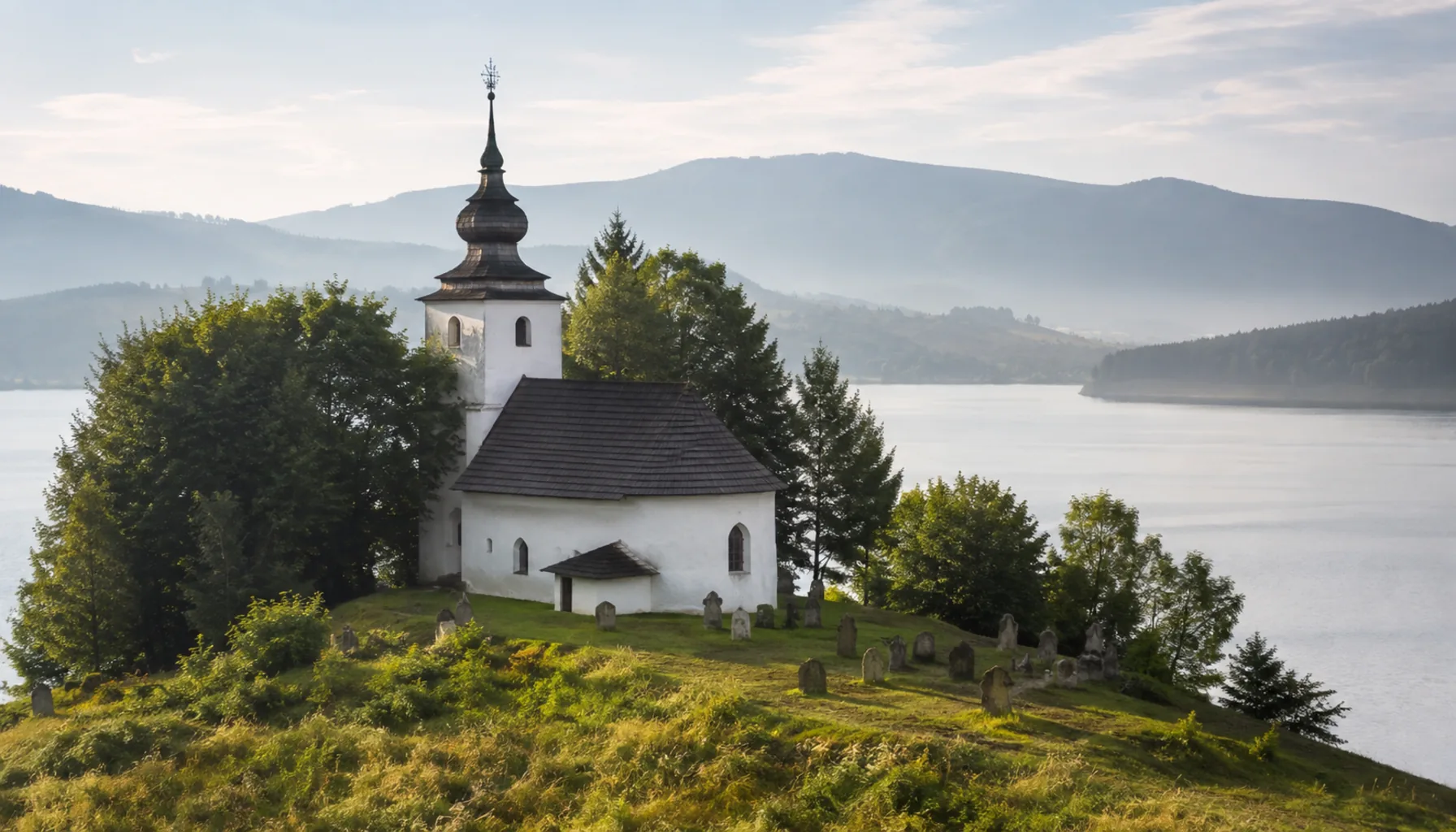
The Slanica Island of Art is the reason to come. A boat crosses in season from Slanická Osada to the island, where the surviving Baroque church of a drowned village holds a collection of Slovak folk sculpture and painting, run by the Orava Gallery, with gravestones gathered from the flooded cemeteries standing around it. It is an unusual museum in every respect: the building is the last thing left of a place that no longer exists, and the objects in it were made by village carvers rather than by anyone with a studio.Slanický ostrov umenia je dôvod, prečo sem prísť. Loď premáva v sezóne zo Slanickej Osady na ostrov, kde v zachovanom barokovom kostole zatopenej dediny sídli zbierka slovenskej ľudovej plastiky a maľby v správe Oravskej galérie a okolo nej stoja náhrobníky pozbierané zo zaliatych cintorínov. Je to nezvyčajné múzeum v každom ohľade: budova je poslednou vecou, ktorá zostala z miesta, čo už neexistuje, a predmety v nej vyrezali dedinskí rezbári, nie ľudia s ateliérom.
In the town itself the provision is the ordinary one: a cultural centre with a hall and a programme, a library, a school of art for children, and amateur choirs and folk groups attached to the schools and the surrounding villages. We name none of them individually. The district's museum and gallery work is administered from Dolný Kubín, which is where the professional collections of the whole valley sit.V samotnom meste je vybavenie bežné: kultúrne stredisko so sálou a programom, knižnica, základná umelecká škola a ochotnícke spevácke a folklórne súbory pri školách a v okolitých obciach. Menovite neuvádzame ani jeden. Múzejnú a galerijnú prácu okresu spravujú z Dolného Kubína, kde sídlia odborné zbierky celej doliny.
There is very little old fabric here, and the reasons are specific rather than vague. A fire gutted much of the town in 1943. Then the front arrived: the fighting for Námestovo on Easter Monday, 2 April 1945 killed sixty-four inhabitants and destroyed around sixty per cent of the buildings, as German units pulled back northwards and burned as they went. What a visitor sees today is therefore mostly post-war construction, and the old centre of this town exists in photographs.Starej zástavby je tu veľmi málo a dôvody sú konkrétne, nie hmlisté. V roku 1943 vyhorela veľká časť mesta. Potom prišiel front: boje o Námestovo na Veľkonočný pondelok 2. apríla 1945 si vyžiadali šesťdesiatštyri obetí z radov obyvateľov a zničili približne šesťdesiat percent budov, keď sa nemecké jednotky sťahovali na sever a cestou pálili. To, čo návštevník dnes vidí, je preto väčšinou povojnová výstavba a staré centrum tohto mesta existuje na fotografiách.
Then the water took the rest. Digging on the dam began in 1941, the first turbine turned on 2 May 1953 and the lake was declared finished in 1954. It covers thirty-five square kilometres, and beneath it lie five villages, part of Bobrov, and the lower two-thirds of Námestovo itself. Thousands of people were moved and cemeteries were dug up and carried away. A town cannot show a visitor a square that is under a lake.Zvyšok potom vzala voda. Kopať na priehrade sa začalo v roku 1941, prvá turbína sa roztočila 2. mája 1953 a jazero vyhlásili za dokončené v roku 1954. Zaberá tridsaťpäť štvorcových kilometrov a pod ním leží päť dedín, časť Bobrova a spodné dve tretiny samotného Námestova. Tisíce ľudí sa museli vysťahovať, cintoríny rozkopali a preniesli. Mesto nemôže návštevníkovi ukázať námestie, ktoré je pod jazerom.
So the oldest building the town can point at stands on the island, on what used to be a hill. Religion changed twice here as well: a Lutheran parish was set up in 1612, because the Thurzos who owned Orava were Lutherans and their tenants followed them, and a first wooden church went up in 1663. Both were undone within a lifetime by the Counter-Reformation, and the Upper Orava has been strongly Catholic ever since. Whole valleys changed religion twice in a century, and the reason was usually who happened to hold the castle.Najstaršou budovou, na akú môže mesto ukázať, je teda tá na ostrove, na bývalom kopci. Aj náboženstvo sa tu zmenilo dvakrát: v roku 1612 tu vznikla evanjelická farnosť, lebo Thurzovci vlastniaci Oravu boli evanjelici a poddaní ich nasledovali, a v roku 1663 postavili prvý drevený kostol. Oboje zvrátila do jednej generácie protireformácia a horná Orava je odvtedy silne katolícka. Celé doliny zmenili vieru dvakrát za storočie a dôvodom bolo zvyčajne to, kto práve držal hrad.
On 3 October 1762 Anton Bernolák was born at Slanica, a village a few kilometres from Námestovo and now the island. He became a Catholic priest, and in 1787 he and a circle of seminary students in Bratislava published the argument that Slovaks should write their own language rather than Czech.Tretieho októbra 1762 sa v Slanici, dedine pár kilometrov od Námestova a dnešnom ostrove, narodil Anton Bernolák. Stal sa katolíckym kňazom a v roku 1787 spolu s okruhom seminaristov v Bratislave zverejnil argument, že Slováci by mali písať vlastným jazykom, a nie po česky.
In 1790 he followed it with the first normative grammar of Slovak, and he spent years on a six-volume dictionary that appeared only after his death at Nové Zámky in 1813. The version of Slovak he codified was not the one that finally won, but it was the first, and every later argument started from it. That is a large thing to come out of a cold basin at the top of a poor valley.V roku 1790 na to nadviazal prvou normatívnou gramatikou slovenčiny a roky pracoval na šesťzväzkovom slovníku, ktorý vyšiel až po jeho smrti v Nových Zámkoch v roku 1813. Podoba slovenčiny, ktorú kodifikoval, nebola tá, ktorá napokon zvíťazila, ale bola prvá a každý neskorší spor sa od nej odvíjal. Na studenú kotlinu na konci chudobnej doliny je to veľká vec.
His birthplace is somewhere under the surface below the island, which makes that church the closest thing the Slovak language has to a birthplace you reach by boat. It is worth saying plainly what happened here: the thing that drowned the town's past is also what carries its present, because the reservoir is now the summer economy of the whole shore.Jeho rodisko je kdesi pod hladinou pod ostrovom, čo robí z toho kostola najbližšiu vec k rodisku slovenčiny, na ktoré sa dá doplaviť. Oplatí sa povedať naplno, čo sa tu stalo: to, čo utopilo minulosť mesta, je zároveň to, čo nesie jeho prítomnosť, lebo nádrž je dnes letným hospodárstvom celého pobrežia.
Sixteen videos for Culture in Námestovo.Šestnásť videí — Kultúra v Námestove.