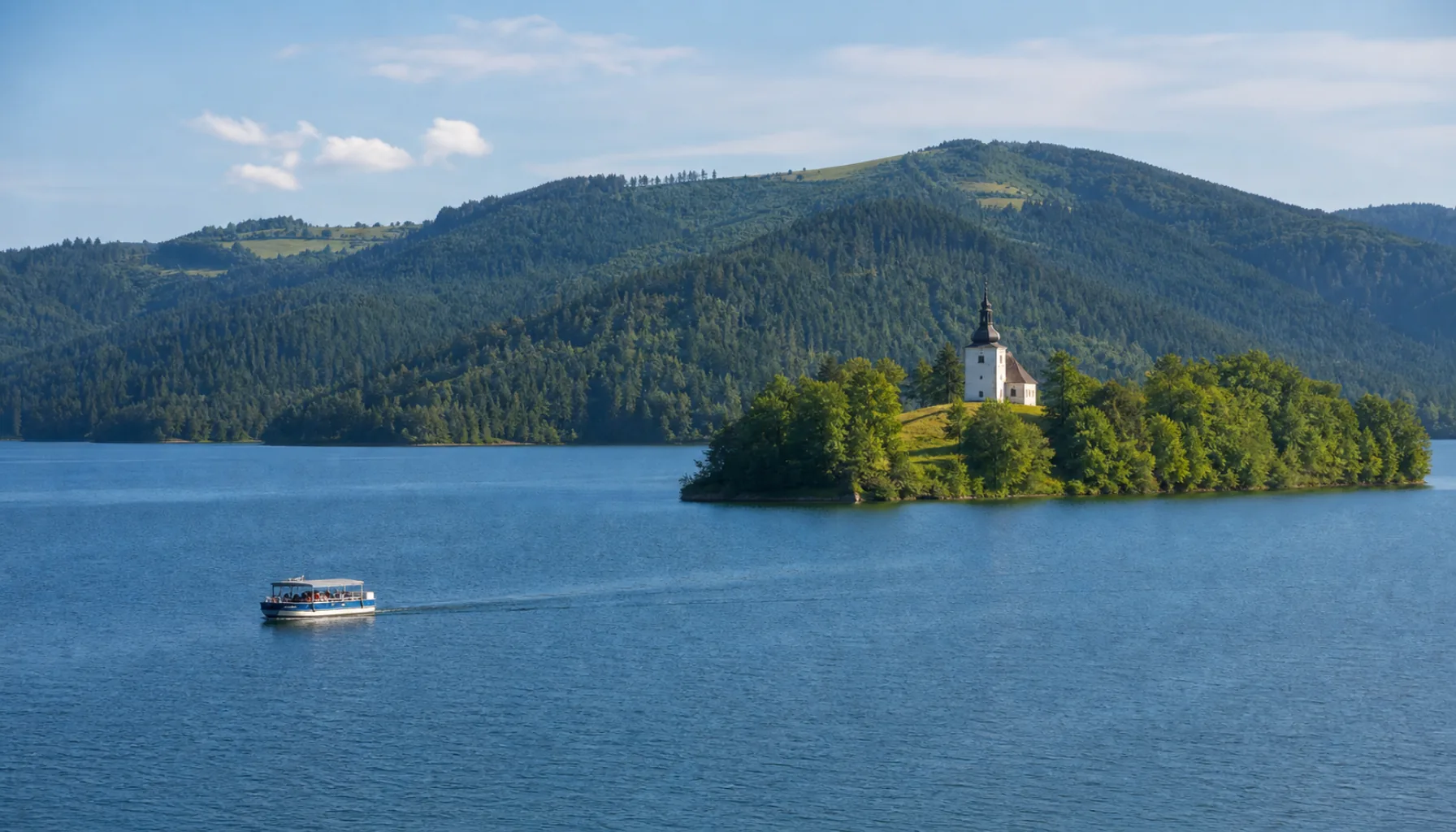
The town of the Upper Orava, on the shore of the reservoir that drowned five villages in 1953 — among them Slanica, where Anton Bernolák was born.Mesto hornej Oravy na brehu priehrady, ktorá v roku 1953 zatopila päť dedín — medzi nimi Slanicu, rodisko Antona Bernoláka.
The Orava reservoir at Námestovo with the island church of drowned SlanicaOravská priehrada pri Námestove s ostrovným kostolom zatopenej Slanice
Where it standsKde leží
Námestovo stands at the northern end of Orava, on the shore of the Orava reservoir, in the wide, high basin between the Oravská Magura and the Oravské Beskydy. The Polish border runs a few kilometres north; above the border village of Oravská Polhora rises Babia hora, at about 1,725 metres the highest peak of the Beskyd range and, on a clear day, visible from most of the town.Námestovo leží na severnom konci Oravy, na brehu Oravskej priehrady, v širokej a vysoko položenej kotline medzi Oravskou Magurou a Oravskými Beskydami. Poľská hranica vedie pár kilometrov na sever; nad pohraničnou Oravskou Polhorou sa dvíha Babia hora, s približne 1 725 metrami najvyšší vrch pohoria, ktorý za jasného dňa vidno z väčšiny mesta.
This is the coldest and wettest corner of Orava, and parts of the basin floor are peat bog rather than farmland — several of the surviving bogs are protected. It is also demographically the youngest: the Upper Orava has long had one of the highest birth rates in Slovakia, and the villages around the town are large.Je to najchladnejší a najvlhkejší kút Oravy a časti dna kotliny sú skôr rašeliniskom než poľnohospodárskou pôdou — niekoľko zachovaných rašelinísk je chránených. Zároveň ide o demograficky najmladšiu časť kraja: horná Orava má už dlho jednu z najvyšších pôrodností na Slovensku a obce v okolí mesta sú veľké.
The storyHistória
Námestovo was founded in the middle of the sixteenth century, when the owners of the Orava estate pushed settlement into the highest and coldest part of the valley, and it became the market and administrative centre of that end of Orava. Its trades were the local ones — cattle, timber, linen, and carting over the passes into Poland — and it was, even by Orava standards, poor.Námestovo vzniklo v polovici 16. storočia, keď majitelia oravského panstva posunuli osídlenie do najvyššej a najchladnejšej časti doliny, a stalo sa trhovým a správnym strediskom tohto konca Oravy. Živilo sa tým, čím kraj — dobytkom, drevom, plátnom a povozníctvom cez priesmyky do Poľska — a bolo aj na oravské pomery chudobné.
Everything about the modern town follows from the dam. The Orava reservoir was built on the river between 1941 and 1953, and when it filled it took five villages with it — Slanica, Ústie nad Oravou, Osada, Hámre and Ľavkovo — and moved thousands of people out of the valley floor. Only the hill of Slanica stayed above water; its church is now the highest point of an island.Všetko na dnešnom meste vyplýva z priehrady. Oravská priehrada vznikala na rieke v rokoch 1941 až 1953 a keď sa napustila, vzala so sebou päť dedín — Slanicu, Ústie nad Oravou, Osadu, Hámre a Ľavkovo — a vysťahovala tisíce ľudí z dna doliny. Nad hladinou zostal iba slanický kopec; jeho kostol je dnes najvyšším bodom ostrova.
Anton Bernolák, the priest who produced the first codification of literary Slovak, was born at Slanica in 1762. His birthplace is under the water, which makes the island the closest thing the Slovak language has to a submerged birthplace.Anton Bernolák, kňaz, ktorý vytvoril prvú kodifikáciu spisovnej slovenčiny, sa v Slanici narodil v roku 1762. Jeho rodisko je pod vodou, a tak je ostrov najbližším, čo má slovenčina k zatopenému rodnému domu.
What to seeČo vidieť
The Slanica Island of Art is the reason to come. A boat crosses in season from Slanická Osada to the island, where the surviving Baroque church of the drowned village now holds a collection of Slovak folk sculpture and painting, run by the Orava Gallery, with gravestones gathered from the flooded cemeteries around it.Slanický ostrov umenia je hlavným dôvodom návštevy. V sezóne naň zo Slanickej Osady premáva loď a v zachovanom barokovom kostole zatopenej dediny je dnes zbierka slovenskej ľudovej plastiky a maľby, ktorú spravuje Oravská galéria; okolo nej stoja náhrobníky pozbierané zo zaliatych cintorínov.
The water itself is the town's other draw: beaches and a marina on the near shore, sailing and windsurfing through the summer, and in a hard winter an ice sheet that people walk on. The reservoir is shallow and mountain-fed, so it warms late and cools early — the season is genuinely short.Druhým lákadlom je samotná voda: pláže a prístav na bližšom brehu, cez leto plachtenie a windsurfing a v tuhej zime ľad, po ktorom sa chodí. Priehrada je plytká a napájaná horskými prítokmi, preto sa neskoro zohrieva a skoro vychladne — sezóna je naozaj krátka.
North of the town the Goral villages run up to the border, with Babia hora above them and marked trails onto the ridge; the peat-bog reserves of the Orava basin lie east towards Suchá Hora.Severne od mesta stúpajú k hranici gorálske dediny s Babou horou nad nimi a značenými chodníkmi na hrebeň; rašeliniskové rezervácie Oravskej kotliny ležia na východ smerom na Suchú Horu.
Work and industryPráca a priemysel
Electronics is the town's industry: contract manufacturing of electronic assemblies has grown here since the 1990s, and a supplier of welded structures for tractors and harvesters works on the edge of town. Timber, joinery and construction take up much of the rest, and the reservoir supports a summer economy of its own.Priemyslom mesta je elektrotechnika: zmluvná výroba elektronických zostáv tu rastie od 90. rokov a na okraji mesta pracuje dodávateľ zvarencov pre traktory a kombajny. Zvyšok tvorí najmä drevárstvo, stolárstvo a stavebníctvo — a priehrada živí vlastnú letnú ekonomiku.
The district also exports labour. Building crews from the Upper Orava have worked across Slovakia and abroad for two generations, and the pattern of men away on contract and families at home is an old one here.Okres zároveň vyváža prácu. Stavebné partie z hornej Oravy pracujú po celom Slovensku aj v zahraničí už dve generácie a schéma mužov na montáži a rodín doma je tu stará.
Getting thereAko sa tam dostať
Námestovo has no railway. Buses from Dolný Kubín, Trstená and Žilina are the way in, the nearest stations are at Trstená and Tvrdošín, and by car the road runs along the reservoir from Tvrdošín or up from Dolný Kubín.Námestovo nemá železnicu. Prichádza sa autobusmi z Dolného Kubína, Trstenej a Žiliny, najbližšie stanice sú v Trstenej a Tvrdošíne a autom vedie cesta popri priehrade od Tvrdošína alebo hore od Dolného Kubína.
Explore NámestovoObjavujte Námestovo
Every part of this place with a page of its own.Každá časť tohto miesta, ktorá má vlastnú stránku.