Vráble · the Žitava valley below the TribečVráble · údolie Žitavy pod Tribečom

Culture in VrábleKultúra vo Vrábľoch

A small engineering town whose most remarkable heritage is under the fields rather than on the square, and whose centre is honest enough not to pretend otherwise.Malé strojárske mesto, ktorého najpozoruhodnejšie dedičstvo leží pod poľami, nie na námestí — a ktorého centrum sa netvári inak.

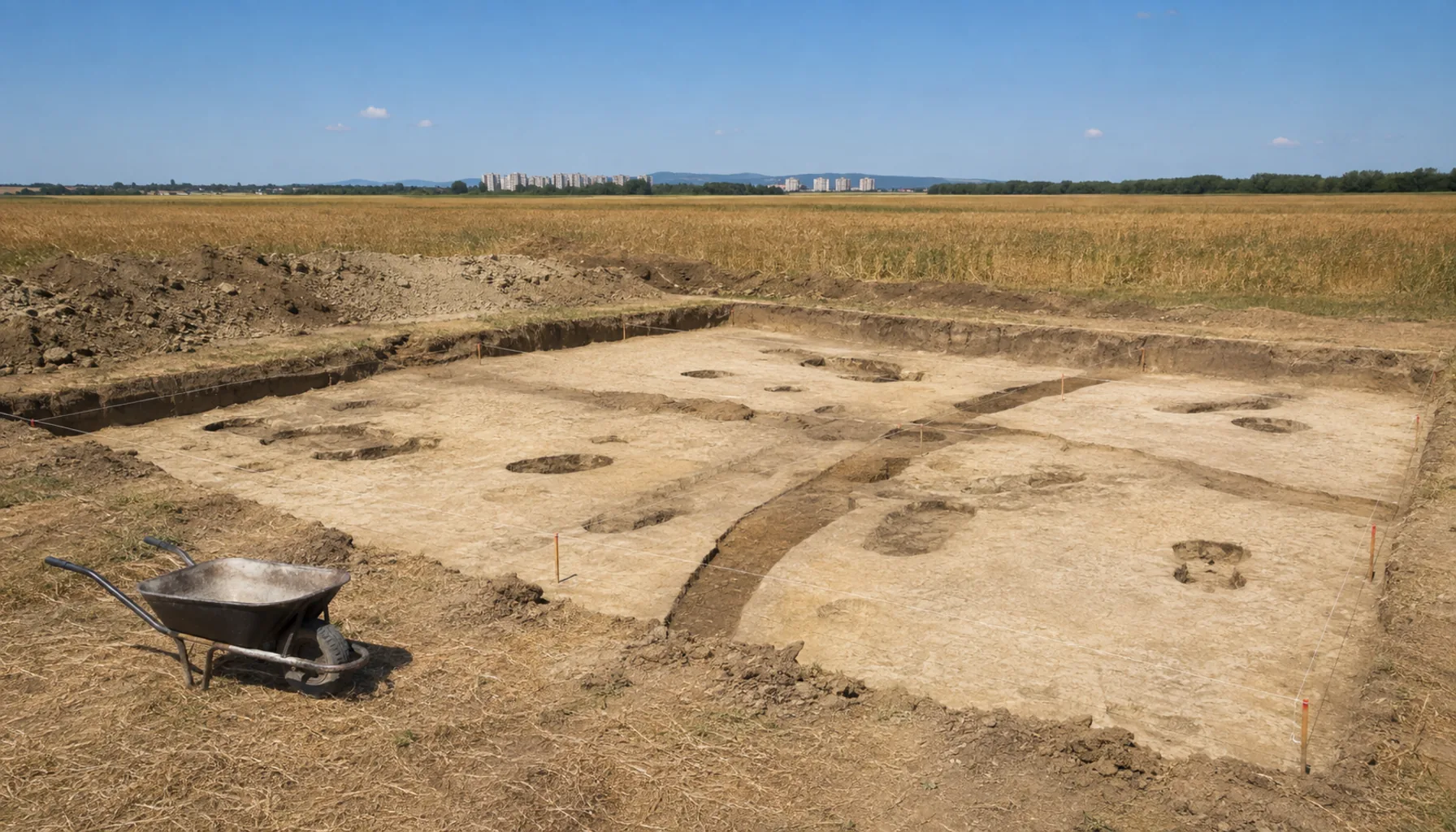
An open archaeological trench in the fields outside Vráble, where one of the largest early farming settlements in Central Europe is being excavated
An open archaeological trench in the fields outside Vráble, where one of the largest early farming settlements in Central Europe is being excavated.Otvorená archeologická sonda v poliach za Vráblami, kde sa skúma jedno z najväčších sídlisk prvých roľníkov v strednej Európe.

The year in VrábleRok vo Vrábľoch

Vráble was already a market place by 1294 and had a toll station on the road by the 1480s, so the habit of gathering to buy and sell here is seven hundred years old. What it looks like now is the ordinary calendar of a town of around eight thousand: market days, a town day, church feasts, school and club events, and a Christmas programme. We name no titles or dates, because they are set a season at a time and the town's own listings are the only reliable ones.Vráble boli trhovým miestom už v roku 1294 a v osemdesiatych rokoch 15. storočia mali na ceste mýtnicu, takže zvyk schádzať sa tu kupovať a predávať má sedemsto rokov. Dnes vyzerá ako bežný kalendár mesta s asi ôsmimi tisíckami obyvateľov: trhové dni, dni mesta, cirkevné sviatky, školské a záujmové podujatia a vianočný program. Názvy ani termíny tu neuvádzame — určujú sa od sezóny k sezóne a spoľahlivý je len program mesta.

Summer moves to the water and autumn to the slopes. The reservoir on the Žitava north of the town is used for fishing and recreation, and the warm hillsides above the valley carry vineyards — good enough that from 1971 the Bratislava wine company ran a plant in the town on grapes grown here. Wine is still half of what the land around Vráble does, alongside cereals and oilseed, and the year has the shape any wine district's year has.Leto sa presúva k vode a jeseň na svahy. Vodná nádrž na Žitave severne od mesta slúži na rybárčenie a rekreáciu a teplé stráne nad dolinou nesú vinice — dosť dobré na to, aby tu od roku 1971 mal bratislavský vinársky podnik závod postavený na hrozne odtiaľto. Víno je dodnes polovicou toho, čo tunajšia pôda robí, popri obilninách a olejninách, a rok má tvar, aký má rok v každom vinohradníckom kraji.

Where culture livesKde žije kultúra

The town keeps a small museum collection, and beyond it the infrastructure is the standard Slovak set: a cultural centre with a hall and a programme, a public library, amateur choirs and folk groups, and a school of art for children. We name none of them individually, because premises, ensembles and programmes change faster than a page like this does, and a wrong name is worse than no name.Mesto má malú múzejnú zbierku a okrem nej štandardnú slovenskú výbavu: kultúrne stredisko so sálou a programom, mestskú knižnicu, amatérske spevácke zbory a folklórne skupiny a základnú umeleckú školu pre deti. Menovite tu neuvádzame ani jednu z nich: priestory, telesá aj programy sa menia rýchlejšie než takáto stránka a nesprávne meno je horšie než žiadne.

The serious research about this place is not done in a museum at all but in the fields outside it, by Slovak and foreign archaeologists working season after season. Their results are published rather than exhibited, which means the most important thing anyone knows about Vráble is currently easier to read than to visit. That is worth saying plainly to a visitor who arrives expecting a site with a gate and a ticket desk.Vážny výskum tohto miesta sa nerobí v múzeu, ale na poliach za ním — slovenskí a zahraniční archeológovia tam pracujú sezónu za sezónou. Ich výsledky sa publikujú, nie vystavujú, takže to najdôležitejšie, čo sa o Vrábľoch vie, sa dnes ľahšie prečíta, než navštívi. Návštevníkovi, ktorý prichádza s predstavou lokality s bránou a pokladňou, to treba povedať priamo.

The buildings that carry itBudovy, ktoré ju nesú

The centre is modest — a parish church, a square, the museum collection — and the reason to stop is what surrounds it: the Žitava valley, the archaeological landscape, and the road up into the Tribeč towards the castle ruins at Hrušov. A page that inflated this centre into something it is not would be doing the town no favours.Centrum je skromné — farský kostol, námestie, múzejná zbierka — a dôvodom zastaviť sa je to, čo ho obklopuje: údolie Žitavy, archeologická krajina a cesta do Tribeča k zrúcaninám hradu Hrušov. Stránka, ktorá by z tohto centra robila niečo, čím nie je, by mestu nepomohla.

It is modest despite five hundred years of unusual importance. From the thirteenth century Vráble belonged to the Archbishop of Esztergom and became the seat of his predial nobles — men who held their land from the church rather than from the king, owed the archbishop military service instead of tax, and had a court of their own here, headed by an official called a palatine; one of them, Tomáš, is on record in 1337. Vráble was, in plain terms, the little capital of a private country belonging to a bishop. A court of minor nobles is an institution rather than a palace, though, so it left records instead of architecture, and the revolutionary laws of 1848 abolished the jurisdiction outright.Skromné je napriek piatim storočiam neobyčajného významu. Od trinásteho storočia patrili Vráble ostrihomskému arcibiskupovi a stali sa sídlom jeho prediálnych šľachticov — mužov, ktorí držali pôdu od cirkvi, nie od kráľa, arcibiskupovi dlhovali vojenskú službu namiesto dane a mali tu vlastnú stolicu na čele s úradníkom zvaným palatín; jeden z nich, Tomáš, je doložený v roku 1337. Vráble boli, povedané priamo, malým hlavným mestom súkromnej krajiny jedného biskupa. Stolica nižšej šľachty je však inštitúcia, nie palác, takže po sebe nechala písomnosti, nie architektúru — a revolučné zákony z roku 1848 túto jurisdikciu zrušili nadobro.

The other missing building is a fort. An Ottoman raiding party burned Vráble in 1530, eleven years before the sultan took Buda, and once the frontier actually arrived the valley road became a raiding route. In 1624 an order went out to build a palanka here — a fort of earth and timber rather than stone, quick, cheap and perfectly adequate against horsemen with no siege guns. It was finished around 1626 and beat off an attack the same year; it was captured in 1653 and destroyed in 1663, the year Nové Zámky fell. Earth and timber leave nothing to visit, which is the standing difficulty of this town's heritage.Druhá chýbajúca stavba je pevnosť. Osmanský nájazd vypálil Vráble v roku 1530, jedenásť rokov predtým, než sultán dobyl Budín, a keď hranica naozaj dorazila, stala sa cesta dolinou nájazdovou trasou. V roku 1624 vyšiel príkaz postaviť tu palánk — pevnôstku zo zeme a dreva namiesto kameňa, rýchlu, lacnú a proti jazdcom bez obliehacích diel celkom postačujúcu. Dokončili ju okolo roku 1626 a ešte v tom istom roku odrazila útok; v roku 1653 ju dobyli a v roku 1663, keď padli Nové Zámky, zničili. Zo zeme a dreva nezostane nič, čo by sa dalo navštíviť, a to je trvalá ťažkosť tunajšieho dedičstva.

The two towns under the fieldsDve mestá pod poľami

Two enormous prehistoric settlements lie in the fields at Vráble. The older belongs to the first farmers of Central Europe, the people of the Linear Pottery culture, named after the incised lines on their pots; it is one of the largest complexes of its kind known anywhere in the region. The second, called Fidvár, is an Early Bronze Age settlement of roughly 2100 to 1800 BC with more than 160 houses inside a system of ditches and ramparts — not a village so much as a small town, and a centre of the metal trade coming up from the south.V poliach pri Vrábľoch ležia dve obrovské praveké sídliská. Staršie patrí prvým roľníkom strednej Európy, ľudu kultúry s lineárnou keramikou, pomenovanému podľa rytých línií na jeho nádobách; je to jeden z najväčších komplexov svojho druhu, aké sú v regióne známe. Druhé, zvané Fidvár, je sídlisko zo staršej doby bronzovej, zhruba z rokov 2100 až 1800 pred n. l., s vyše 160 domami vo vnútri sústavy priekop a valov — nie dedina, skôr malé mesto a stredisko obchodu s kovom prichádzajúceho z juhu.

Both are still being dug, and the picture keeps changing; what is known about the first farmers of Central Europe is being rewritten a few hundred metres from the housing blocks. It is the strangest thing about Vráble and the most interesting: a town that was a market for the Žitava villages, then an archbishop's private capital, then a factory town of over nine thousand people where 156 houses had stood in 1828, is also the place where the very beginning of settled life in this part of Europe is being worked out, in the same fields, by people with trowels.Obe sa stále skúmajú a obraz sa mení; to, čo vieme o prvých roľníkoch strednej Európy, sa prepisuje pár sto metrov od bytoviek. Je to na Vrábľoch najzvláštnejšie a zároveň najzaujímavejšie: mesto, ktoré bolo trhom pre žitavské dediny, potom súkromným hlavným mestom arcibiskupa a napokon továrenským mestom s vyše deviatimi tisíckami ľudí tam, kde v roku 1828 stálo 156 domov, je aj miestom, kde sa práve teraz — v tých istých poliach a lopatkou v ruke — rozhoduje o tom, ako sa v tejto časti Európy začal usadlý život.

← Vráble← Vráble

WatchPozrite si

Sixteen videos for Culture in Vráble.Šestnásť videí — Kultúra vo Vrábľoch.