Nové Zámky · Danubian Lowland, on the Nitra riverNové Zámky · Podunajská nížina, na rieke Nitra
Culture in Nové ZámkyKultúra v Nových Zámkoch
A town shaped like a fortress that no longer exists, rebuilt after heavy wartime bombing, and holding one large claim on Slovak cultural history in the square at its centre.Mesto s pôdorysom pevnosti, ktorá už neexistuje, obnovené po ťažkom vojnovom bombardovaní — a s jedným veľkým nárokom na slovenské kultúrne dejiny na námestí v jeho strede.
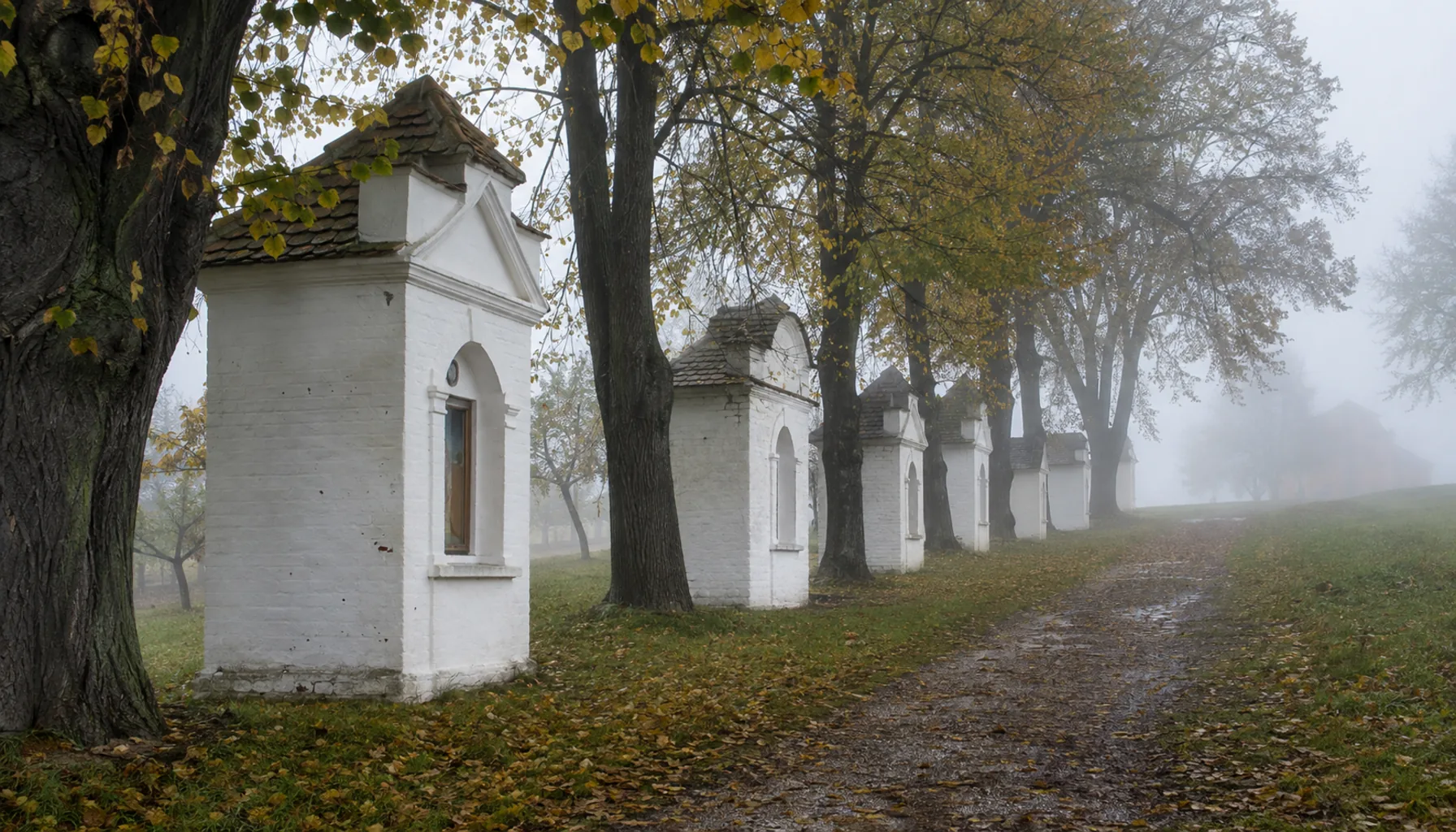
The whitewashed eighteenth-century Calvary chapels on the edge of Nové Zámky on an autumn morning.Obielené kaplnky kalvárie z 18. storočia na okraji Nových Zámkov v jesenné ráno.
The year in Nové ZámkyRok v Nových Zámkoch
The town's own anniversary belongs to a parish priest. Anton Bernolák arrived here in May 1797 and stayed until he died in the town on 15 January 1813. Ten years before he came he had written down a set of rules for a Slovak written language, so that Slovak could be printed and taught; his enormous five-language dictionary was unfinished at his death and published afterwards. The square in the middle of the town carries his name and his monument.Vlastné výročie patrí v tomto meste farárovi. Anton Bernolák sem prišiel v máji 1797 a zostal až do svojej smrti 15. januára 1813. Desať rokov predtým zapísal pravidlá spisovnej slovenčiny, aby sa dalo po slovensky tlačiť a učiť; jeho obrovský päťjazyčný slovník zostal pri jeho smrti nedokončený a vyšiel neskôr. Námestie v strede mesta nesie jeho meno aj jeho pomník.
The rest of the calendar is a district town's: fairs and markets, a town day, church feasts, outdoor programme in the warm months, and a Christmas market. We give no titles or dates, because they are set a season at a time and the town's own listings are the ones worth reading.Zvyšok kalendára je kalendárom okresného mesta: jarmoky a trhy, dni mesta, cirkevné sviatky, vonkajší program v teplých mesiacoch a vianočné trhy. Názvy ani termíny tu neuvádzame — určujú sa od sezóny k sezóne a čítať sa oplatí mestský program.
Summer here has a fixed address. The town's thermal swimming complex draws on the same hot-water aquifer that supplies the spas along the Danube, and it is a season and an economy in itself: the flat country around offers no lake, no hill and no forest, so the water people spend their summers in came out of a borehole.Leto má tu pevnú adresu. Mestské termálne kúpalisko čerpá z tej istej zásoby horúcej vody, ktorá napája kúpele pozdĺž Dunaja, a je samo osebe sezónou aj hospodárstvom: rovina naokolo neponúka ani jazero, ani kopec, ani les, takže voda, v ktorej tu ľudia trávia leto, prišla z vrtu.
Where culture livesKde žije kultúra
The Thain House, a merchant house on the main square, holds the town museum; in a town whose principal monument was demolished three hundred years ago it does more work than a museum usually has to. Alongside it the infrastructure is the standard Slovak set: a cultural centre with a hall and a programme, a public library, amateur choirs and ensembles, and a school of art for children. We name none of them, because premises and programmes change faster than a page like this does.Thainov dom, meštiansky dom na hlavnom námestí, ukrýva mestské múzeum; v meste, ktorého hlavná pamiatka bola pred tristo rokmi zbúraná, má viac práce než býva zvykom. Popri ňom je tu štandardná slovenská výbava: kultúrne stredisko so sálou a programom, mestská knižnica, amatérske zbory a súbory a základná umelecká škola pre deti. Menovite ich neuvádzame, priestory a programy sa menia rýchlejšie než takáto stránka.
Slovak and Hungarian are both everyday languages here, and the town's older name, Érsekújvár — the archbishop's new castle — records who paid for the fortress that made the place. Any programme worth the name is put on in both, which is how the town works rather than a policy anyone announced.Bežne sa tu hovorí po slovensky aj po maďarsky a staršie meno mesta, Érsekújvár — arcibiskupov nový hrad — hovorí, kto zaplatil pevnosť, z ktorej mesto vzniklo. Program, ktorý za niečo stojí, sa robí v oboch jazykoch; nie je to vyhlásená politika, len spôsob, akým mesto funguje.
The buildings that carry itBudovy, ktoré ju nesú
Two buildings are worth going inside: the Franciscan church and monastery, and the parish Church of the Exaltation of the Holy Cross. On the edge of the centre the Calvary is a quiet piece of eighteenth-century devotional landscape — a hillside walk built as a sequence of stations, not one monument.Dovnútra sa oplatí vojsť v dvoch stavbách: vo františkánskom kostole s kláštorom a vo farskom Kostole Povýšenia svätého Kríža. Na okraji centra je Kalvária, tichý kus zbožnej krajiny osemnásteho storočia — prechádzka po svahu poskladaná zo zastavení, nie jediný pomník.
Almost everything else is younger than 1945, and there is a reason. The railway junction that made the town rich also made it a target: three heavy Allied air raids, the first on 7 October 1944 and the worst on 14 March 1945, destroyed roughly two thirds of the buildings, and Slovak accounts call it the most heavily bombed town in the country. The number of dead is disputed and different sources give different figures, which is worth saying rather than picking one.Takmer všetko ostatné je mladšie než rok 1945 a má to svoj dôvod. Železničný uzol, ktorý mesto obohatil, z neho urobil aj cieľ: tri ťažké spojenecké nálety, prvý 7. októbra 1944 a najhorší 14. marca 1945, zničili zhruba dve tretiny zástavby a slovenské pramene mesto označujú za najviac bombardované v krajine. Počet obetí je sporný a pramene sa v ňom rozchádzajú, čo je poctivejšie povedať než si jedno číslo vybrať.
So a town founded in the sixteenth century has a centre that looks as though it was built in the 1950s, because it was. The compensation is the street plan. The six-pointed outline of the vanished fortress still shows in the streets of the centre, and Nové Zámky is one of the few places in Slovakia where a building that is completely gone can be read straight off a map.Mesto založené v šestnástom storočí tak má centrum, ktoré vyzerá ako z päťdesiatych rokov — pretože z nich je. Náhradou je pôdorys. Šesťcípy obrys zaniknutej pevnosti dodnes presvitá v uliciach centra a Nové Zámky sú jedným z mála miest na Slovensku, kde sa úplne zaniknutá stavba dá prečítať priamo z mapy.
The fortress its own government pulled downPevnosť, ktorú zbúrala vlastná vláda
After the Ottomans destroyed the Hungarian army at Mohács in 1526 and took Esztergom, nothing stood between the open lowland along the Nitra and the Ottoman garrisons on the Danube. A first fort was thrown up in 1545-46, and everyone involved knew it was not strong enough. Between 1573 and 1580 an entirely new fortress went up on the other bank, paid for by Archbishop Anton Vrančič and designed by the Italian brothers Ottavio and Giulio Baldigara: a six-pointed star with a bastion at every point, its ramparts low, thick and of earth to swallow a cannonball rather than shatter. It was finished on 2 October 1580.Keď Osmani v roku 1526 zničili pri Moháči uhorské vojsko a dobyli Ostrihom, medzi otvorenou rovinou pri Nitre a osmanskými posádkami na Dunaji už nestálo nič. Prvá pevnôstka tu vyrástla v rokoch 1545 – 1546 a všetci vedeli, že nestačí. V rokoch 1573 až 1580 postavili na druhom brehu úplne novú pevnosť, ktorú zaplatil arcibiskup Anton Vrančič a navrhli talianski bratia Ottavio a Giulio Baldigarovci: šesťcípu hviezdu s bastiónom v každom cípe a s nízkymi, hrubými zemnými valmi, ktoré delovú guľu pohltia namiesto toho, aby sa rozsypali. Dokončili ju 2. októbra 1580.
It held the line for eighty years. On 18 August 1663 the grand vizier Köprülü Fazıl Ahmed brought the main Ottoman army up to the walls, and after five weeks of bombardment and mining the garrison marched out on 24 September; the town then spent twenty-two years as the seat of a pasha's province, the northernmost the Ottoman Empire ever held in Central Europe. The imperial army stormed it back on 19 August 1685, and in 1691 the archbishop granted the settlement under the walls the privileges of a town. Then the kuruc of Francis II Rákóczi took the fortress on 16 November 1704 and held it until September 1710.Osemdesiat rokov držala líniu. 18. augusta 1663 privliekol veľkovezír Köprülü Fazıl Ahmed pod hradby hlavné osmanské vojsko a po piatich týždňoch bombardovania a podkopov posádka 24. septembra odtiahla; mesto potom dvadsaťdva rokov bolo sídlom pašovho ejáletu, najsevernejšej provincie, akú kedy Osmanská ríša v strednej Európe držala. Cisárske vojsko ho 19. augusta 1685 dobylo útokom späť a v roku 1691 udelil arcibiskup osade pod hradbami mestské výsady. Potom pevnosť 16. novembra 1704 obsadili kuruci Františka II. Rákócziho a držali ju až do septembra 1710.
That decided its fate. In fifty years Vienna had watched the best border fortress in the kingdom used against it twice, so Emperor Charles VI ordered it razed, and the work was done in 1724-25. The reason given was blunt: a fortress that strong was a ready-made base for the next rebellion. Remember it whenever you hear that some Slovak castle was destroyed by the Turks. Nové Zámky survived the Ottomans; what it did not survive was its own government.Práve to rozhodlo o jej osude. Viedeň za päťdesiat rokov dvakrát videla, ako sa najlepšia pohraničná pevnosť kráľovstva obracia proti nej, a tak cisár Karol VI. nariadil jej zbúranie; vykonali ho v rokoch 1724 – 1725. Dôvod bol povedaný priamo: taká silná pevnosť je hotovou základňou pre ďalšie povstanie. Spomeňte si na to vždy, keď počujete, že ten či onen slovenský hrad zničili Turci. Nové Zámky Osmanov prežili; neprežili vlastnú vládu.