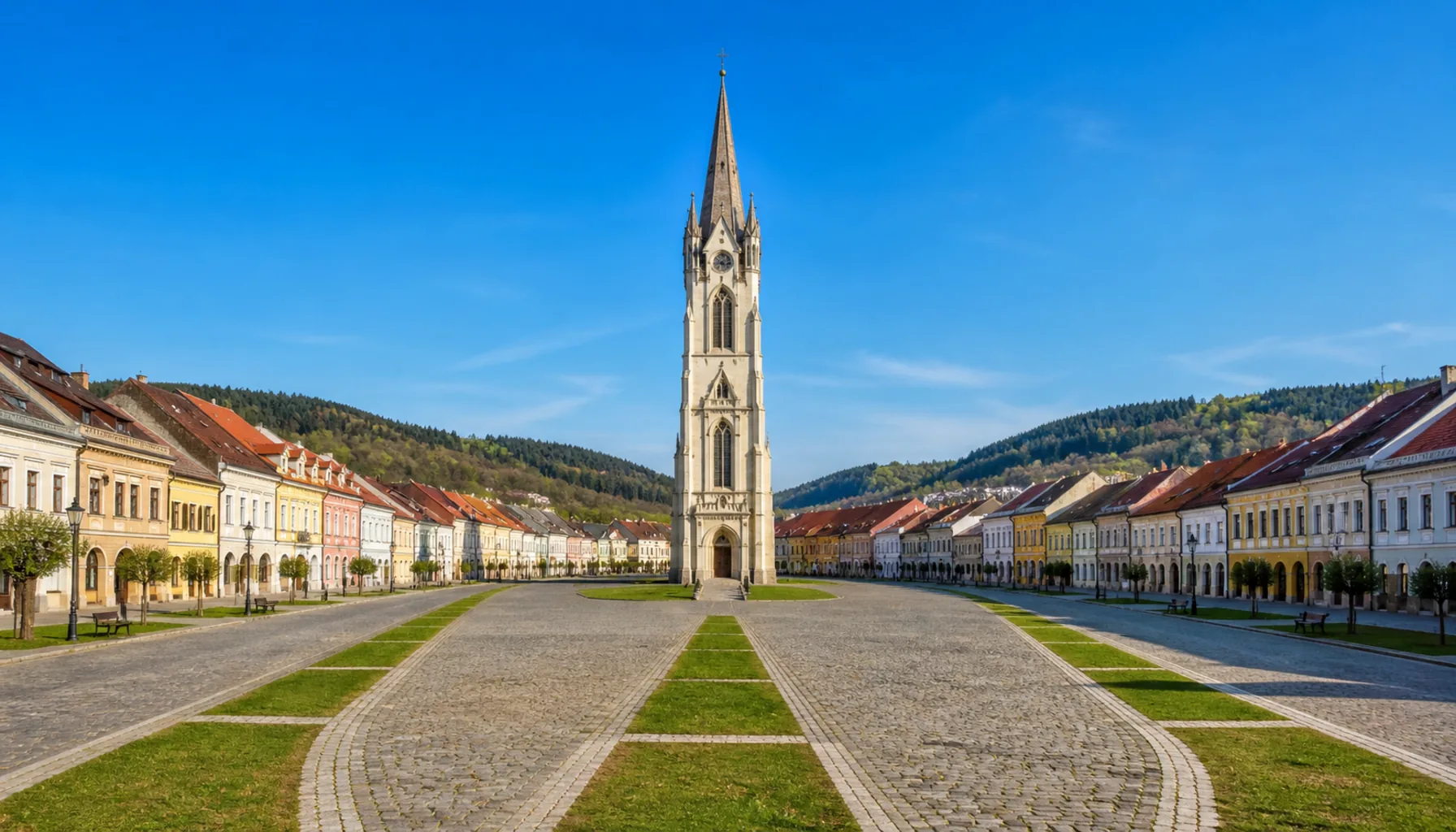
A Spiš town built around what is commonly called the longest lens-shaped square in Europe, with the tallest church tower in Slovakia standing in the middle of it and the gorges of the Slovak Paradise beginning in the woods a few kilometres up the valley.Spišské mesto vystavané okolo šošovkovitého námestia, ktoré býva označované za najdlhšie v Európe, s najvyššou kostolnou vežou na Slovensku uprostred a s roklinami Slovenského raja, ktoré sa začínajú v lesoch pár kilometrov dolinou.
The long lens-shaped square of Spisska Nova Ves and the tower of its Gothic churchDlhé šošovkovité námestie Spišskej Novej Vsi a veža jej gotického kostola
Where it standsKde leží
Spišská Nová Ves lies on the Hornád in the basin of the same name, between the Slovak Ore Mountains to the south and the Levoča Hills to the north. Poprad and the High Tatras are about thirty kilometres west; Košice is some eighty kilometres away by road to the south-east.Spišská Nová Ves leží na Hornáde v rovnomennej kotline, medzi Slovenským rudohorím na juhu a Levočskými vrchmi na severe. Poprad a Vysoké Tatry sú asi tridsať kilometrov na západ, Košice po ceste zhruba osemdesiat kilometrov na juhovýchod.
It is the largest town of the Spiš and the practical base for the Slovak Paradise National Park, whose entrance at Čingov is only a few kilometres up the valley from the last houses.Je najväčším mestom Spiša a praktickým východiskom do Národného parku Slovenský raj, ktorého vstup na Čingove je len pár kilometrov dolinou od posledných domov.
The storyHistória
German settlers were brought into the Spiš in the twelfth and thirteenth centuries to work the ore and the land, and the new village — the name means exactly that — was one of their foundations. It joined the association of Spiš towns and lived on mining, metalworking and trade.Nemeckých osadníkov priviedli na Spiš v 12. a 13. storočí, aby ťažili rudu a obrábali pôdu, a nová ves — meno hovorí presne to — bola jednou z ich osád. Pripojila sa k spolku spišských miest a žila z baníctva, spracovania kovov a obchodu.
In 1412 Sigismund of Luxembourg pledged sixteen Spiš towns, this one among them, to the Polish crown to raise money for a war. The pledge went unredeemed for three hundred and sixty years: the towns were administered from Poland until 1772, which is why the Spiš developed as a distinct legal and cultural island inside the kingdom.V roku 1412 dal Žigmund Luxemburský šestnásť spišských miest — medzi nimi aj toto — do zálohy poľskej korune, aby získal peniaze na vojnu. Záloh nikto tristošesťdesiat rokov nevyplatil: mestá spravovalo Poľsko až do roku 1772, a práve preto sa Spiš vyvíjal ako svojbytný právny a kultúrny ostrov vnútri kráľovstva.
Copper and iron from the surrounding mountains were traded and worked here for centuries, and the town kept its metalworking trades — bell-founding among them — long after the richest seams had gone. The railway through the Hornád valley, built in the nineteenth century, fixed the town's position as the centre of the region.Meď a železo z okolitých hôr sa tu po stáročia obchodovali a spracúvali a mesto si udržalo kovospracujúce remeslá — vrátane zvonolejárstva — dlho po tom, čo najbohatšie žily došli. Železnica dolinou Hornádu, postavená v 19. storočí, potvrdila jeho postavenie centra regiónu.
What to seeČo vidieť
The square is the town. It is a lens in plan — wide in the middle, tapering at both ends — and it runs for about a kilometre, which is why it is commonly called the longest of its shape in Europe. Burgher houses line both long sides; the buildings standing in the middle are the church, the town hall and the theatre.Námestie je celé mesto. Pôdorysne je to šošovka — v strede široká, na oboch koncoch zúžená — a tiahne sa zhruba kilometer, preto býva označované za najdlhšie námestie svojho tvaru v Európe. Obe dlhé strany lemujú meštianske domy, uprostred stoja kostol, radnica a divadlo.
The Gothic Church of the Assumption carries a tower 87 metres high, the tallest church tower in Slovakia; it is open to climb in season and the view takes in the whole square and the ring of mountains. Beside it stands the Reduta, an ornate building of the turn of the twentieth century that houses the Spiš Theatre, and the Spiš Museum on the square covers the region's history.Gotický Kostol Nanebovzatia Panny Márie nesie vežu vysokú 87 metrov — najvyššiu kostolnú vežu na Slovensku; v sezóne sa dá vystúpiť hore a výhľad obsiahne celé námestie aj veniec hôr. Vedľa stojí Reduta, zdobná budova z prelomu 19. a 20. storočia so Spišským divadlom, a na námestí sídli aj Múzeum Spiša s dejinami regiónu.
The Slovak Paradise is why most visitors come: gorges with ladders and log steps, waterfalls, and one-way routes that may only be walked uphill. Markušovce, a few kilometres east, has a manor house and the Dardanely rococo pavilion, both museum interiors and both better options in bad weather.Slovenský raj je dôvodom, prečo sem väčšina návštevníkov prichádza: rokliny s rebríkmi a drevenými stupňami, vodopády a jednosmerné trasy, ktoré sa smú prechádzať len smerom nahor. Markušovce pár kilometrov na východ majú kaštieľ a rokokový letohrádok Dardanely — oba sú múzejnými interiérmi a oba lepšou voľbou za zlého počasia.
Work and industryPráca a priemysel
Mining ended, and the town rebuilt its economy on engineering, electrical manufacturing and services, a good deal of it now supplying the car plants further west. Tourism is the other pillar, concentrated in summer and almost entirely dependent on the national park.Baníctvo skončilo a mesto postavilo hospodárstvo nanovo — na strojárstve, elektrotechnickej výrobe a službách, z ktorých nemalá časť dnes dodáva pre automobilky na západe. Druhou oporou je cestovný ruch, sústredený do leta a takmer úplne závislý od národného parku.
The Spiš has struggled with unemployment since the mines and the state enterprises contracted, and the district's fortunes remain uneven from village to village. The town itself is the administrative and hospital centre for a wide area, which steadies it.Spiš zápasí s nezamestnanosťou od čias, keď sa bane a štátne podniky zmenšili, a osudy okresu sú dodnes obec od obce nerovnaké. Samotné mesto je administratívnym a nemocničným centrom širokého okolia, čo mu dodáva stabilitu.
Getting thereAko sa tam dostať
Spišská Nová Ves is a stop on the main railway between Košice and Žilina, so it has fast trains in both directions; in season buses run from the station to Čingov and the other park entrances. By car it is reached from the motorway corridor between Poprad and Prešov, or up the Hornád valley from the east.Spišská Nová Ves je zastávkou na hlavnej trati medzi Košicami a Žilinou, takže má rýchliky v oboch smeroch; v sezóne premávajú od stanice autobusy na Čingov a k ďalším vstupom do parku. Autom sa sem dá prísť z diaľničného koridoru Poprad – Prešov alebo dolinou Hornádu od východu.
Explore Spišská Nová VesObjavujte Spišská Nová Ves
Every part of this place with a page of its own.Každá časť tohto miesta, ktorá má vlastnú stránku.