Sobrance · Under the VihorlatSobrance · Pod Vihorlatom
The last town before the frontier keeps a modest calendar of its own; what people come for is out in the district — a lake in the forest, a wooden church that is kept locked, and beech woods left alone.Posledné mesto pred hranicou si vedie vlastný skromný kalendár; to, za čím sem ľudia chodia, je v okrese — jazero v lese, drevený kostolík, ktorý sa drží zamknutý, a bučiny ponechané na pokoji.
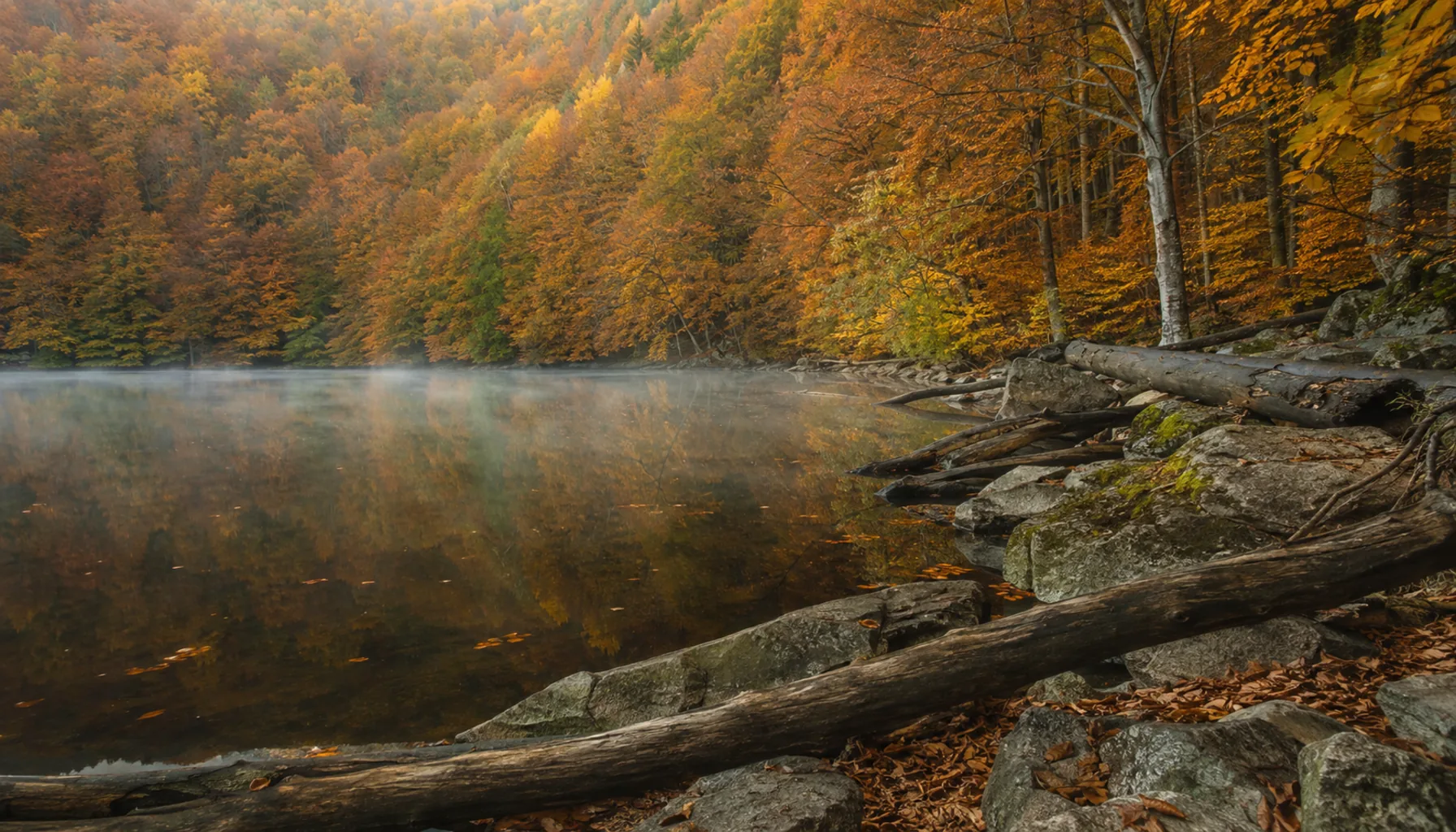
The visiting year here is short and outdoors. Morské oko, the volcanic lake held in the forest of the Vihorlat above Remetské Hámre, is walked to from the road and has nothing built on its shore, which makes it a summer and autumn place; the beech woods around it colour late. In winter the district is quiet and the forest roads are not a promise.Návštevnícky rok je tu krátky a vonkajší. K Morskému oku, sopečnému jazeru v lesoch Vihorlatu nad Remetskými Hámrami, sa chodí pešo od cesty a na brehu nestojí nič — je to teda miesto na leto a jeseň; buky okolo neho farbia neskoro. V zime je okres tichý a lesné cesty nie sú istota.
The wooden church at Ruská Bystrá is the other reason to come, and it is locked outside arranged visits. That is not inhospitality — it is how every one of the wooden churches of eastern Slovakia is kept — but it means a visit has to be arranged in advance. An unarranged drive out there is a look at the outside of the building.Druhým dôvodom na cestu je drevený kostolík v Ruskej Bystrej — a ten je mimo dohodnutých návštev zamknutý. Nie je to nehostinnosť, takto sa strážia všetky drevené kostolíky východného Slovenska, ale znamená to, že návštevu treba dohodnúť vopred. Nedohodnutá cesta je prehliadkou vonkajška.
In the town itself the year is the year of a small district seat: town celebrations in the warm months, a church calendar that in this corner runs in two Catholic rites, school and club fixtures, and whatever the cultural centre has in its hall. We list no names and no dates, because they change.V samotnom meste je rok rokom malého okresného sídla: mestské oslavy v teplých mesiacoch, cirkevný kalendár, ktorý v tomto kúte beží v dvoch katolíckych obradoch, školské a spolkové termíny a to, čo má kultúrny dom v sále. Názvy ani dátumy neuvádzame, lebo sa menia.
Sobrance lost its district status after the war and got it back only in 1996, and its institutions are about what that implies: a cultural centre with a hall and a programme, a library, a school of art for children, amateur groups and church choirs. We name none of them, because premises and programmes change faster than a page like this does.Sobrance stratili po vojne postavenie okresného mesta a získali ho späť až v roku 1996 — a inštitúcie tomu zodpovedajú: kultúrny dom so sálou a programom, knižnica, základná umelecká škola, amatérske súbory a chrámové zbory. Menovite ich neuvádzame, lebo priestory aj programy sa menia rýchlejšie než takáto stránka.
There is no museum of any size in the town. The nearest is at Michalovce, thirty kilometres west, which is also where the district goes for a cinema or a concert. Anything on in the town's own hall is worth checking on the day rather than in advance.Múzeum väčšieho formátu v meste nie je. Najbližšie je v Michalovciach tridsať kilometrov na západ, kam sa z okresu chodí aj do kina či na koncert. Čo je práve v mestskej sále, oplatí sa overiť si v ten deň, nie dopredu.
What the district has instead of institutions is protected landscape, and it is administered rather than programmed. The old-growth beech reserves of the Vihorlat belong to the transnational World Heritage listing of ancient beech forests: unmanaged woodland, restricted access in places, and paths that should be kept to. Those are the terms of the visit, not small print.Namiesto inštitúcií má okres chránenú krajinu — a tá sa skôr spravuje, než programuje. Pralesovité bučiny Vihorlatu patria do medzinárodného zápisu starých bukových lesov vo svetovom dedičstve: neobhospodarovaný les, miestami obmedzený prístup a chodníky, z ktorých sa nemá schádzať. To sú podmienky návštevy, nie drobné písmo.
The town is a square, a church and a row of offices — a market settlement that never grew into anything larger, and one whose own starting date is disputed: some read the first mention as a market document of 1284, while the historian Ferdinand Uličný puts the first reliable mention of Sobrance itself at 1409. There is no castle either, because the stone castles the kingdom built after the Mongol invasion of 1241 needed defensible rock, and there is none here.Mesto je námestie, kostol a rad úradov — trhová osada, ktorá nikdy nevyrástla do niečoho väčšieho a ktorej vlastný počiatočný dátum je sporný: jedni čítajú prvú zmienku v trhovej listine z roku 1284, historik Ferdinand Uličný kladie prvú spoľahlivú zmienku o samotných Sobranciach až do roku 1409. Nie je tu ani hrad, lebo kamenné hrady, ktoré kráľovstvo stavalo po mongolskom vpáde roku 1241, potrebovali brániteľnú skalu — a tá tu nie je.
The district's one building of international rank is at Ruská Bystrá, in the hills to the north-east: a small Greek Catholic church built of logs in the eighteenth century, shingled, in the three-part plan these churches share, on the UNESCO list since 2008 with the other wooden churches of the Slovak Carpathians. A village built it, out of the material a village had, for a rite that came from the east.Jediná stavba okresu medzinárodného významu je v Ruskej Bystrej, v kopcoch na severovýchod: malý gréckokatolícky kostolík zrubený z dreva v osemnástom storočí, pokrytý šindľom, v trojdielnom pôdoryse, aký majú tieto stavby spoločný, od roku 2008 na zozname UNESCO spolu s ostatnými drevenými kostolmi slovenských Karpát. Postavila ho dedina z materiálu, ktorý mala, pre obrad, ktorý prišiel z východu.
That the town has no great church and no grand town hall is administrative rather than accidental. Sobrance belonged to Ung county, whose seat was Ungvár — today Uzhhorod, in Ukraine, and closer to here than Košice. The money, the offices and the records were east of the town for nine hundred years; the frontier that put them in another country was drawn in the twentieth century.Že v meste nie je veľký kostol ani honosná radnica, má správny dôvod, nie náhodný. Sobrance patrili do Užskej stolice, ktorej sídlom bol Ungvár — dnešný Užhorod na Ukrajine, odtiaľto bližšie než Košice. Peniaze, úrady aj matriky boli deväťsto rokov na východ od mesta; hranica, ktorá ich postavila do inej krajiny, sa nakreslila v dvadsiatom storočí.
North of the town, at the foot of the Vihorlat, sulphur springs were developed into a bathing resort, the Sobranecké kúpele. In the age when going to the baths was what the middle classes did with a summer, that spa was the one thing that brought outsiders to this district, and for a few decades it put a small market town on a list with much grander places.Severne od mesta, na úpätí Vihorlatu, boli sírne pramene rozvinuté na kúpele — Sobranecké kúpele. V čase, keď bolo chodenie do kúpeľov tým, čo stredné vrstvy robili s letom, boli práve ony jedinou vecou, ktorá do okresu privádzala cudzích, a na pár desaťročí dostali malé trhové mesto na zoznam s oveľa honosnejšími miestami.
Their best years ended with the First World War, and after a century of closures and half-restarts the buildings stand largely abandoned. We give no season, no prices and no telephone number, for exactly that reason: check what is open before planning anything around them. What has not changed is the water and the setting that brought the spa here.Ich najlepšie roky sa skončili s prvou svetovou vojnou a po storočí zatváraní a polovičných obnov dnes budovy stoja z veľkej časti opustené. Práve preto tu neuvádzame ani sezónu, ani ceny, ani telefón: skôr než okolo nich niečo naplánujete, overte si, čo je vôbec otvorené. Nezmenilo sa to, čo kúpele sem privábilo — voda a poloha.
Sixteen videos for Culture in Sobrance.Šestnásť videí — Kultúra v Sobranciach.