867 – 885A licence from Rome, and a bishop at NitraPovolenie z Ríma a biskup v Nitre
SlovakiaSlovensko
A licence from Rome, and a bishop at NitraPovolenie z Ríma a biskup v Nitre
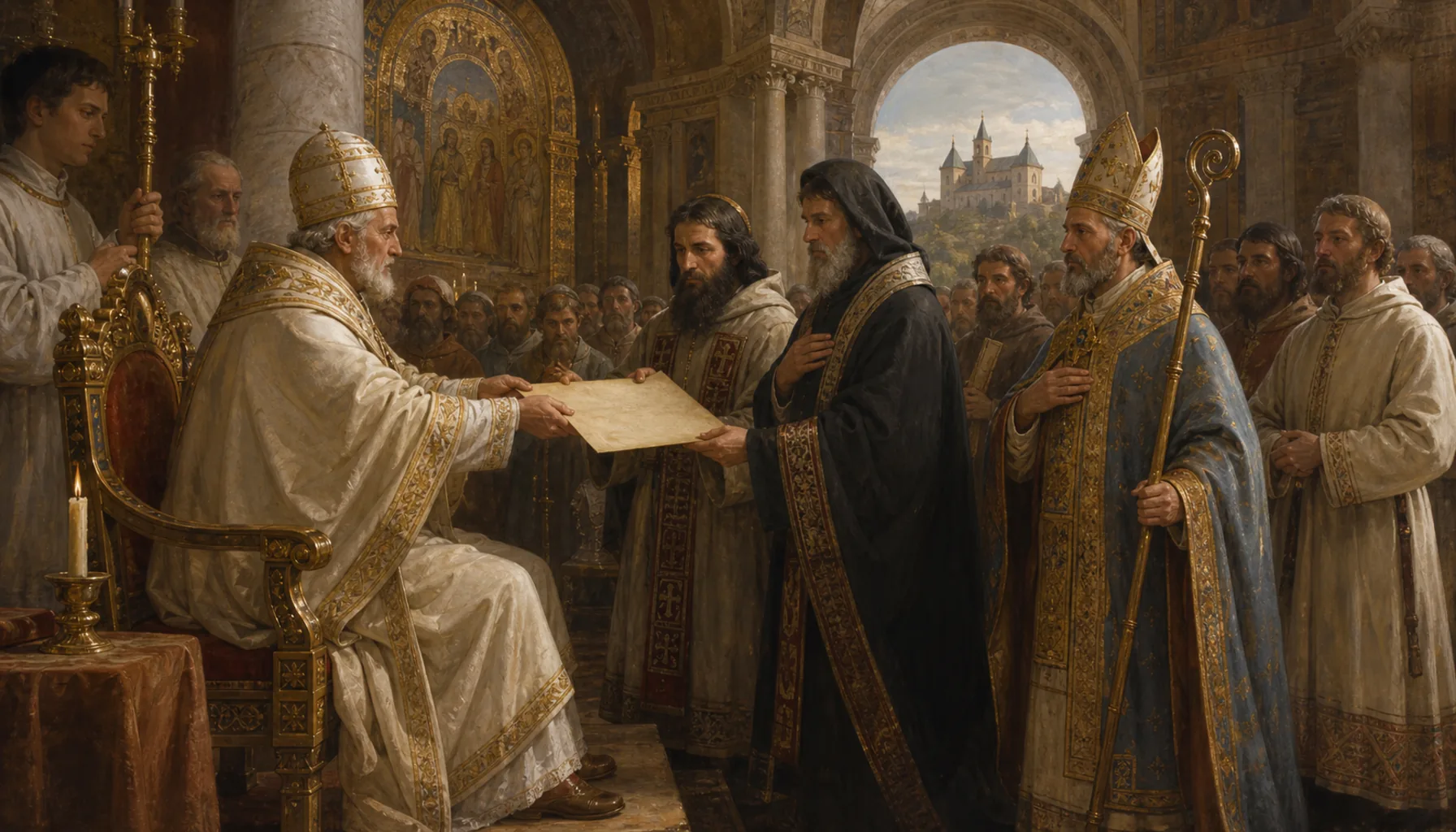
The mission ran into a firm conviction that only Latin, Greek and Hebrew were fit languages for worship, so the brothers took their case to Rome, and in 868 the pope approved the Slavonic liturgy — Old Church Slavonic became the fourth liturgical language of Christian Europe. Constantine died in Rome in 869, shortly after entering a monastery and taking the name Cyril. Methodius was made an archbishop, then jailed for two and a half years by Bavarian bishops who wanted him out of the way, and was freed only when the pope intervened. In 880 a papal bull confirmed the Slavonic liturgy again and founded a bishopric at Nitra — the first bishopric of the Western and Eastern Slavs, and, refounded early in the 1100s, the oldest diocese in Slovakia today. When Methodius died in 885 his opponents won: his pupils were driven out of the country and carried the alphabet and the books south to Bulgaria, where Cyrillic — named after Cyril — grew out of their work.Misia narazila na pevné presvedčenie, že bohoslužobným jazykom môže byť len latinčina, gréčtina a hebrejčina, a tak si bratia išli po povolenie priamo do Ríma; pápež roku 868 slovanskú liturgiu schválil a staroslovienčina sa stala štvrtým bohoslužobným jazykom kresťanskej Európy. Konštantín zomrel v Ríme roku 869, krátko po tom, čo vstúpil do kláštora a prijal meno Cyril. Metoda vymenovali za arcibiskupa, bavorskí biskupi ho však na dva a pol roka uväznili a prepustili ho až na zásah pápeža. Roku 880 pápežská bula znova potvrdila slovanskú liturgiu a založila biskupstvo v Nitre — prvé biskupstvo západných a východných Slovanov a po obnovení začiatkom 12. storočia najstaršiu diecézu na Slovensku. Keď Metod roku 885 zomrel, jeho odporcovia zvíťazili: žiakov vyhnali z krajiny a tí odniesli písmo aj knihy na juh do Bulharska, kde z ich práce vyrástla cyrilika, pomenovaná po Cyrilovi.
ReferencesZdroje
Where this came fromOdkiaľ to pochádza
Sources consulted while researching this page. Follow them to read further — and to check us.Zdroje, z ktorých sme pri príprave tejto stránky vychádzali. Kliknite a čítajte ďalej — aj si nás overte.
Černová massacre — Wikipediadate, 15 killed and 12 seriously wounded, gendarmes' own nationalitydate, 15 killed and 12 seriously wounded, gendarmes' own nationality
Magyarization — Wikipediathe 1907 Apponyi education laws, the closing of the Slovak grammar schools and of Matica slovenská in April 1875the 1907 Apponyi education laws, the closing of the Slovak grammar schools and of Matica slovenská in April 1875
Žiadosti slovenského národa — Wikipédia10 May 1848, fourteen points, the arrest warrants of May–June 184810 May 1848, fourteen points, the arrest warrants of May–June 1848
Slovak Uprising of 1848–49 — Wikipediathe three volunteer campaigns and the disbanding of the corps on 21 November 1849the three volunteer campaigns and the disbanding of the corps on 21 November 1849
Pittsburgh Agreement — Wikipediathe Cleveland Agreement of 22 October 1915 and the text of the Pittsburgh promisesthe Cleveland Agreement of 22 October 1915 and the text of the Pittsburgh promises
Slovak–Hungarian War — Wikipediathe 'Little War' of March 1939 and the 1,697 km² ceded on 4 April 1939the 'Little War' of March 1939 and the 1,697 km² ceded on 4 April 1939
Slovak National Uprising — Wikipediainsurgent numbers, territory held, the fall of Banská Bystrica on 27 October 1944insurgent numbers, territory held, the fall of Banská Bystrica on 27 October 1944
Kremnička and Nemecká massacres — Wikipedia747 victims at Kremnička, about 900 at Nemecká, the units responsible747 victims at Kremnička, about 900 at Nemecká, the units responsible
Masaker v Kľakovskej doline — Wikipédia21 January 1945, 148 civilians including 48 children under eighteen21 January 1945, 148 civilians including 48 children under eighteen
Battle of the Dukla Pass — Wikipedia8 September – 28 October 1944 and the casualty figures8 September – 28 October 1944 and the casualty figures
Kalinov — Wikipédiathe first village in Slovakia liberated, 21 September 1944the first village in Slovakia liberated, 21 September 1944
Slovak Greek Catholic Church — Wikipediathe staged Prešov assembly of April 1950, Bishop Gojdič, the 1968 restorationthe staged Prešov assembly of April 1950, Bishop Gojdič, the 1968 restoration