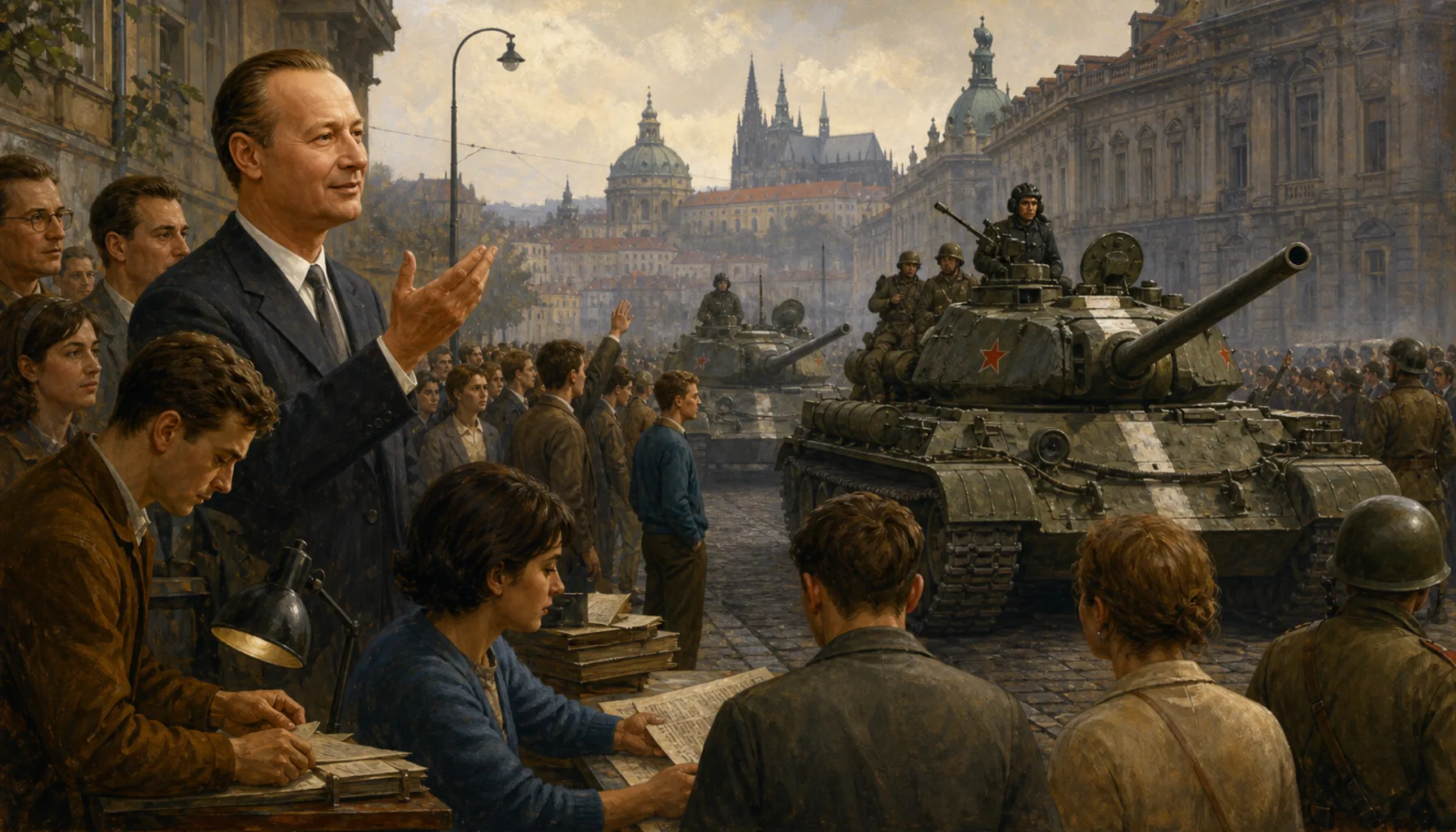
1968 – 1969Prague Spring, tanks, and the one reform that survivedPražská jar, tanky a jediná reforma, ktorá prežila
SlovakiaSlovensko
Prague Spring, tanks, and the one reform that survivedPražská jar, tanky a jediná reforma, ktorá prežila
In January 1968 the Slovak communist Alexander Dubček became the country's leader and tried to make the system bearable: censorship lifted, the victims of the 1950s rehabilitated, 'socialism with a human face'. Moscow watched for eight months. On the night of 20–21 August 1968 the armies of the Warsaw Pact invaded, some 200,000 troops in the first wave; in Bratislava soldiers fired on crowds and a young woman, Danka Košanová, was shot dead. Twenty years of 'normalisation' followed — reformers expelled from the party, hundreds of thousands pushed out of their jobs, Dubček himself ending up working for a forestry enterprise. One reform did survive, because Moscow saw no harm in it: the constitutional law adopted on 27 October 1968 turned the state into a federation of a Czech and a Slovak republic from 1 January 1969, and the Greek Catholic Church was allowed to exist again in the same year.V januári 1968 sa slovenský komunista Alexander Dubček postavil na čelo štátu a pokúsil sa systém urobiť znesiteľným: zrušil cenzúru, rehabilitoval obete päťdesiatych rokov, hovorilo sa o „socializme s ľudskou tvárou“. Moskva to sledovala osem mesiacov. V noci z 20. na 21. augusta 1968 vtrhli do krajiny armády Varšavskej zmluvy, v prvej vlne asi 200 000 vojakov; v Bratislave strieľali vojaci do ľudí a mladá žena Danka Košanová pritom zahynula. Nasledovalo dvadsať rokov „normalizácie“ — reformátorov vyhodili zo strany, státisíce ľudí prišli o prácu a sám Dubček skončil ako zamestnanec lesného závodu. Jedna reforma však prežila, lebo Moskve neprekážala: ústavný zákon prijatý 27. októbra 1968 zmenil od 1. januára 1969 štát na federáciu českej a slovenskej republiky a v tom istom roku smela znova existovať aj gréckokatolícka cirkev.
ReferencesZdroje
Where this came fromOdkiaľ to pochádza
Sources consulted while researching this page. Follow them to read further — and to check us.Zdroje, z ktorých sme pri príprave tejto stránky vychádzali. Kliknite a čítajte ďalej — aj si nás overte.
Černová massacre — Wikipediadate, 15 killed and 12 seriously wounded, gendarmes' own nationalitydate, 15 killed and 12 seriously wounded, gendarmes' own nationality
Magyarization — Wikipediathe 1907 Apponyi education laws, the closing of the Slovak grammar schools and of Matica slovenská in April 1875the 1907 Apponyi education laws, the closing of the Slovak grammar schools and of Matica slovenská in April 1875
Žiadosti slovenského národa — Wikipédia10 May 1848, fourteen points, the arrest warrants of May–June 184810 May 1848, fourteen points, the arrest warrants of May–June 1848
Slovak Uprising of 1848–49 — Wikipediathe three volunteer campaigns and the disbanding of the corps on 21 November 1849the three volunteer campaigns and the disbanding of the corps on 21 November 1849
Pittsburgh Agreement — Wikipediathe Cleveland Agreement of 22 October 1915 and the text of the Pittsburgh promisesthe Cleveland Agreement of 22 October 1915 and the text of the Pittsburgh promises
Slovak–Hungarian War — Wikipediathe 'Little War' of March 1939 and the 1,697 km² ceded on 4 April 1939the 'Little War' of March 1939 and the 1,697 km² ceded on 4 April 1939
Slovak National Uprising — Wikipediainsurgent numbers, territory held, the fall of Banská Bystrica on 27 October 1944insurgent numbers, territory held, the fall of Banská Bystrica on 27 October 1944
Kremnička and Nemecká massacres — Wikipedia747 victims at Kremnička, about 900 at Nemecká, the units responsible747 victims at Kremnička, about 900 at Nemecká, the units responsible
Masaker v Kľakovskej doline — Wikipédia21 January 1945, 148 civilians including 48 children under eighteen21 January 1945, 148 civilians including 48 children under eighteen
Battle of the Dukla Pass — Wikipedia8 September – 28 October 1944 and the casualty figures8 September – 28 October 1944 and the casualty figures
Kalinov — Wikipédiathe first village in Slovakia liberated, 21 September 1944the first village in Slovakia liberated, 21 September 1944
Slovak Greek Catholic Church — Wikipediathe staged Prešov assembly of April 1950, Bishop Gojdič, the 1968 restorationthe staged Prešov assembly of April 1950, Bishop Gojdič, the 1968 restoration