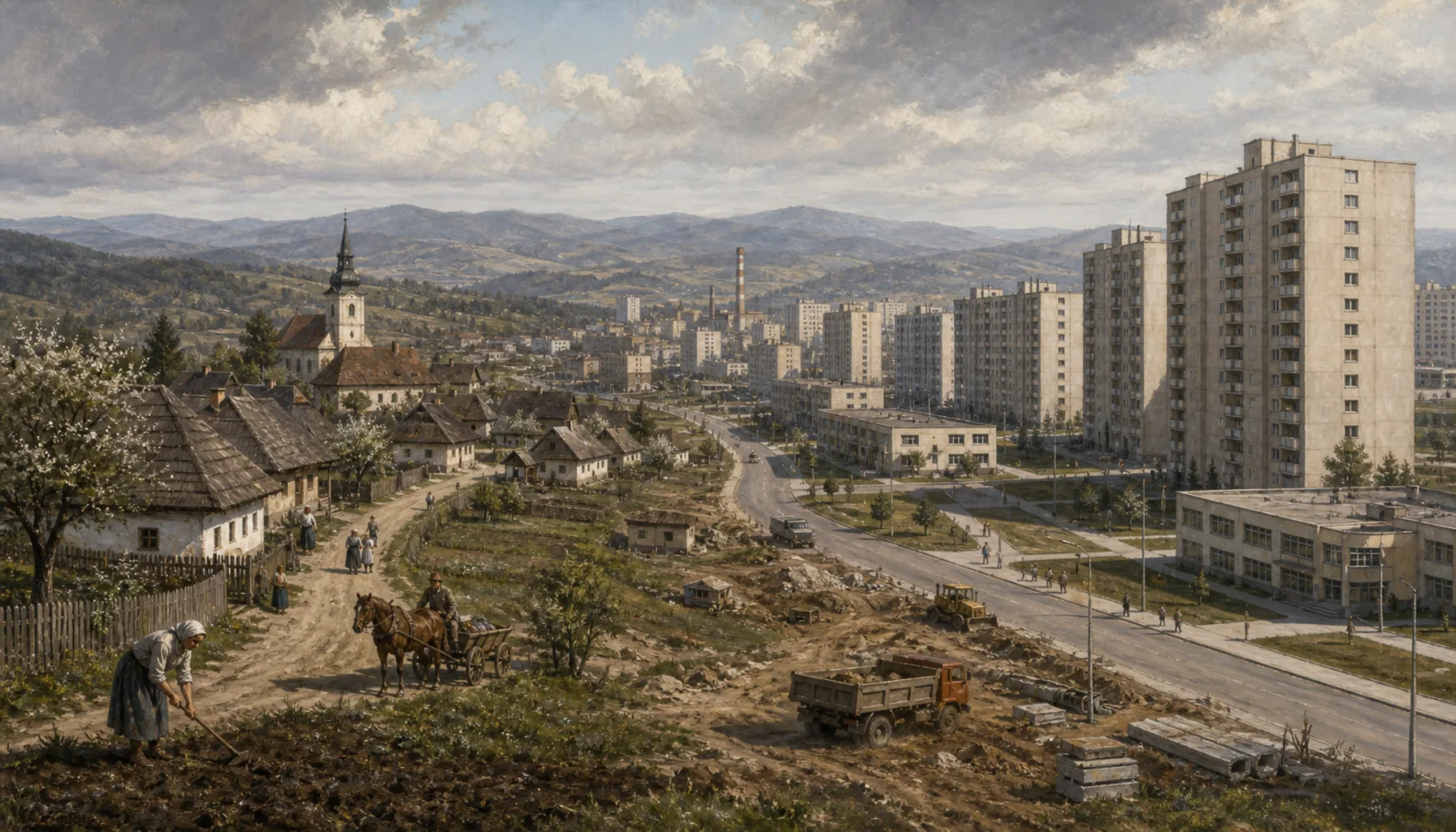
1950s – 1980sFrom the village to the panelákZ dediny do paneláku
SlovakiaSlovensko
From the village to the panelákZ dediny do paneláku
The same regime changed Slovakia physically more than any government before it. A country that had been overwhelmingly agricultural was industrialised on purpose: the East Slovak ironworks rose at Šaca outside Košice in the 1960s, fed by a broad-gauge railway laid all the way from the Soviet border, and chemical, engineering and armaments plants went up across the country. Villages emptied into the towns, and the towns grew rings of prefabricated concrete blocks — the panelák, where a large share of Slovaks still live. Schooling, healthcare and work were universal and free, and living standards rose steeply from a very low base. Both halves of that sentence are true at the same time, and much of the argument about this period inside Slovak families comes down to which half gets said first.Ten istý režim zmenil Slovensko fyzicky viac než ktorákoľvek vláda pred ním. Krajinu, ktorá bola prevažne poľnohospodárska, cielene industrializovali: v šesťdesiatych rokoch vyrástli v Šaci pri Košiciach Východoslovenské železiarne, ktoré zásobovala širokorozchodná trať položená až od sovietskej hranice, a po celej krajine pribudli chemické, strojárske a zbrojárske závody. Dediny sa vysťahovali do miest a mestá obrástli prstencami montovaných betónových domov — panelákov, v ktorých dodnes býva veľká časť Slovákov. Škola, zdravotná starostlivosť aj práca boli pre všetkých a zadarmo a životná úroveň z veľmi nízkeho základu prudko stúpla. Obe polovice tejto vety platia naraz — a veľká časť sporov o toto obdobie v slovenských rodinách je len o tom, ktorá polovica sa povie prvá.
ReferencesZdroje
Where this came fromOdkiaľ to pochádza
Sources consulted while researching this page. Follow them to read further — and to check us.Zdroje, z ktorých sme pri príprave tejto stránky vychádzali. Kliknite a čítajte ďalej — aj si nás overte.
Černová massacre — Wikipediadate, 15 killed and 12 seriously wounded, gendarmes' own nationalitydate, 15 killed and 12 seriously wounded, gendarmes' own nationality
Magyarization — Wikipediathe 1907 Apponyi education laws, the closing of the Slovak grammar schools and of Matica slovenská in April 1875the 1907 Apponyi education laws, the closing of the Slovak grammar schools and of Matica slovenská in April 1875
Žiadosti slovenského národa — Wikipédia10 May 1848, fourteen points, the arrest warrants of May–June 184810 May 1848, fourteen points, the arrest warrants of May–June 1848
Slovak Uprising of 1848–49 — Wikipediathe three volunteer campaigns and the disbanding of the corps on 21 November 1849the three volunteer campaigns and the disbanding of the corps on 21 November 1849
Pittsburgh Agreement — Wikipediathe Cleveland Agreement of 22 October 1915 and the text of the Pittsburgh promisesthe Cleveland Agreement of 22 October 1915 and the text of the Pittsburgh promises
Slovak–Hungarian War — Wikipediathe 'Little War' of March 1939 and the 1,697 km² ceded on 4 April 1939the 'Little War' of March 1939 and the 1,697 km² ceded on 4 April 1939
Slovak National Uprising — Wikipediainsurgent numbers, territory held, the fall of Banská Bystrica on 27 October 1944insurgent numbers, territory held, the fall of Banská Bystrica on 27 October 1944
Kremnička and Nemecká massacres — Wikipedia747 victims at Kremnička, about 900 at Nemecká, the units responsible747 victims at Kremnička, about 900 at Nemecká, the units responsible
Masaker v Kľakovskej doline — Wikipédia21 January 1945, 148 civilians including 48 children under eighteen21 January 1945, 148 civilians including 48 children under eighteen
Battle of the Dukla Pass — Wikipedia8 September – 28 October 1944 and the casualty figures8 September – 28 October 1944 and the casualty figures
Kalinov — Wikipédiathe first village in Slovakia liberated, 21 September 1944the first village in Slovakia liberated, 21 September 1944
Slovak Greek Catholic Church — Wikipediathe staged Prešov assembly of April 1950, Bishop Gojdič, the 1968 restorationthe staged Prešov assembly of April 1950, Bishop Gojdič, the 1968 restoration