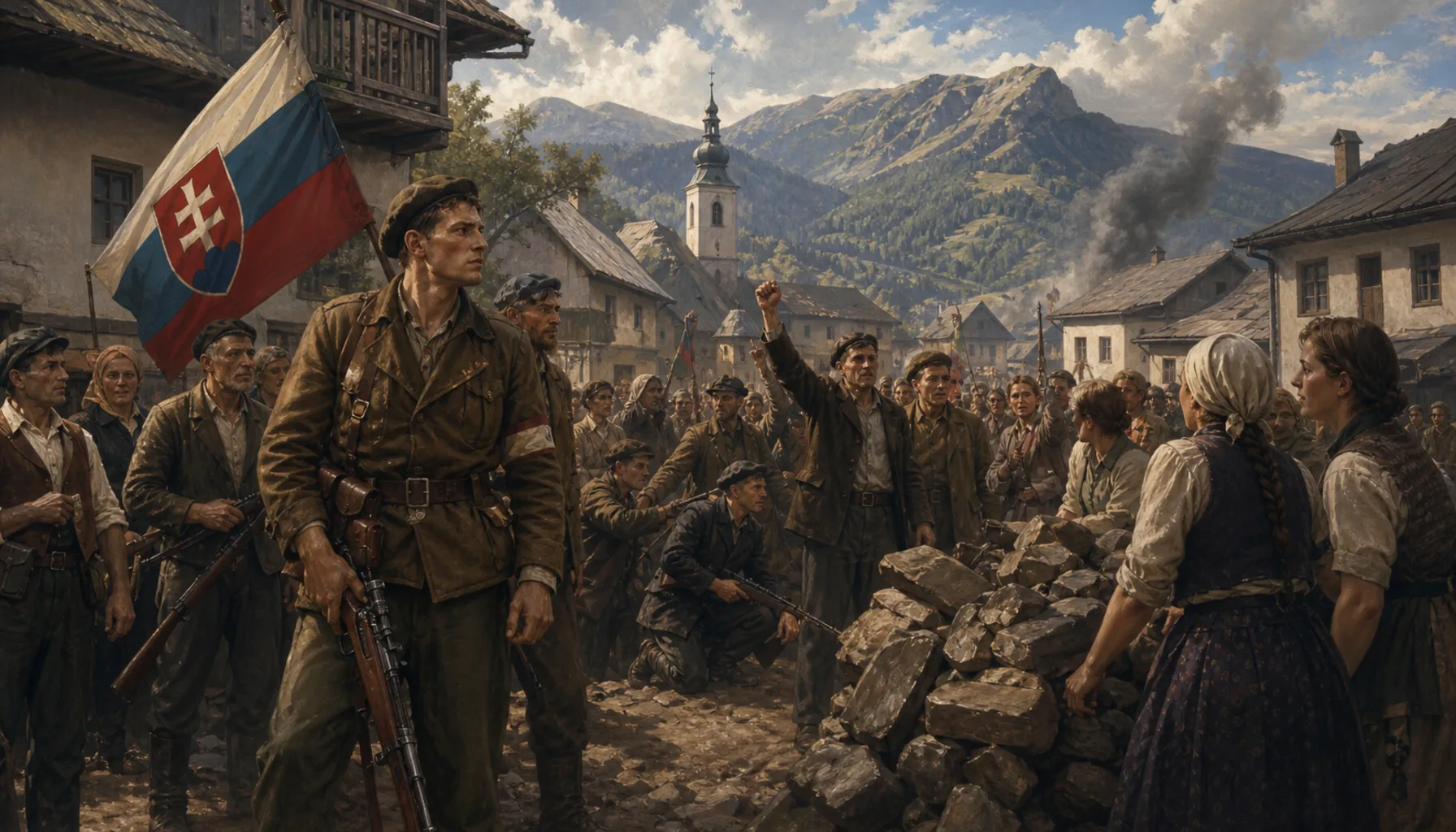
29 August – 28 October 1944The Slovak National UprisingSlovenské národné povstanie
SlovakiaSlovensko
The Slovak National UprisingSlovenské národné povstanie
Slovakia also rose against the regime it had been living under. Prepared in secret by an underground Slovak National Council formed at Christmas 1943, the Slovak National Uprising was launched from Banská Bystrica on 29 August 1944 — the day German troops began occupying the country. It was one of the largest anti-Nazi risings anywhere in Europe: some 18,000 soldiers at the start, about 60,000 after mobilisation, plus partisans, holding roughly 22,000 square kilometres in the first days — more than half of Slovakia, with 1.7 million people in it. Banská Bystrica fell on 27 October and the open front ended the next day, after two months. The fighters who could get away went into the mountains and carried on as partisans through the winter.Slovensko sa proti režimu, v ktorom žilo, aj vzbúrilo. Slovenské národné povstanie, ktoré v ilegalite pripravovala Slovenská národná rada vytvorená na Vianoce 1943, vypuklo 29. augusta 1944 z Banskej Bystrice — v deň, keď nemecké vojská začali obsadzovať krajinu. Bolo jedným z najväčších protinacistických povstaní v Európe: na začiatku asi 18 000 vojakov, po mobilizácii okolo 60 000, k tomu partizáni, a v prvých dňoch držali zhruba 22 000 kilometrov štvorcových — viac než polovicu Slovenska s 1,7 milióna obyvateľov. Banská Bystrica padla 27. októbra a otvorený front sa o deň neskôr, po dvoch mesiacoch, skončil. Kto sa dostal preč, odišiel do hôr a bojoval ďalej partizánsky celú zimu.
ReferencesZdroje
Where this came fromOdkiaľ to pochádza
Sources consulted while researching this page. Follow them to read further — and to check us.Zdroje, z ktorých sme pri príprave tejto stránky vychádzali. Kliknite a čítajte ďalej — aj si nás overte.
Černová massacre — Wikipediadate, 15 killed and 12 seriously wounded, gendarmes' own nationalitydate, 15 killed and 12 seriously wounded, gendarmes' own nationality
Magyarization — Wikipediathe 1907 Apponyi education laws, the closing of the Slovak grammar schools and of Matica slovenská in April 1875the 1907 Apponyi education laws, the closing of the Slovak grammar schools and of Matica slovenská in April 1875
Žiadosti slovenského národa — Wikipédia10 May 1848, fourteen points, the arrest warrants of May–June 184810 May 1848, fourteen points, the arrest warrants of May–June 1848
Slovak Uprising of 1848–49 — Wikipediathe three volunteer campaigns and the disbanding of the corps on 21 November 1849the three volunteer campaigns and the disbanding of the corps on 21 November 1849
Pittsburgh Agreement — Wikipediathe Cleveland Agreement of 22 October 1915 and the text of the Pittsburgh promisesthe Cleveland Agreement of 22 October 1915 and the text of the Pittsburgh promises
Slovak–Hungarian War — Wikipediathe 'Little War' of March 1939 and the 1,697 km² ceded on 4 April 1939the 'Little War' of March 1939 and the 1,697 km² ceded on 4 April 1939
Slovak National Uprising — Wikipediainsurgent numbers, territory held, the fall of Banská Bystrica on 27 October 1944insurgent numbers, territory held, the fall of Banská Bystrica on 27 October 1944
Kremnička and Nemecká massacres — Wikipedia747 victims at Kremnička, about 900 at Nemecká, the units responsible747 victims at Kremnička, about 900 at Nemecká, the units responsible
Masaker v Kľakovskej doline — Wikipédia21 January 1945, 148 civilians including 48 children under eighteen21 January 1945, 148 civilians including 48 children under eighteen
Battle of the Dukla Pass — Wikipedia8 September – 28 October 1944 and the casualty figures8 September – 28 October 1944 and the casualty figures
Kalinov — Wikipédiathe first village in Slovakia liberated, 21 September 1944the first village in Slovakia liberated, 21 September 1944
Slovak Greek Catholic Church — Wikipediathe staged Prešov assembly of April 1950, Bishop Gojdič, the 1968 restorationthe staged Prešov assembly of April 1950, Bishop Gojdič, the 1968 restoration