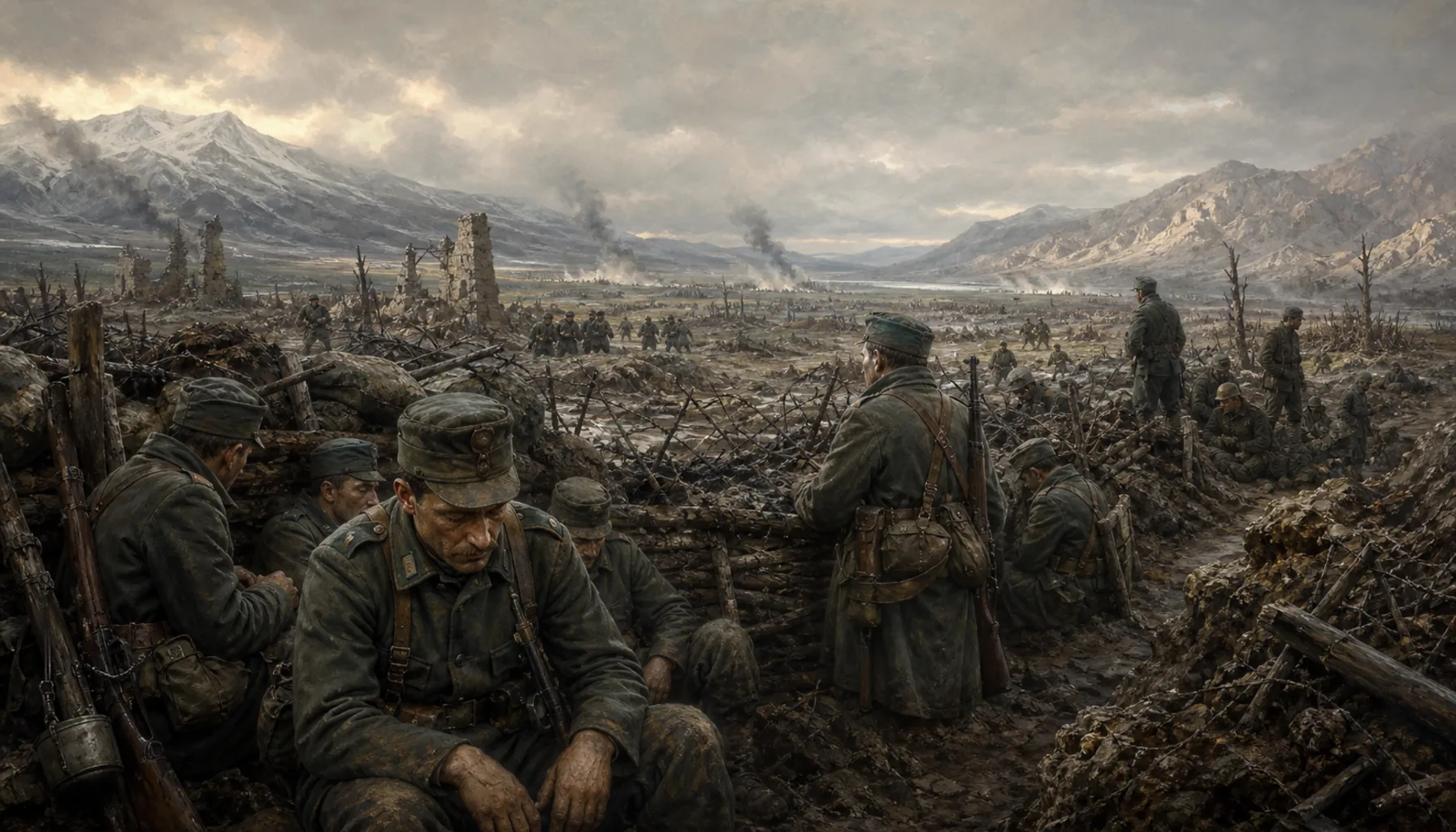
1914 – 1918A war for a monarchy that did not survive itVojna za monarchiu, ktorá ju neprežila
SlovakiaSlovensko
A war for a monarchy that did not survive itVojna za monarchiu, ktorá ju neprežila
Slovak men were conscripted into the Austro-Hungarian army and died in Galicia, in Serbia and on the Isonzo for a state that would not outlive the war. At home the army requisitioned grain and livestock, bread was rationed and ran short, and the harvest was brought in by women and children. Wartime censorship silenced what little Slovak press had survived Magyarization, and talk of national rights was treason. Four years of that used up whatever loyalty to Budapest was still left in Slovak villages — which is why, in the autumn of 1918, the old kingdom simply fell away here and nobody defended it.Slovenských mužov odviedli do rakúsko-uhorskej armády a umierali v Haliči, v Srbsku a na rieke Soči za štát, ktorý vojnu neprežil. Doma armáda rekvirovala obilie a dobytok, chlieb bol na lístky a chýbal, žatvu robili ženy a deti. Vojnová cenzúra umlčala aj tú trochu slovenských novín, čo maďarizáciu prežili, a reč o národných právach bola vlastizradou. Štyri roky takéhoto života minuli aj zvyšok lojality k Budapešti, ktorý na slovenskom vidieku ešte bol — a preto sa na jeseň 1918 staré kráľovstvo tu jednoducho rozsypalo a nikto ho nebránil.
ReferencesZdroje
Where this came fromOdkiaľ to pochádza
Sources consulted while researching this page. Follow them to read further — and to check us.Zdroje, z ktorých sme pri príprave tejto stránky vychádzali. Kliknite a čítajte ďalej — aj si nás overte.
Černová massacre — Wikipediadate, 15 killed and 12 seriously wounded, gendarmes' own nationalitydate, 15 killed and 12 seriously wounded, gendarmes' own nationality
Magyarization — Wikipediathe 1907 Apponyi education laws, the closing of the Slovak grammar schools and of Matica slovenská in April 1875the 1907 Apponyi education laws, the closing of the Slovak grammar schools and of Matica slovenská in April 1875
Žiadosti slovenského národa — Wikipédia10 May 1848, fourteen points, the arrest warrants of May–June 184810 May 1848, fourteen points, the arrest warrants of May–June 1848
Slovak Uprising of 1848–49 — Wikipediathe three volunteer campaigns and the disbanding of the corps on 21 November 1849the three volunteer campaigns and the disbanding of the corps on 21 November 1849
Pittsburgh Agreement — Wikipediathe Cleveland Agreement of 22 October 1915 and the text of the Pittsburgh promisesthe Cleveland Agreement of 22 October 1915 and the text of the Pittsburgh promises
Slovak–Hungarian War — Wikipediathe 'Little War' of March 1939 and the 1,697 km² ceded on 4 April 1939the 'Little War' of March 1939 and the 1,697 km² ceded on 4 April 1939
Slovak National Uprising — Wikipediainsurgent numbers, territory held, the fall of Banská Bystrica on 27 October 1944insurgent numbers, territory held, the fall of Banská Bystrica on 27 October 1944
Kremnička and Nemecká massacres — Wikipedia747 victims at Kremnička, about 900 at Nemecká, the units responsible747 victims at Kremnička, about 900 at Nemecká, the units responsible
Masaker v Kľakovskej doline — Wikipédia21 January 1945, 148 civilians including 48 children under eighteen21 January 1945, 148 civilians including 48 children under eighteen
Battle of the Dukla Pass — Wikipedia8 September – 28 October 1944 and the casualty figures8 September – 28 October 1944 and the casualty figures
Kalinov — Wikipédiathe first village in Slovakia liberated, 21 September 1944the first village in Slovakia liberated, 21 September 1944
Slovak Greek Catholic Church — Wikipediathe staged Prešov assembly of April 1950, Bishop Gojdič, the 1968 restorationthe staged Prešov assembly of April 1950, Bishop Gojdič, the 1968 restoration