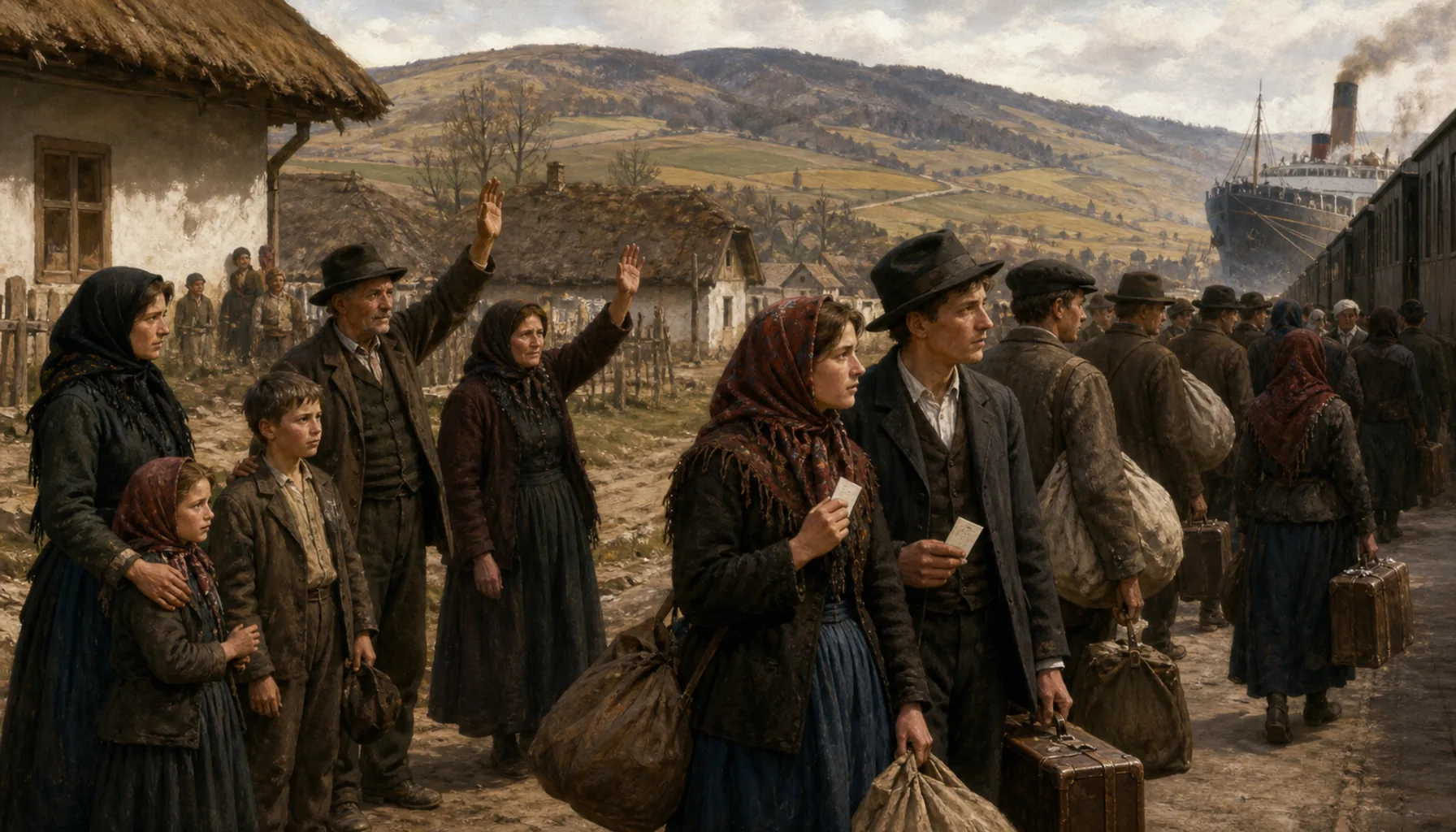
1880s – 1914Half a million leaveOdchádza pol milióna ľudí
SlovakiaSlovensko
Half a million leaveOdchádza pol milióna ľudí
There was too little land and no industry to absorb the children born on it, and for a whole generation the answer was a ticket to America. From the 1880s to the First World War several hundred thousand people left; by the mid-1920s around half a million Slovaks had gone, most of them to the coal mines and steel mills of Pennsylvania. Districts in Šariš, Zemplín, Orava and Kysuce lost a very large share of their working-age population within a single generation and never got it back. What came back was money — the brick houses that still stand out among timber ones in poor villages were paid for from America — and something less obvious: the Slovak associations in Pittsburgh and Cleveland became, by 1918, one of the few places on earth where Slovak politics could be conducted freely at all.Pôdy bolo primálo a priemysel, ktorý by uživil deti narodené na nej, neexistoval — a odpoveďou celej generácie bol lístok do Ameriky. Od 80. rokov 19. storočia do prvej svetovej vojny odišli stovky tisíc ľudí, do polovice 20. rokov už asi pol milióna Slovákov, väčšinou do uhoľných baní a oceliarní v Pensylvánii. Okresy na Šariši, Zemplíne, Orave a Kysuciach stratili počas jednej generácie veľkú časť práceschopných ľudí a nikdy ich nezískali späť. Späť prichádzali peniaze — tehlové domy, ktoré v chudobných dedinách dodnes vyčnievajú spomedzi drevených, zaplatila Amerika — a ešte čosi menej viditeľné: slovenské spolky v Pittsburghu a Clevelande sa do roku 1918 stali jedným z mála miest na svete, kde sa vôbec dala slobodne robiť slovenská politika.
ReferencesZdroje
Where this came fromOdkiaľ to pochádza
Sources consulted while researching this page. Follow them to read further — and to check us.Zdroje, z ktorých sme pri príprave tejto stránky vychádzali. Kliknite a čítajte ďalej — aj si nás overte.
Černová massacre — Wikipediadate, 15 killed and 12 seriously wounded, gendarmes' own nationalitydate, 15 killed and 12 seriously wounded, gendarmes' own nationality
Magyarization — Wikipediathe 1907 Apponyi education laws, the closing of the Slovak grammar schools and of Matica slovenská in April 1875the 1907 Apponyi education laws, the closing of the Slovak grammar schools and of Matica slovenská in April 1875
Žiadosti slovenského národa — Wikipédia10 May 1848, fourteen points, the arrest warrants of May–June 184810 May 1848, fourteen points, the arrest warrants of May–June 1848
Slovak Uprising of 1848–49 — Wikipediathe three volunteer campaigns and the disbanding of the corps on 21 November 1849the three volunteer campaigns and the disbanding of the corps on 21 November 1849
Pittsburgh Agreement — Wikipediathe Cleveland Agreement of 22 October 1915 and the text of the Pittsburgh promisesthe Cleveland Agreement of 22 October 1915 and the text of the Pittsburgh promises
Slovak–Hungarian War — Wikipediathe 'Little War' of March 1939 and the 1,697 km² ceded on 4 April 1939the 'Little War' of March 1939 and the 1,697 km² ceded on 4 April 1939
Slovak National Uprising — Wikipediainsurgent numbers, territory held, the fall of Banská Bystrica on 27 October 1944insurgent numbers, territory held, the fall of Banská Bystrica on 27 October 1944
Kremnička and Nemecká massacres — Wikipedia747 victims at Kremnička, about 900 at Nemecká, the units responsible747 victims at Kremnička, about 900 at Nemecká, the units responsible
Masaker v Kľakovskej doline — Wikipédia21 January 1945, 148 civilians including 48 children under eighteen21 January 1945, 148 civilians including 48 children under eighteen
Battle of the Dukla Pass — Wikipedia8 September – 28 October 1944 and the casualty figures8 September – 28 October 1944 and the casualty figures
Kalinov — Wikipédiathe first village in Slovakia liberated, 21 September 1944the first village in Slovakia liberated, 21 September 1944
Slovak Greek Catholic Church — Wikipediathe staged Prešov assembly of April 1950, Bishop Gojdič, the 1968 restorationthe staged Prešov assembly of April 1950, Bishop Gojdič, the 1968 restoration