Revolution and the awakeningRevolúcia a národné prebudenie
1787 · 1843 – 1846The language is decidedRozhodnutie o jazyku
SlovakiaSlovensko
The language is decidedRozhodnutie o jazyku
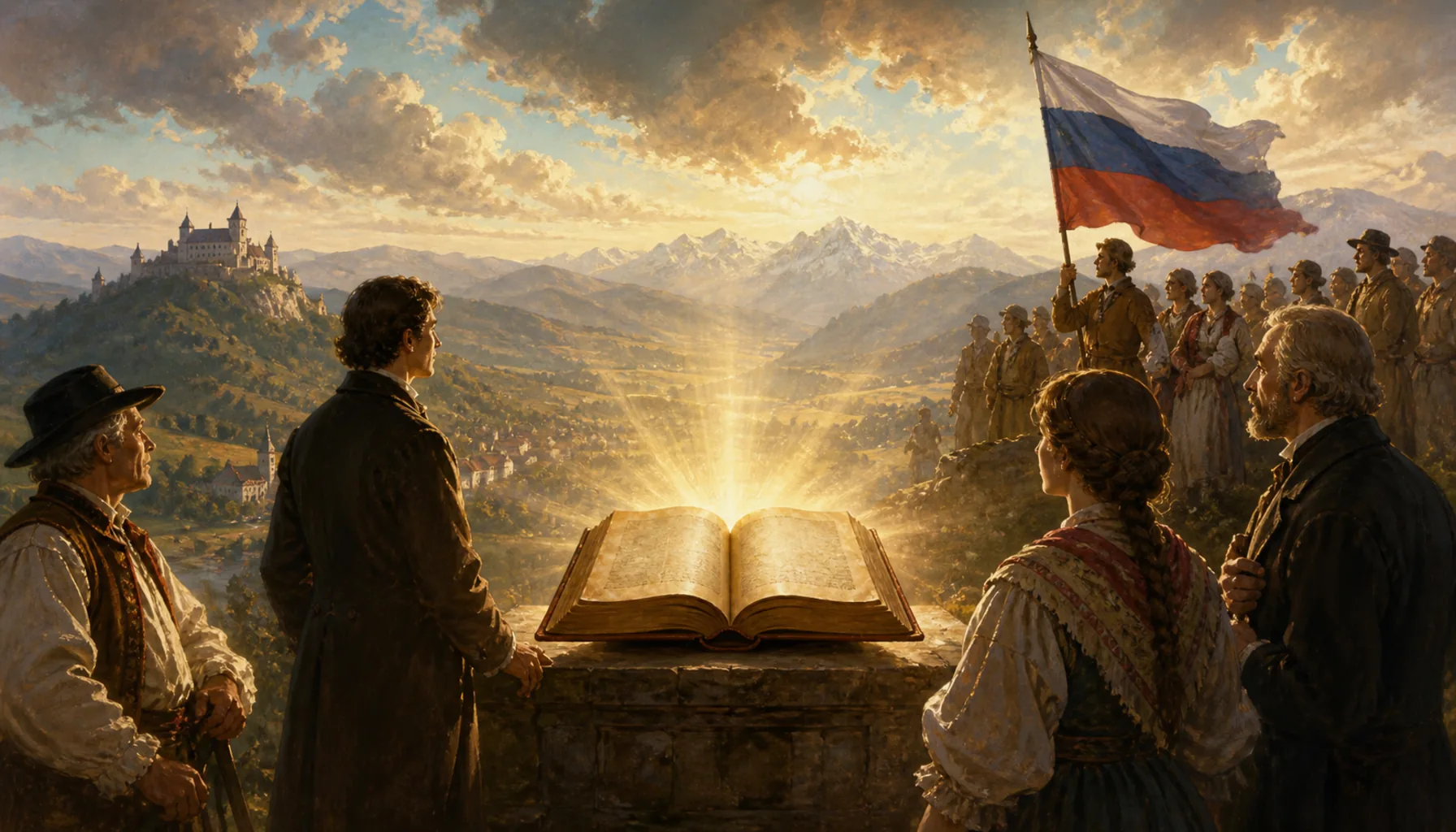
Modern Slovak nationhood begins with a grammar book. The Catholic priest Anton Bernolák had already standardised a written Slovak in 1787, built on the western dialects around Trnava; it never quite caught on, but it proved the thing could be done. In February 1843 Ľudovít Štúr, together with Jozef Miloslav Hurban and Michal Miloslav Hodža, agreed to build a common standard on the central Slovak dialects instead — spoken in the middle of the country, and acceptable to Lutherans and Catholics alike. The first newspaper printed in that new written language appeared in 1845 and Štúr's grammar in 1846. Every Slovak sentence written since — including the one you are reading in the Slovak version of this page — descends from that decision.Moderný slovenský národ sa začína gramatikou. Katolícky kňaz Anton Bernolák kodifikoval spisovnú slovenčinu už roku 1787 a postavil ju na západoslovenských nárečiach z okolia Trnavy; celkom sa neujala, ale ukázala, že sa to dá. Vo februári 1843 sa Ľudovít Štúr spolu s Jozefom Miloslavom Hurbanom a Michalom Miloslavom Hodžom dohodol, že spoločný spisovný jazyk postavia radšej na stredoslovenských nárečiach — hovorilo sa nimi v strede krajiny a boli prijateľné pre evanjelikov aj katolíkov. Prvé noviny v tejto novej reči vyšli roku 1845, Štúrova gramatika roku 1846. Každá slovenská veta napísaná odvtedy — aj tá, ktorú práve čítate — pochádza z toho rozhodnutia.
ReferencesZdroje
Where this came fromOdkiaľ to pochádza
Sources consulted while researching this page. Follow them to read further — and to check us.Zdroje, z ktorých sme pri príprave tejto stránky vychádzali. Kliknite a čítajte ďalej — aj si nás overte.
Černová massacre — Wikipediadate, 15 killed and 12 seriously wounded, gendarmes' own nationalitydate, 15 killed and 12 seriously wounded, gendarmes' own nationality
Magyarization — Wikipediathe 1907 Apponyi education laws, the closing of the Slovak grammar schools and of Matica slovenská in April 1875the 1907 Apponyi education laws, the closing of the Slovak grammar schools and of Matica slovenská in April 1875
Žiadosti slovenského národa — Wikipédia10 May 1848, fourteen points, the arrest warrants of May–June 184810 May 1848, fourteen points, the arrest warrants of May–June 1848
Slovak Uprising of 1848–49 — Wikipediathe three volunteer campaigns and the disbanding of the corps on 21 November 1849the three volunteer campaigns and the disbanding of the corps on 21 November 1849
Pittsburgh Agreement — Wikipediathe Cleveland Agreement of 22 October 1915 and the text of the Pittsburgh promisesthe Cleveland Agreement of 22 October 1915 and the text of the Pittsburgh promises
Slovak–Hungarian War — Wikipediathe 'Little War' of March 1939 and the 1,697 km² ceded on 4 April 1939the 'Little War' of March 1939 and the 1,697 km² ceded on 4 April 1939
Slovak National Uprising — Wikipediainsurgent numbers, territory held, the fall of Banská Bystrica on 27 October 1944insurgent numbers, territory held, the fall of Banská Bystrica on 27 October 1944
Kremnička and Nemecká massacres — Wikipedia747 victims at Kremnička, about 900 at Nemecká, the units responsible747 victims at Kremnička, about 900 at Nemecká, the units responsible
Masaker v Kľakovskej doline — Wikipédia21 January 1945, 148 civilians including 48 children under eighteen21 January 1945, 148 civilians including 48 children under eighteen
Battle of the Dukla Pass — Wikipedia8 September – 28 October 1944 and the casualty figures8 September – 28 October 1944 and the casualty figures
Kalinov — Wikipédiathe first village in Slovakia liberated, 21 September 1944the first village in Slovakia liberated, 21 September 1944
Slovak Greek Catholic Church — Wikipediathe staged Prešov assembly of April 1950, Bishop Gojdič, the 1968 restorationthe staged Prešov assembly of April 1950, Bishop Gojdič, the 1968 restoration