Hussites, Jiskra and CorvinusHusiti, Jiskra a Korvín
1440 – 1462Jiskra holds the north for a child kingJiskra drží sever pre kráľa-dieťa
SlovakiaSlovensko
Jiskra holds the north for a child kingJiskra drží sever pre kráľa-dieťa
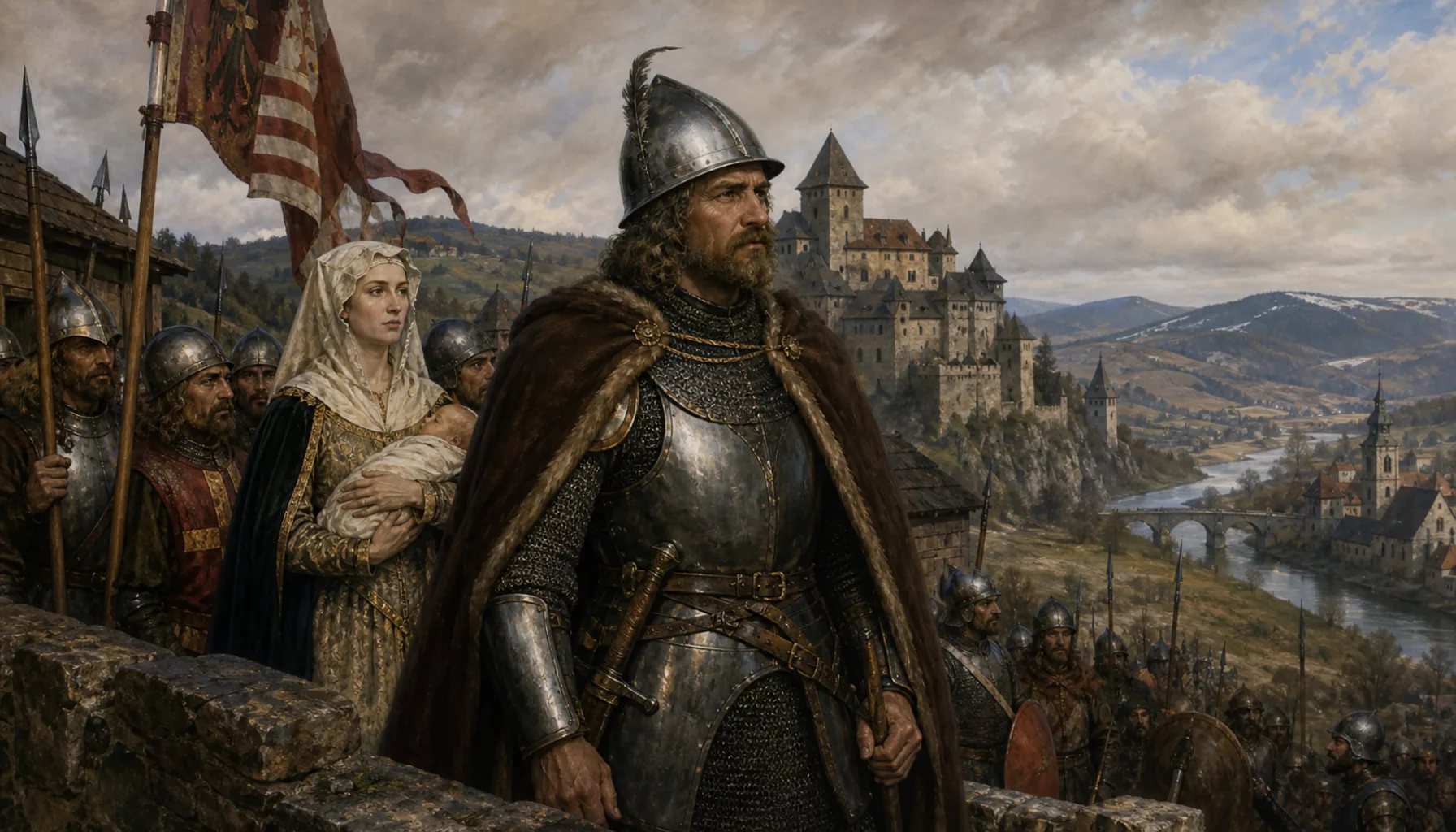
When King Albert died in 1439 his widow, Queen Elizabeth, hired a Bohemian captain named Ján Jiskra of Brandýs to defend the claim of her newborn son Ladislaus against the king the nobles had elected instead. From 1440 Jiskra and some five thousand mercenaries held the central mining towns, the Spiš and most of the east, commanding from Zvolen Castle and from Košice; for two decades the north of the kingdom answered to him rather than to Buda. In April 1462 he came to terms with the young King Matthias Corvinus, entered his service and was paid off with estates far to the south. His discharged soldiers did not go home: they became the bratríci, the brethren, armed brotherhoods living off fortified camps, and Matthias broke the last of them at Veľké Kostoľany in 1467.Keď roku 1439 zomrel kráľ Albrecht, jeho vdova, kráľovná Alžbeta, si najala českého veliteľa Jána Jiskru z Brandýsa, aby uhájil nárok jej práve narodeného syna Ladislava Pohrobka proti kráľovi, ktorého si šľachta zvolila namiesto neho. Od roku 1440 držal Jiskra s asi piatimi tisícmi žoldnierov stredoslovenské banské mestá, Spiš a väčšinu východu; velil zo Zvolenského hradu a z Košíc a celé dve desaťročia poslúchal sever kráľovstva jeho, nie Budín. V apríli 1462 sa dohodol s mladým kráľom Matejom Korvínom, vstúpil do jeho služieb a odmenou dostal panstvá ďaleko na juhu. Jeho prepustení vojaci sa však domov nevrátili — stali sa z nich bratríci, ozbrojené bratstvá žijúce z opevnených táborov, a posledných z nich rozprášilo Korvínovo vojsko roku 1467 pri Veľkých Kostoľanoch.
ReferencesZdroje
Where this came fromOdkiaľ to pochádza
Sources consulted while researching this page. Follow them to read further — and to check us.Zdroje, z ktorých sme pri príprave tejto stránky vychádzali. Kliknite a čítajte ďalej — aj si nás overte.
Černová massacre — Wikipediadate, 15 killed and 12 seriously wounded, gendarmes' own nationalitydate, 15 killed and 12 seriously wounded, gendarmes' own nationality
Magyarization — Wikipediathe 1907 Apponyi education laws, the closing of the Slovak grammar schools and of Matica slovenská in April 1875the 1907 Apponyi education laws, the closing of the Slovak grammar schools and of Matica slovenská in April 1875
Žiadosti slovenského národa — Wikipédia10 May 1848, fourteen points, the arrest warrants of May–June 184810 May 1848, fourteen points, the arrest warrants of May–June 1848
Slovak Uprising of 1848–49 — Wikipediathe three volunteer campaigns and the disbanding of the corps on 21 November 1849the three volunteer campaigns and the disbanding of the corps on 21 November 1849
Pittsburgh Agreement — Wikipediathe Cleveland Agreement of 22 October 1915 and the text of the Pittsburgh promisesthe Cleveland Agreement of 22 October 1915 and the text of the Pittsburgh promises
Slovak–Hungarian War — Wikipediathe 'Little War' of March 1939 and the 1,697 km² ceded on 4 April 1939the 'Little War' of March 1939 and the 1,697 km² ceded on 4 April 1939
Slovak National Uprising — Wikipediainsurgent numbers, territory held, the fall of Banská Bystrica on 27 October 1944insurgent numbers, territory held, the fall of Banská Bystrica on 27 October 1944
Kremnička and Nemecká massacres — Wikipedia747 victims at Kremnička, about 900 at Nemecká, the units responsible747 victims at Kremnička, about 900 at Nemecká, the units responsible
Masaker v Kľakovskej doline — Wikipédia21 January 1945, 148 civilians including 48 children under eighteen21 January 1945, 148 civilians including 48 children under eighteen
Battle of the Dukla Pass — Wikipedia8 September – 28 October 1944 and the casualty figures8 September – 28 October 1944 and the casualty figures
Kalinov — Wikipédiathe first village in Slovakia liberated, 21 September 1944the first village in Slovakia liberated, 21 September 1944
Slovak Greek Catholic Church — Wikipediathe staged Prešov assembly of April 1950, Bishop Gojdič, the 1968 restorationthe staged Prešov assembly of April 1950, Bishop Gojdič, the 1968 restoration