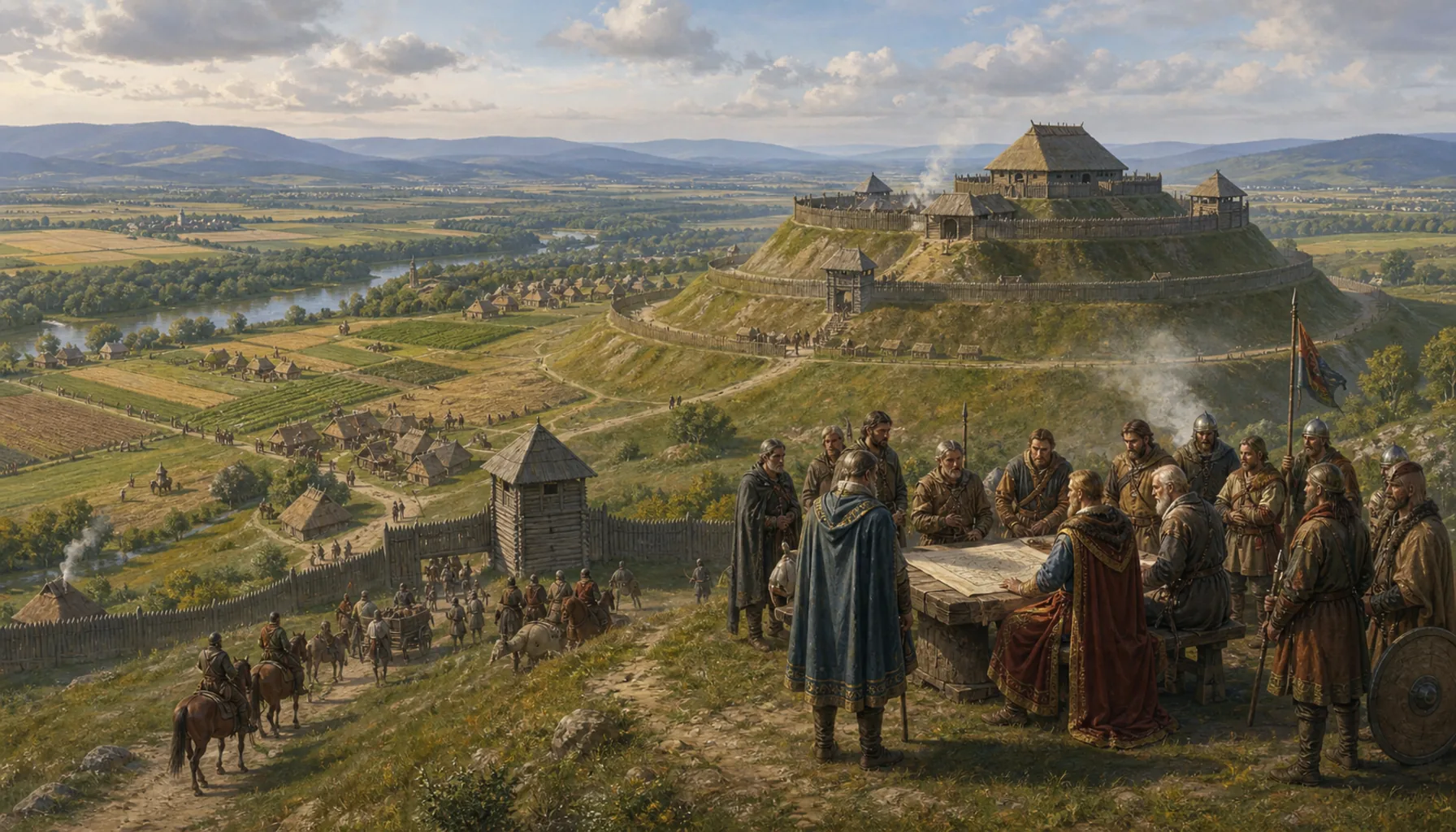
11th – 12th centuryCounties, castles of earth, and a duchy at NitraStolice, hradiská z hliny a nitrianske kniežatstvo
SlovakiaSlovensko
Counties, castles of earth, and a duchy at NitraStolice, hradiská z hliny a nitrianske kniežatstvo
The new kingdom was organised into counties — stolice or župy in Slovak, comitatus in the Latin the clerks wrote. Each was run from a fortified seat by an official the king appointed, who collected his taxes and led his soldiers. Those early castles were not the stone ruins tourists climb today; they were ramparts of earth and timber, usually on hills people had been fortifying for centuries. Nitra kept a special status: through the eleventh century and into the twelfth it was the seat of a duchy, roughly a third of the kingdom handed to the king's younger brother or son to govern, and more than one duke used it as a springboard at the throne. There was no unit called Slovakia and no border where one runs now — the counties simply reached from the Danube up into the mountains.Nové kráľovstvo sa členilo na stolice — po slovensky aj župy, v latinčine pisárov komitáty. Na čele každej stál kráľom menovaný úradník, ktorý sídlil na opevnenom hrade, vyberal dane a viedol vojsko. Tieto najstaršie hrady neboli kamenné zrúcaniny, po ktorých sa dnes štverajú turisti — boli to valy z hliny a dreva, spravidla na kopcoch, ktoré ľudia opevňovali už stáročia predtým. Nitra si udržala osobitné postavenie: v 11. a začiatkom 12. storočia bola sídlom údelného kniežatstva, teda asi tretiny krajiny, ktorú kráľ dával spravovať mladšiemu bratovi alebo synovi — a nejedno údelné knieža si z nej urobilo odrazový mostík k trónu. Nijaká jednotka menom Slovensko neexistovala a hranica tam, kade beží dnes, tiež nie: stolice jednoducho siahali od Dunaja hore do hôr.
ReferencesZdroje
Where this came fromOdkiaľ to pochádza
Sources consulted while researching this page. Follow them to read further — and to check us.Zdroje, z ktorých sme pri príprave tejto stránky vychádzali. Kliknite a čítajte ďalej — aj si nás overte.
Černová massacre — Wikipediadate, 15 killed and 12 seriously wounded, gendarmes' own nationalitydate, 15 killed and 12 seriously wounded, gendarmes' own nationality
Magyarization — Wikipediathe 1907 Apponyi education laws, the closing of the Slovak grammar schools and of Matica slovenská in April 1875the 1907 Apponyi education laws, the closing of the Slovak grammar schools and of Matica slovenská in April 1875
Žiadosti slovenského národa — Wikipédia10 May 1848, fourteen points, the arrest warrants of May–June 184810 May 1848, fourteen points, the arrest warrants of May–June 1848
Slovak Uprising of 1848–49 — Wikipediathe three volunteer campaigns and the disbanding of the corps on 21 November 1849the three volunteer campaigns and the disbanding of the corps on 21 November 1849
Pittsburgh Agreement — Wikipediathe Cleveland Agreement of 22 October 1915 and the text of the Pittsburgh promisesthe Cleveland Agreement of 22 October 1915 and the text of the Pittsburgh promises
Slovak–Hungarian War — Wikipediathe 'Little War' of March 1939 and the 1,697 km² ceded on 4 April 1939the 'Little War' of March 1939 and the 1,697 km² ceded on 4 April 1939
Slovak National Uprising — Wikipediainsurgent numbers, territory held, the fall of Banská Bystrica on 27 October 1944insurgent numbers, territory held, the fall of Banská Bystrica on 27 October 1944
Kremnička and Nemecká massacres — Wikipedia747 victims at Kremnička, about 900 at Nemecká, the units responsible747 victims at Kremnička, about 900 at Nemecká, the units responsible
Masaker v Kľakovskej doline — Wikipédia21 January 1945, 148 civilians including 48 children under eighteen21 January 1945, 148 civilians including 48 children under eighteen
Battle of the Dukla Pass — Wikipedia8 September – 28 October 1944 and the casualty figures8 September – 28 October 1944 and the casualty figures
Kalinov — Wikipédiathe first village in Slovakia liberated, 21 September 1944the first village in Slovakia liberated, 21 September 1944
Slovak Greek Catholic Church — Wikipediathe staged Prešov assembly of April 1950, Bishop Gojdič, the 1968 restorationthe staged Prešov assembly of April 1950, Bishop Gojdič, the 1968 restoration