Banská Bystrica region · VillagesBanskobystrický kraj · Obce
HronsekHronsek
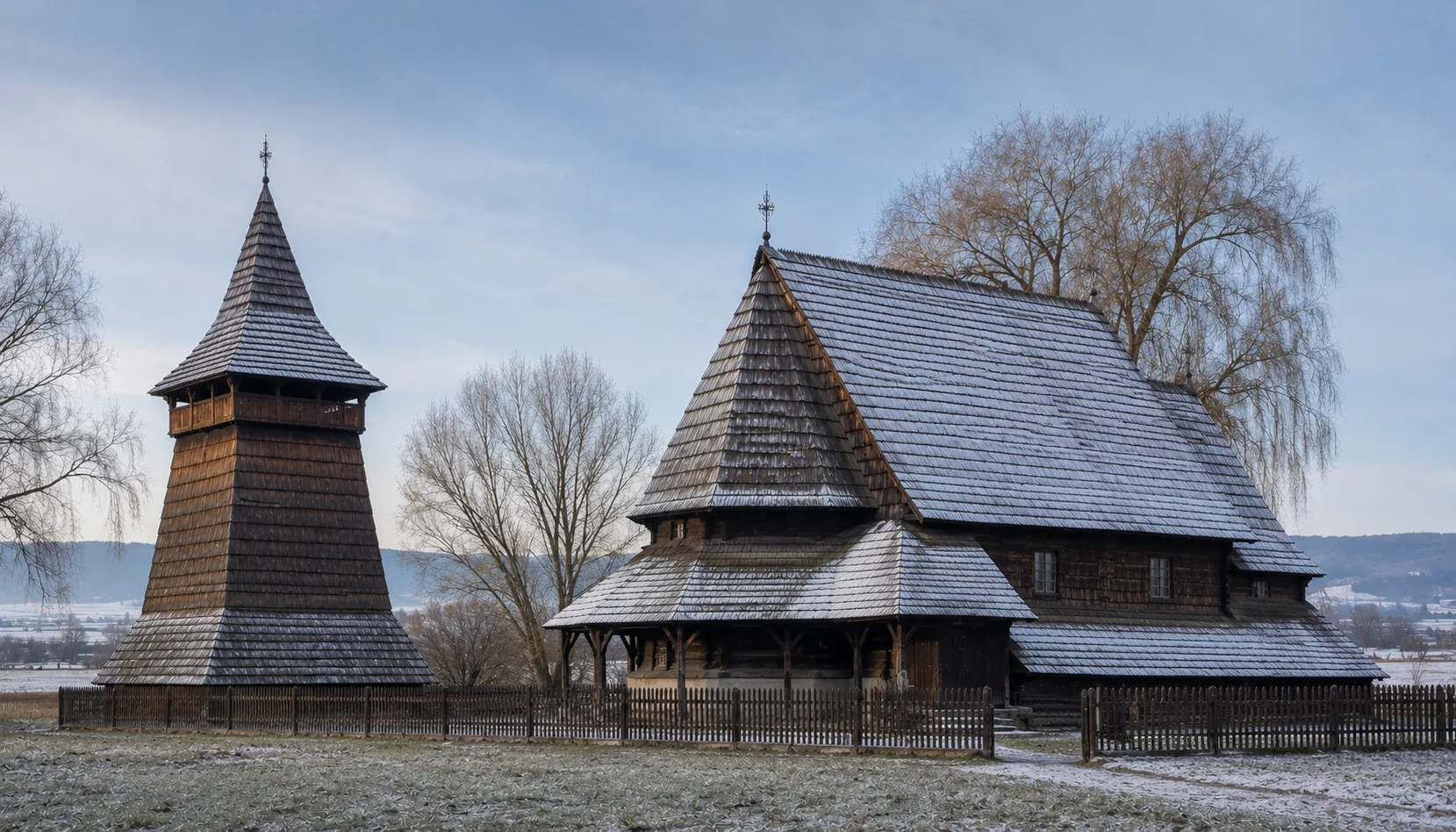
A Lutheran congregation forbidden a tower or bells, and permitted only timber, built this instead: a cross-shaped church raised on oak piles in the wet ground beside the Hron in the mid-1720s, with a separate wooden belfry and room inside for around eleven hundred people.Evanjelickému zboru zakázali vežu aj zvony a povolili mu iba drevo. Postavil teda toto: kostol na pôdoryse kríža, vztýčený na dubových pilótach v mokrej pôde pri Hrone v polovici dvadsiatych rokov 18. storočia, so samostatnou drevenou zvonicou a s miestom pre približne tisícsto ľudí.
The articular wooden church at Hronsek with its separate timber bell towerArtikulárny drevený kostol v Hronseku so samostatnou drevenou zvonicou
Where it standsKde leží
Hronsek lies on the Hron between Banská Bystrica and Zvolen, in the broad flat-bottomed stretch of the valley where the river has room to wander and the water table sits close to the surface. The spa of Sliač is a few kilometres downstream; the Kremnické vrchy stand back to the west and the country opens away east towards Poľana.Hronsek leží na Hrone medzi Banskou Bystricou a Zvolenom, v širokom úseku doliny s plochým dnom, kde má rieka priestor blúdiť a hladina podzemnej vody je plytko pod povrchom. Kúpele Sliač a ich letisko sú pár kilometrov nižšie po prúde, na západe ustupujú Kremnické vrchy a na východ sa krajina otvára smerom k Poľane.
The church stands at the edge of the village on ground that has always been damp — which is precisely why it is where it is.Kostol stojí na okraji obce na pôde, ktorá bola odjakživa vlhká — a práve preto stojí tam, kde stojí.
Why it is herePrečo práve tu
The reason is a law. At the Diet of Sopron in 1681 the Habsburg court conceded to Protestants in royal Hungary the right to build churches again, in two articles of the Diet's acts — hence articular — and hedged the concession about with conditions: at most two churches to a county, outside the town walls, of wood, without a tower and without bells.Dôvodom je zákon. Na šopronskom sneme v roku 1681 priznal habsburský dvor protestantom v Uhorsku právo znovu stavať kostoly, a to v dvoch článkoch snemových zákonov — odtiaľ artikulárne —, obložené podmienkami: najviac dva kostoly na stolicu, za hradbami miest, z dreva, bez veže a bez zvonov.
The plot allotted here was low land by the river, and the builders answered it by driving oak piles and setting the church on them; oak kept permanently damp does not rot, and the building has stood on that raft for three centuries. It went up in 1725 and 1726, and the free-standing bell tower followed at once — a separate building, since the church was allowed none.Pridelený pozemok bola nízka pôda pri rieke a stavitelia na to odpovedali dubovými pilótami, na ktoré kostol postavili; dub trvale pod vodou nehnije a stavba na tomto rošte stojí tri storočia. Vznikla v rokoch 1725 a 1726 a hneď po nej pribudla samostatne stojaca zvonica — vlastná budova, keďže kostol vežu mať nesmel.
In 2008 UNESCO inscribed the church and its belfry among the Wooden Churches of the Slovak part of the Carpathian Mountain Area, a group of nine buildings at eight villages that takes in Catholic, Lutheran and Greek Catholic timber building alike.V roku 2008 zapísalo UNESCO kostol aj zvonicu medzi Drevené chrámy v slovenskej časti Karpatského oblúka — do skupiny deviatich stavieb v ôsmich obciach, ktorá zahŕňa katolícke, evanjelické i gréckokatolícke drevené staviteľstvo.
What you actually seeČo naozaj uvidíte
From outside it is deliberately unassuming: a long, low, dark-timbered building with a steep shingled roof and small windows, keeping to the letter of a law that would have preferred it invisible. The plan is a cross, and the discipline of the design lies in fitting a congregation of over a thousand into something not allowed to be tall.Zvonka pôsobí zámerne nenápadne: dlhá nízka stavba z tmavého dreva so strmou šindľovou strechou a malými oknami, verná litere zákona, ktorý by ju bol najradšej nevidel. Pôdorys má tvar kríža a disciplína návrhu spočíva v tom, ako vmestiť vyše tisíc ľudí do niečoho, čo nesmelo byť vysoké.
Inside, galleries run round three sides on turned wooden posts, the ceiling is a painted timber vault, and everything the eye lands on is carpentry — pews, pulpit, gallery fronts, organ loft. The acoustic is unusually good and the church is used for concerts as well as services.Vnútri obiehajú po troch stranách empory na sústružených drevených stĺpoch, strop je maľovaná drevená klenba a všetko, na čo oko padne, je tesárska práca — lavice, kazateľnica, čelá empor, organový chór. Akustika je mimoriadne dobrá a kostol slúži nielen bohoslužbám, ale aj koncertom.
The bell tower stands apart, a squat shingled timber frame of the same date. Close by is the manor house of the estate on whose land the congregation was permitted to build — Renaissance in origin and much altered since.Zvonica stojí osve, zavalitá šindľom obitá drevená konštrukcia z tých istých rokov. Neďaleko je kaštieľ panstva, na ktorého pozemku smel zbor stavať — renesančný v jadre a odvtedy mnohokrát prestavaný.
Living village, not a museumŽivá obec, nie skanzen
The church belongs to the Lutheran parish and is in use. It is not open all day every day: visiting is in the season, with someone to unlock it and show you round, and outside the summer months it is worth arranging ahead rather than turning up. Services and concerts are not tours.Kostol patrí evanjelickému zboru a používa sa. Nie je otvorený každý deň od rána do večera: navštevuje sa v sezóne a s niekým, kto odomkne a posprevádza, a mimo letných mesiacov sa oplatí dohodnúť vopred, nie prísť naslepo. Bohoslužby ani koncerty nie sú prehliadkami.
Hronsek itself is an ordinary commuter village between two cities, with no tourist street and nothing staged. The church sits in its own fenced ground at the edge of it; the exterior, which is most of the point, can be seen at any hour.Samotný Hronsek je bežnou obcou medzi dvoma mestami, odkiaľ sa dochádza za prácou, bez turistickej ulice a bez inscenovania. Kostol stojí na okraji obce vo vlastnom oplotenom areáli; exteriér, ktorý je väčšinou toho, o čo ide, si pozriete v ktorúkoľvek hodinu.
Getting thereAko sa tam dostať
Hronsek is on the main road and the railway between Banská Bystrica and Zvolen, about a quarter of an hour from either by car; buses along the valley are frequent and trains on that line stop close by. Sliač spa and Zvolen Castle are both a short drive on.Hronsek leží pri hlavnej ceste a železnici medzi Banskou Bystricou a Zvolenom, autom je to z jedného aj druhého asi štvrťhodina; autobusy dolinou premávajú často a vlaky na tejto trati zastavujú nablízku. Kúpele Sliač aj Zvolenský zámok sú odtiaľ kúsok autom.
Explore HronsekObjavujte Hronsek
Every part of this place with a page of its own.Každá časť tohto miesta, ktorá má vlastnú stránku.