Banská Bystrica region · TownsBanskobystrický kraj · Mestá
TisovecTisovec
A small town at the head of the Rimava valley under the cliffs of the Muráň plateau: an iron town that became a Lutheran school town, and the lower end of the only rack railway ever built in Slovakia.Mestečko v závere Rimavskej doliny pod bralami Muránskej planiny: železiarske mesto, z ktorého sa stalo evanjelické školské mesto, a dolný koniec jedinej ozubnicovej železnice, aká kedy na Slovensku vznikla.
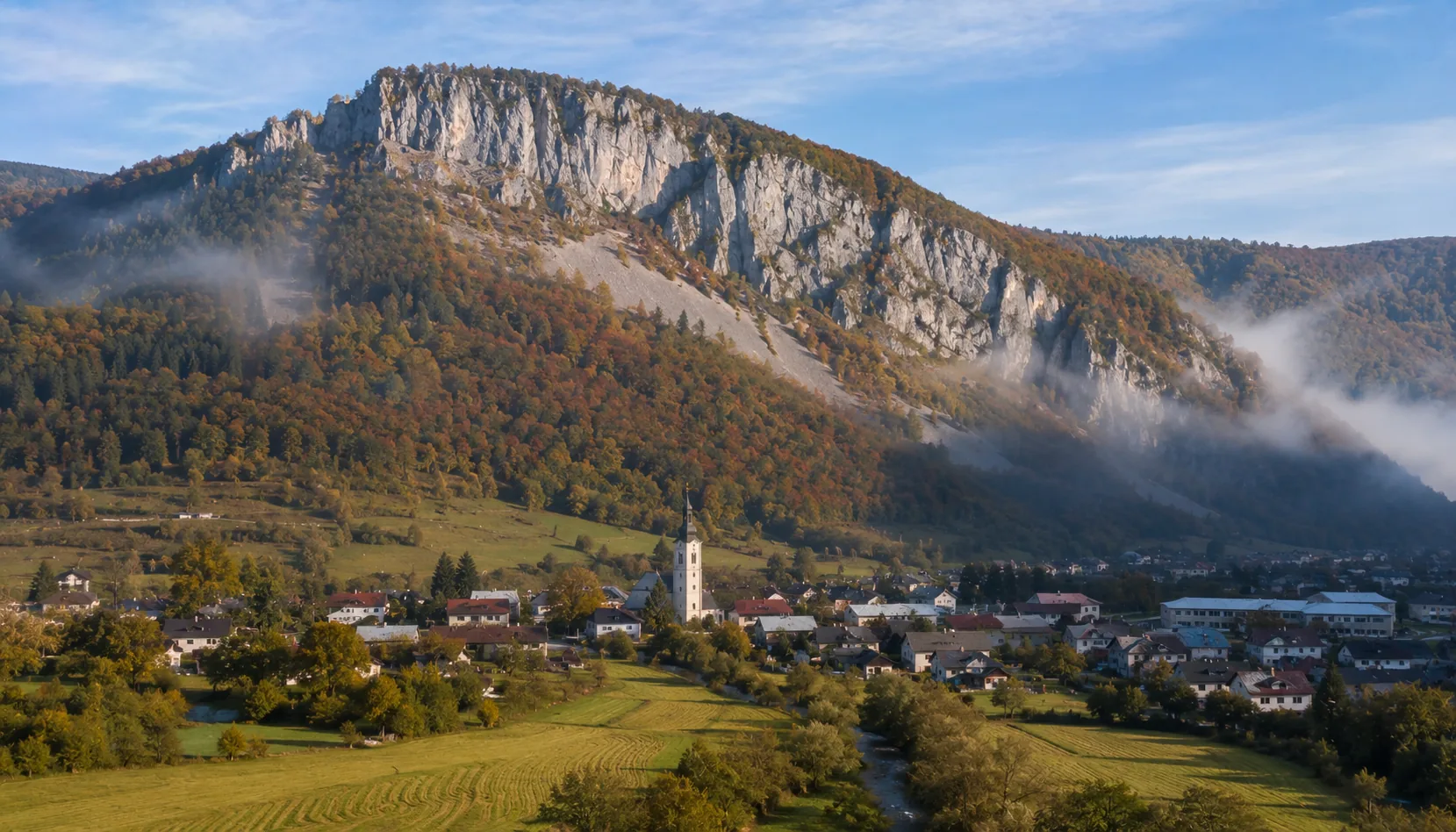
The limestone crag of Hradová standing over Tisovec at the edge of the Muráň plateauVápencové bralo Hradovej nad Tisovcom na okraji Muránskej planiny
Where it standsKde leží
Tisovec sits at the head of the Rimava valley in Malohont, the western half of historic Gemer, some thirty-five kilometres north of Rimavská Sobota. Limestone closes in from both sides: the Muránska planina national park begins at the town's edge, the crag of Hradová stands directly over the houses, and a few kilometres north the road and the railway cross the watershed into the Hron basin.Tisovec leží v závere Rimavskej doliny v Malohonte, západnej polovici historického Gemera, asi tridsaťpäť kilometrov severne od Rimavskej Soboty. Vápenec sa tlačí z oboch strán: národný park Muránska planina sa začína na okraji mesta, bralo Hradová stojí priamo nad domami a pár kilometrov na sever prekonáva cesta aj železnica rozvodie do Pohronia.
That position — the last town before the mountains, on the boundary between Gemer and Horehronie — explains most of what has happened here.Práve táto poloha — posledné mesto pred horami, na rozhraní Gemera a Horehronia — vysvetľuje väčšinu toho, čo sa tu udialo.
The storyHistória
Iron made the town. Ore from the Ore Mountains was smelted in this valley from an early date, charcoal came from the beech woods around it, and in the nineteenth century the works at Tisovec were absorbed into the Rimava-valley iron company that later combined with Salgótarján to form one of the largest iron concerns in the Hungarian kingdom. Furnaces ran here into the twentieth century.Železo bolo tým, čo z mesta urobilo mesto. Rudu z Rudohoria tavili v tejto doline už oddávna, drevené uhlie prichádzalo z okolitých bučín a v devätnástom storočí sa tisovské závody stali súčasťou rimavskej železiarskej spoločnosti, ktorá sa neskôr spojila so Salgótarjánom do jedného z najväčších železiarskych koncernov v Uhorsku. Pece tu bežali ešte v dvadsiatom storočí.
To get that iron and the valley's timber over the watershed to the Hron and the lines of the north, a railway was built in the 1890s from Tisovec up to the Zbojská saddle and down to Pohronská Polhora and Brezno. The climb was far too steep for adhesion working, so a toothed rack was laid between the rails on the Abt system and locomotives with a cog wheel hauled the trains up it. It is the only standard-gauge rack railway ever built in Slovakia.Aby sa železo a drevo z doliny dostali cez rozvodie k Hronu a k severným tratiam, postavili v deväťdesiatych rokoch devätnásteho storočia železnicu z Tisovca hore na sedlo Zbojská a dolu do Pohronskej Polhory a Brezna. Stúpanie bolo na adhézny pohon priveľmi strmé, a tak medzi koľajnice položili ozubnicu systému Abt a vlaky hore ťahali rušne s ozubeným kolesom. Je to jediná ozubnicová železnica, aká kedy na Slovensku vznikla.
Two men born in Tisovec matter far beyond it. Štefan Marko Daxner, one of the authors of the Memorandum of the Slovak Nation of 1861, was born here in 1822 and died here; Vladimír Clementis, born in 1902, became foreign minister of Czechoslovakia after the war, was condemned in the Slánský trial and executed in Prague in 1952, and was rehabilitated a decade later.Dvaja rodáci z Tisovca znamenajú omnoho viac, než by mesto tejto veľkosti napovedalo. Štefan Marko Daxner, jeden z autorov Memoranda národa slovenského z roku 1861, sa tu v roku 1822 narodil a tu aj zomrel; Vladimír Clementis, narodený v roku 1902, sa po vojne stal československým ministrom zahraničných vecí, v procese so Slánským ho odsúdili, v roku 1952 v Prahe popravili a o desaťročie neskôr rehabilitovali.
What to seeČo vidieť
Tisovec is a Lutheran town and looks it: the evangelical church is the largest building on the main street, and the church's grammar school, which has taught partly in English since the 1990s, keeps young people in a place that would otherwise be emptying.Tisovec je evanjelické mesto a aj tak vyzerá: evanjelický kostol je najväčšou budovou na hlavnej ulici a cirkevné gymnázium, ktoré od deväťdesiatych rokov učí sčasti po anglicky, drží mladých ľudí v meste, ktoré by sa inak vyľudňovalo.
Hradová, the limestone crag over the town, is a steep half-hour with the whole valley underneath it, and marked paths run on from there onto the Muránska planina — karst meadows, beech forest, sinkholes and cliffs, and the herd of semi-wild Norik horses bred on the plateau. Muráň castle stands on its rock at the far side of it.Hradová, vápencové bralo nad mestom, je strmá polhodina a celá dolina leží pod ňou; značené chodníky pokračujú odtiaľ na Muránsku planinu — krasové lúky, bučiny, závrty a brala a stádo polodivokých koní plemena norik muránsky, ktoré na planine chovajú. Na jej druhom konci stojí na skale Muránsky hrad.
The railway north of the town is a sight in its own right. The rack section climbs through the woods to the Zbojská saddle in a series of curves; heritage trains work it on advertised days in summer, and the pass at the top, with its sheep farm and inn, is a stop on the road between Gemer and Horehronie.Železnica severne od mesta je pamiatkou sama osebe. Ozubnicový úsek stúpa lesom v oblúkoch na sedlo Zbojská; v lete ho vo vyhlásených termínoch obsluhujú historické vlaky a sedlo na vrchole so salašom a hostincom je zastávkou na ceste medzi Gemerom a Horehroním.
Work and industryPráca a priemysel
The furnaces are gone. What is left is quarrying — limestone is worked from the edge of the plateau above the town — with forestry, sawmilling and small manufacturing, and the school and public services. This is one of the districts with the highest unemployment in Slovakia, and a great many people work in Brezno, Banská Bystrica or abroad.Pece sú preč. Zostalo lámanie kameňa — vápenec sa ťaží na okraji planiny nad mestom — a k tomu lesníctvo, píly a menšia výroba, škola a verejné služby. Ide o jeden z okresov s najvyššou nezamestnanosťou na Slovensku a mnoho ľudí pracuje v Brezne, v Banskej Bystrici alebo v zahraničí.
Getting thereAko sa tam dostať
Trains run up the Rimava valley from Jesenské on the Zvolen–Košice main line, through Rimavská Sobota and Hnúšťa to Tisovec, where scheduled services end; north of the town the rack section is used only by special trains. By road the valley road from Rimavská Sobota carries on over the Zbojská pass to Brezno, the direct link between Gemer and the upper Hron.Vlaky idú hore Rimavskou dolinou z Jesenského na hlavnej trati Zvolen – Košice cez Rimavskú Sobotu a Hnúšťu do Tisovca, kde pravidelná doprava končí; severne od mesta využívajú ozubnicový úsek len mimoriadne vlaky. Cesta dolinou z Rimavskej Soboty pokračuje cez sedlo Zbojská do Brezna — je to priame spojenie Gemera s horným Pohroním.
Explore TisovecObjavujte Tisovec
Every part of this place with a page of its own.Každá časť tohto miesta, ktorá má vlastnú stránku.