Detva · PodpoľanieDetva · Podpoľanie
A town planted in royal hunting forest in 1638 by herders and woodsmen, whose culture sits less in institutions than in a cemetery of carved oak crosses, an amphitheatre that fills every July, and the farmsteads scattered across the slopes of Poľana.Mesto vysadené v roku 1638 do kráľovského poľovného lesa pastiermi a drevorubačmi, ktorého kultúra nesídli ani tak v inštitúciách ako na cintoríne s vyrezávanými dubovými krížmi, v amfiteátri, ktorý sa každý júl zaplní, a na lazoch roztrúsených po svahoch Poľany.
In early July the amphitheatre below the town fills for the Podpoľanie folk festival, which has run since the 1960s and is one of the two or three in Slovakia that genuinely matter. It is a gathering of village ensembles rather than a staged show, and it brings out what this district is known for: the shepherds' dances, the axe work in them, and the fujara.Začiatkom júla sa amfiteáter pod mestom zaplní na folklórne slávnosti pod Poľanou, ktoré sa konajú od šesťdesiatych rokov a patria k dvom-trom na Slovensku, na ktorých naozaj záleží. Je to stretnutie dedinských súborov, nie inscenovaná šou, a vynáša na svetlo to, čím je tento kraj známy: pastierske tance, valašku v nich a fujaru.
The festival dates from the same decade as the factory, and that is not a coincidence: when the engineering works built in 1955 turned a town of shepherds' descendants into a town of shift workers, the culture of the lazy went up on a stage in the new town. What you watch in July is a district that had just stopped living that way, deciding to keep it.Slávnosti pochádzajú z toho istého desaťročia ako fabrika a nie je to náhoda: keď strojárne postavené v roku 1955 zmenili mesto potomkov pastierov na mesto zmenárov, kultúra lazov sa presunula na javisko v novom meste. To, čo v júli sledujete, je kraj, ktorý práve prestal takto žiť a rozhodol sa si to podržať.
Otherwise the year follows the pastures and the market. A royal charter of 1811 raised Detva from a village to a market town with fairs of its own, and its coat of arms — three spruces on a green field — says what it lived on. In 1787 Ján Vagač set up a workshop here for making bryndza, the earliest such manufactory on record: a shepherd's surplus turned into something that could be packed and sold.Inak sa rok riadi pasienkami a trhom. Kráľovská listina z roku 1811 povýšila Detvu z dediny na mestečko s vlastnými jarmokmi a erb s tromi smrekmi na zelenom poli hovorí, z čoho žila. V roku 1787 tu Ján Vagač založil bryndziareň, najstaršiu takú manufaktúru, o akej existuje záznam: pastiersky prebytok premenený na tovar, ktorý sa dal zabaliť a predať.
The honest answer is that in Detva it does not principally live in buildings. Institutionally the town has a regional museum of the Podpoľanie, keeping the costume, the carving and the record of how the scattered farmsteads were settled; the amphitheatre; and the standard set of a district town, which we do not name because programmes and premises change faster than a page like this does.Poctivá odpoveď znie, že v Detve nesídli hlavne v budovách. Inštitucionálne má mesto regionálne múzeum Podpoľania s krojom, rezbárstvom a záznamom o tom, ako sa osídľovali lazy; ďalej amfiteáter; a štandardnú výbavu okresného mesta, ktorú nemenujeme, pretože programy a priestory sa menia rýchlejšie než takáto stránka.
The amphitheatre is the real venue and a good illustration of how this works: an open bowl below the town, built for one purpose and used for it, an empty hillside outside festival week. Not a season of programming, but a district that assembles once, at full strength, and then disperses.Skutočným priestorom je amfiteáter a dobre ilustruje, ako to funguje: otvorená kotlina pod mestom, postavená na jediný účel a naň aj používaná, mimo festivalového týždňa prázdny svah. Nie sezóna programovania, ale kraj, ktorý sa raz do roka zíde v plnej sile a potom sa rozíde.
The ensembles matter more than the premises, and the reason is historical. Isolation and poverty preserved a folk culture here that was worn away elsewhere, so that when collectors and scholars arrived in the nineteenth and twentieth centuries this was one of the richest places in the country to find it. July is a continuation of that rather than a revival.Na súboroch záleží viac než na priestoroch a dôvod je historický. Odľahlosť a chudoba tu zachovali ľudovú kultúru, ktorá sa inde stratila, takže keď sem v devätnástom a dvadsiatom storočí prišli zberatelia a bádatelia, patril tento kraj k najbohatším nálezisiam v krajine. Júl je pokračovaním, nie obnovou.
Detva is a late foundation and the built town shows it. Ladislav Čáky, who held the Vígľaš estate, had the place settled in 1638 in what had been royal hunting forest, so there is no burgher square, no guild houses and no castle. The oldest building is the Renaissance church the settlers put up between 1662 and 1664.Detva je neskorá fundácia a na zastavanom meste to vidno. Ladislav Čáky, ktorý držal vígľašské panstvo, dal miesto osídliť v roku 1638 v niekdajšom kráľovskom poľovnom lese, takže tu nie je meštianske námestie, cechové domy ani hrad. Najstaršou stavbou je renesančný kostol, ktorý si osadníci postavili v rokoch 1662 až 1664.
The real built heritage is dispersed across the hillsides. The lazy — single farmsteads and small clusters, high up, reached by narrow roads and many still lived in — are the physical record of the clearing of Poľana, generation by generation, and they spread so far that whole municipalities grew out of Detva's territory. They are a settlement pattern, not a monument: no gate, no ticket, no caretaker, so drive slowly and remember these are people's houses. The nearest thing to a great house is Vígľaš castle, rebuilt this century, on the road back towards Zvolen.Skutočné stavebné dedičstvo je rozptýlené po svahoch. Lazy — samoty a malé zhluky vysoko v kopcoch, dostupné úzkymi cestami a mnohé stále obývané — sú fyzickým záznamom klčovania Poľany, generáciu po generácii, a rozšírili sa tak, že z detvianskeho chotára vyrástli celé obce. Sú to sídelné štruktúry, nie pamiatka: žiadna brána, vstupenka ani správca, takže choďte pomaly a pamätajte, že sú to ľudské domy. Najbližšie k panskému sídlu má hrad Vígľaš, prestavaný v tomto storočí, na ceste späť do Zvolena.
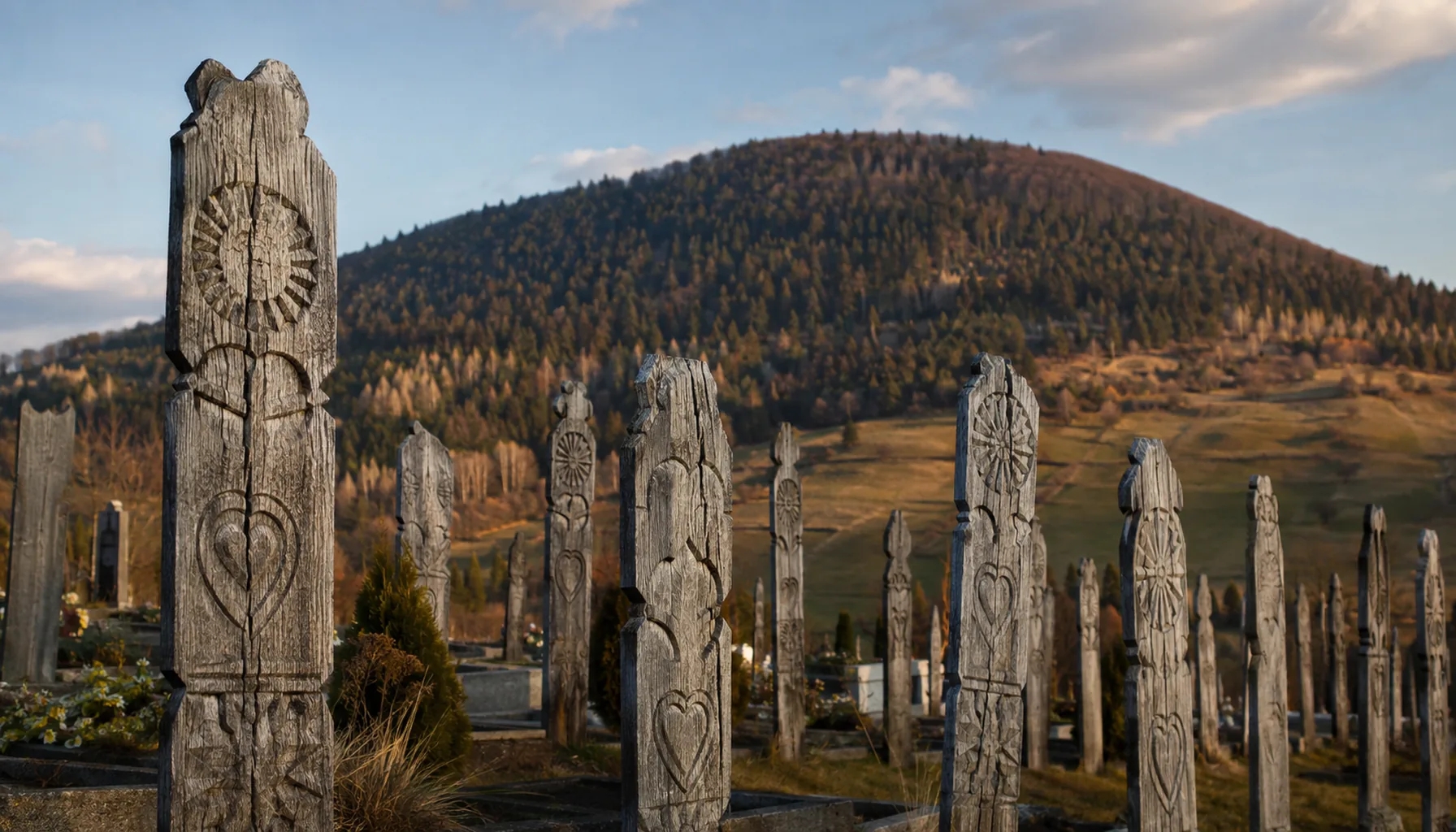
The cemetery is what most visitors remember. Detva's grave crosses are carved oak — tall, flat-fronted, cut with sun discs, hearts, birds and geometric patterns, every one different, the older ones weathered to a silver-grey. There is no real parallel to them elsewhere in Slovakia, and ten minutes among them explains more about this district than an exhibition could.To, čo si väčšina návštevníkov zapamätá, je cintorín. Detvianske náhrobné kríže sú vyrezané z duba — vysoké, s plochým čelom, zdobené slnečnými kotúčmi, srdcami, vtákmi a geometrickými vzormi, každý iný, staršie zvetrané do striebristo-sivej. Nič im na Slovensku naozaj neodpovedá a desať minút medzi nimi vysvetlí o tomto kraji viac než výstava.
It is the same craft as the shepherds' carving — the decorated crook, the horn, the wooden vessel — at the scale of a monument, by people whose main work was pasture and timber. The instrument from that tradition is the fujara, the long overblown shepherd's flute of this district, on UNESCO's list of intangible cultural heritage. Podpoľanie therefore holds two UNESCO designations of quite different kinds: a biosphere reserve for the mountain, an intangible listing for an instrument.Je to to isté remeslo ako pastierska rezba — zdobená valaška, roh, drevená nádoba — len v mierke pamätníka a od ľudí, ktorých hlavnou prácou boli pasienky a drevo. Nástrojom z tej istej tradície je fujara, dlhá pretlačovaná pastierska píšťala tohto kraja, zapísaná v zozname nehmotného kultúrneho dedičstva UNESCO. Podpoľanie tak drží dva zápisy UNESCO celkom odlišného druhu: biosférickú rezerváciu pre horu a nehmotné dedičstvo pre nástroj.
Hold on to one thing: this is a working cemetery, where the town buries its dead, not an open-air museum. Go quietly.Jedno si zapamätajte: je to funkčný cintorín, na ktorom mesto pochováva svojich mŕtvych, nie skanzen. Správajte sa ticho.
Sixteen videos for Culture in Detva.Šestnásť videí — Kultúra v Detve.