Banská Bystrica region · TownsBanskobystrický kraj · Mestá
DetvaDetva
A seventeenth-century foundation under the volcanic dome of Poľana, surrounded by scattered hillside farmsteads, known for its carved oak grave crosses and for the folk festival that fills its amphitheatre every July.Obec založená v sedemnástom storočí pod sopečnou klenbou Poľany, obklopená roztrúsenými lazmi, známa vyrezávanými dubovými krížmi na cintoríne a folklórnymi slávnosťami, ktoré každý júl zaplnia jej amfiteáter.
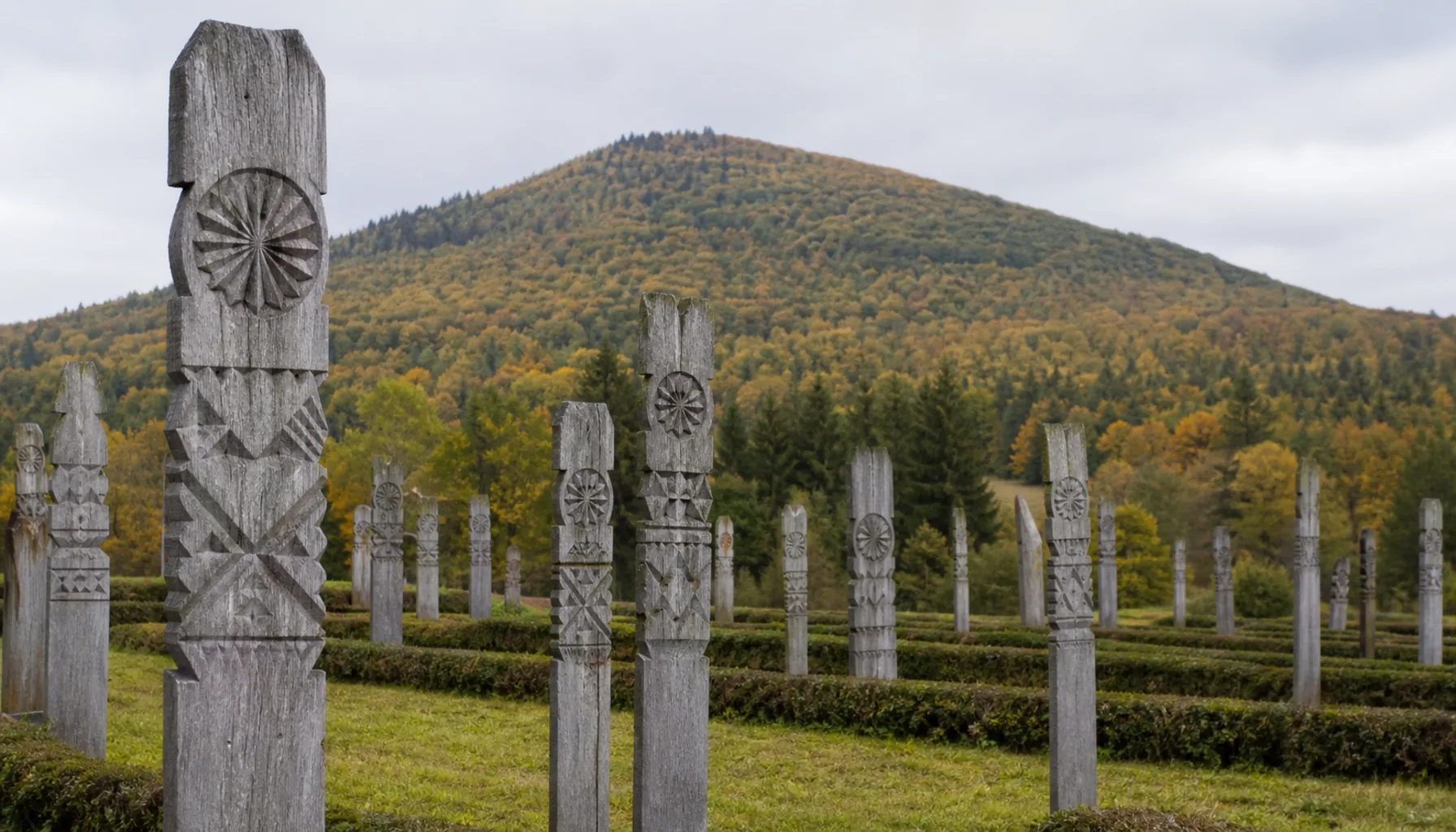
Carved oak grave crosses in the cemetery at Detva, with Poľana behindVyrezávané dubové kríže na detvianskom cintoríne, v pozadí Poľana
Where it standsKde leží
Detva lies in the Podpoľanie, the country under Poľana, about twenty kilometres east of Zvolen on the road towards Lučenec. Poľana itself — a broad forested volcanic massif, the largest of its kind in Slovakia and a UNESCO biosphere reserve — fills the northern skyline, and the Slatina runs below the town.Detva leží v Podpoľaní, v kraji pod Poľanou, asi dvadsať kilometrov východne od Zvolena na ceste smerom na Lučenec. Samotná Poľana — rozložitý zalesnený sopečný masív, najväčší svojho druhu na Slovensku a biosférická rezervácia UNESCO — vypĺňa severný obzor a pod mestom tečie Slatina.
The settlement pattern here is unusual and worth understanding before you drive around: besides the compact town, the district is covered in lazy — single farmsteads and small clusters scattered high on the hillsides, reached by narrow roads and many of them still lived in.Spôsob osídlenia je tu nezvyčajný a pred cestou po okolí sa oplatí mu porozumieť: okrem samotného mesta pokrývajú okres lazy — samoty a drobné zhluky usadlostí roztrúsené vysoko po svahoch, dostupné úzkymi cestami a mnohé dodnes obývané.
The storyHistória
Detva is a late foundation by Slovak standards. The Vígľaš estate settled it in 1638, and the people who came were herders and woodsmen who cleared the slopes of Poľana and took their living from pasture, timber and small fields. The lazy are the physical record of that clearing, generation by generation.Detva je na slovenské pomery neskorou obcou. Vígľašské panstvo ju osadilo v roku 1638 a prišli sem pastieri a drevorubači, ktorí klčovali svahy Poľany a živili sa pašou, drevom a drobnými políčkami. Lazy sú fyzickým záznamom tohto klčovania, generáciu po generácii.
Isolation and poverty preserved a folk culture that was worn away elsewhere — the costume, the shepherds' instruments, the wood carving — and by the time collectors and scholars arrived in the nineteenth and twentieth centuries, Podpoľanie was one of the richest places in the country to find it. The town became an industrial one only in the 1950s, when a heavy engineering works was built on its edge.Odľahlosť a chudoba zachovali ľudovú kultúru, ktorá sa inde stratila — kroj, pastierske nástroje, rezbárstvo — a keď v devätnástom a dvadsiatom storočí prišli zberatelia a bádatelia, Podpoľanie bolo jedným z najbohatších miest v krajine, kde ju hľadať. Priemyselným mestom sa Detva stala až v päťdesiatych rokoch, keď na jej okraji postavili ťažký strojársky závod.
What to seeČo vidieť
The cemetery is what most visitors remember. Detva's carved oak grave crosses are a local craft with no real parallel elsewhere in Slovakia: tall, flat-fronted, cut with sun discs, hearts, birds and geometric patterns, each one different, the older ones weathered to silver-grey. It is a working cemetery, so treat it as one.Najviac si návštevníci zapamätajú cintorín. Detvianske vyrezávané dubové kríže sú miestnym remeslom bez skutočnej obdoby inde na Slovensku: vysoké, s plochým čelom, zdobené slnečnými kotúčmi, srdcami, vtákmi a geometrickými vzormi, každý iný, tie staršie ošľahané do striebrosivej. Je to fungujúci cintorín — správajte sa k nemu podľa toho.
In early July the amphitheatre below the town fills for the Podpoľanie folk festival, which has run since the 1960s and is one of the two or three that matter in Slovakia. It is a genuine gathering of village ensembles rather than a staged show, with the shepherds' dances, the axe-twirling and the fujara playing this district is known for.Začiatkom júla sa amfiteáter pod mestom zapĺňa na Folklórne slávnosti pod Poľanou, ktoré sa konajú od šesťdesiatych rokov a patria k dvom-trom najdôležitejším na Slovensku. Je to skutočné stretnutie dedinských súborov, nie inscenovaná šou — s pastierskymi tancami, krútením valašiek a hrou na fujaru, ktorou je tento kraj známy.
Poľana itself is the other reason to come: marked trails climb from the villages to the rim and the summit through beech forest and open pasture, and the massif's crater-like inner basin is one of the strangest pieces of landscape in the country. Vígľaš castle, rebuilt this century, stands on the road back towards Zvolen.Druhým dôvodom návštevy je samotná Poľana: značené chodníky stúpajú z dedín na okraj masívu a na vrchol, bukovým lesom a otvorenými pasienkami, a vnútorná kotlina masívu pripomínajúca kráter patrí k najzvláštnejším kusom krajiny v celej krajine. Na ceste späť do Zvolena stojí obnovený vígľašský zámok.
Work and industryPráca a priemysel
The engineering works built in the 1950s is still the town's largest employer, making heavy welded steel structures and undercarriage components for construction machinery — a business that rises and falls with the world market for excavators. Forestry, sawmilling and sheep and cattle farming on the Poľana pastures make up most of the rest, with tourism a small but growing share.Strojársky závod postavený v päťdesiatych rokoch je stále najväčším zamestnávateľom mesta — vyrába ťažké zvárané oceľové konštrukcie a časti podvozkov pre stavebné stroje, teda odvetvie, ktoré stúpa a klesá so svetovým dopytom po bagroch. Väčšinu zvyšku tvorí lesníctvo, píly a chov oviec a dobytka na poľanských pasienkoch, s malým, ale rastúcim podielom cestovného ruchu.
Getting thereAko sa tam dostať
The railway between Zvolen and Lučenec runs through the Slatina valley below the town, though buses from Zvolen are more frequent and quicker. By car Detva is directly on the main road east from Zvolen; the lazy and the trailheads on Poľana need a car or a long walk.Železnica medzi Zvolenom a Lučencom vedie dolinou Slatiny pod mestom, autobusy zo Zvolena však premávajú častejšie a sú rýchlejšie. Autom leží Detva priamo na hlavnej ceste zo Zvolena na východ; na lazy a k východiskám chodníkov na Poľanu treba auto alebo dlhú chôdzu.
Explore DetvaObjavujte Detva
Every part of this place with a page of its own.Každá časť tohto miesta, ktorá má vlastnú stránku.