Brezno · HorehronieBrezno · Horehronie
A market town on the upper Hron whose square has held a fair on the same August day since the Middle Ages, whose Lutheran pastor wrote the comedy that began Slovak amateur theatre, and whose forest railway runs because volunteers rebuilt it.Trhové mesto na hornom Pohroní, ktorého námestie drží jarmok na ten istý augustový deň od stredoveku, ktorého evanjelický farár napísal komédiu, ktorou sa začalo slovenské ochotnícke divadlo, a ktorého lesná železnica jazdí len preto, že ju obnovili dobrovoľníci.
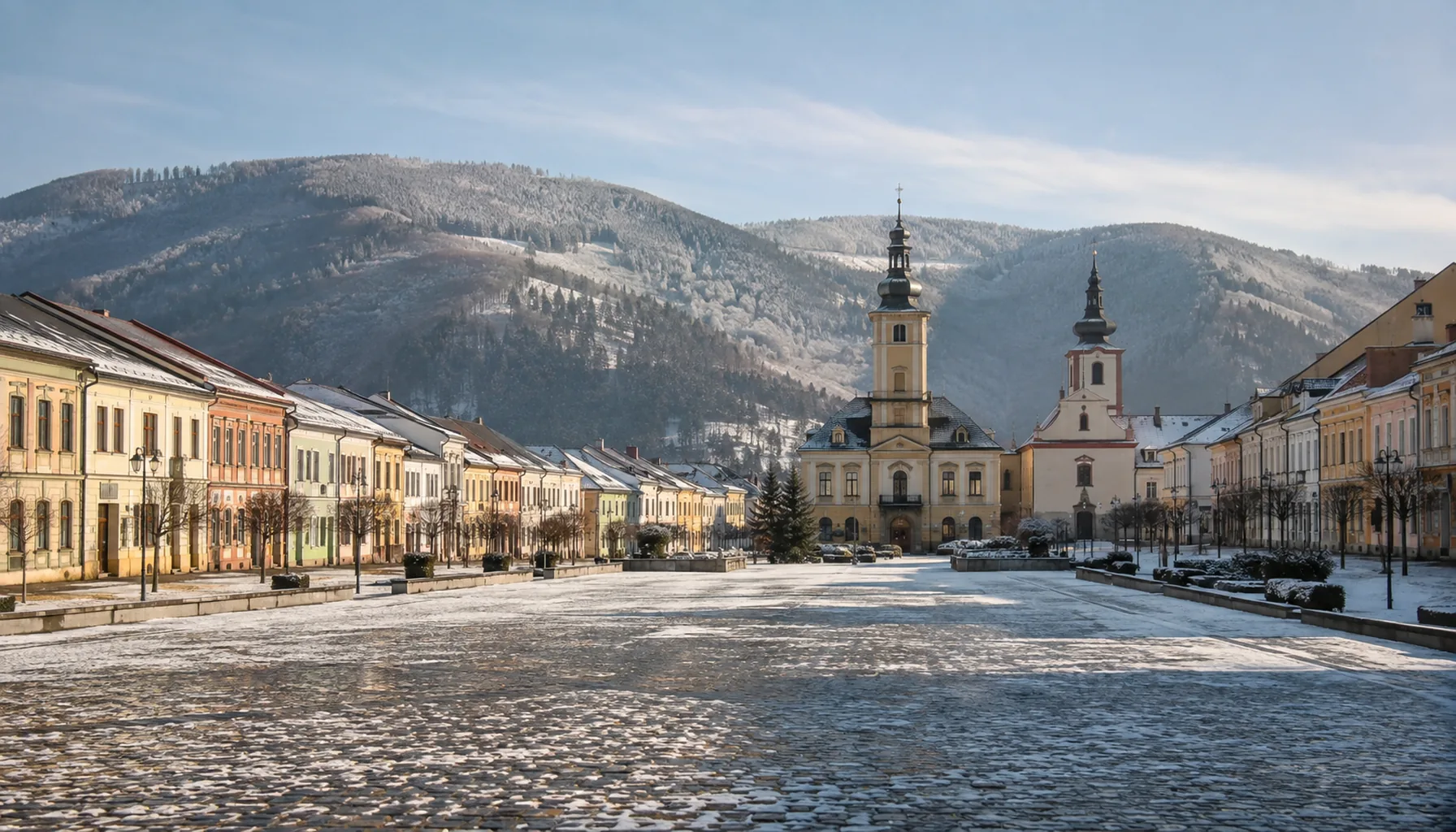
The square is the calendar, and it has a date. Louis I granted Brezno town privileges on 15 August 1380, and in 1488 Matthias Corvinus confirmed its right to a fair on 15 August, the town's patron day. The long square was built wide because it had to hold that fair, and it is still where the town's public life happens — the seasonal markets, the one before Christmas among them, in the open rather than in a hall.Kalendárom je námestie a má svoj dátum. Ľudovít I. udelil Breznu mestské výsady 15. augusta 1380 a v roku 1488 Matej Korvín potvrdil právo na jarmok 15. augusta, v deň patrocínia mesta. Dlhé námestie postavili široké preto, že ten jarmok muselo pojať, a dodnes je miestom verejného života mesta — sezónnych trhov vrátane predvianočného, vonku a nie v sále.
Summer is the folk season in this valley, and the valley's own music is the reason to pay attention. The multipart singing of Horehronie — several voices carried at once, learned by ear and still sung by village groups here — is inscribed on UNESCO's list of intangible cultural heritage. The biggest gatherings of it are held further up the Hron in the villages rather than in Brezno, so ask locally which weekend before planning around one.Leto je v tomto údolí folklórnou sezónou a hudba samotného údolia je dôvodom, prečo si ju všímať. Viachlasný spev Horehronia — niekoľko hlasov naraz, naučených sluchom a dodnes spievaných miestnymi skupinami — je zapísaný v zozname nehmotného kultúrneho dedičstva UNESCO. Najväčšie stretnutia sa konajú vyššie hore Hronom v dedinách, nie v Brezne, takže sa vopred spýtajte miestnych, ktorý víkend to je.
The regional museum of Horehronie keeps its collections in the town hall on the square, and what it holds is what a mountain valley produces: herding and the high pastures, timber floated down the Hron on rafts, the small hammer mills of the side valleys, the costume. A district museum rather than a national one, and the right first hour in the town.Regionálne horehronské múzeum má zbierky v radnici na námestí a drží v nich to, čo horské údolie produkuje: pastierstvo a vysoké pasienky, drevo plavené po Hrone na pltiach, malé hámre v bočných dolinách, kroj. Okresné, nie národné múzeum — a správna prvá hodina v meste.
The other real collection is at Vydrovo, at the far end of the Čierny Hron forest railway: an open-air forestry museum along a valley walk, with the tools, huts, chutes and techniques of the men who worked these woods. The railway itself is what the district is best known for — narrow-gauge, built to reach country no road served, closed in the early 1980s once lorries took the work, and rebuilt and run from the 1990s by volunteers. That is why this is a heritage railway rather than a fairground ride.Druhá skutočná zbierka je vo Vydrove, na konci Čiernohronskej železnice: lesnícky skanzen pozdĺž náučnej doliny s náradím, chatrčami, sklzmi a postupmi ľudí, ktorí v týchto lesoch pracovali. Samotná železnica je tým, čím je okres najznámejší — úzkokoľajka do krajiny bez ciest, zavretá začiatkom osemdesiatych rokov, keď prácu prevzali nákladné autá, a od deväťdesiatych rokov obnovená a prevádzkovaná dobrovoľníkmi. Preto je to historická dráha, a nie púťová atrakcia.
The rest is the ordinary cultural life of a district town: a cultural centre with a hall and a programme, a library, a school of art for children, choirs and folk ensembles adult and children's. We name none of them individually — programmes and premises change faster than a page like this does, and the town's own noticeboards are the reliable source.Ostatné je bežný kultúrny život okresného mesta: kultúrne stredisko so sálou a programom, knižnica, základná umelecká škola, zbory a folklórne súbory dospelých aj detské. Jednotlivo ich nemenujeme — programy a priestory sa menia rýchlejšie než takáto stránka a spoľahlivým zdrojom sú oznamy mesta.
The long square is the monument: a wide open space closed at its head by the parish church and the town hall, with burghers' and craftsmen's houses down both sides, built as a place to trade in and still used as one. This is a working square, not a museum square.Pamiatkou je to dlhé námestie: široký otvorený priestor, na ktorého čele stojí farský kostol a radnica, po oboch stranách meštianske a remeselnícke domy, postavený na obchod a dodnes tak používaný. Je to pracovné, nie múzejné námestie.
Most of what stands is younger than it looks. Plague passed through in 1708 and 1716, and in 1779 a fire burned 113 houses and most of the centre — the town hall on the square carries that year. Brezno was Lutheran and lost its church to the Jesuits in 1694; when Joseph II's Patent of Toleration of 1781 allowed Protestants to build again, a Catholic and a Lutheran church went up over the next two decades, which is why a town this size has two large churches.Väčšina toho, čo stojí, je mladšia, než sa zdá. Mor prešiel mestom v rokoch 1708 a 1716 a v roku 1779 zhorelo 113 domov a väčšina centra — radnica na námestí nesie práve tento rok. Brezno bolo evanjelické a v roku 1694 prišlo o kostol v prospech jezuitov; keď tolerančný patent Jozefa II. z roku 1781 dovolil protestantom znova stavať, počas dvoch desaťročí vyrástol katolícky aj evanjelický kostol — preto má mesto tejto veľkosti dva veľké chrámy.
No aristocracy built any of it. Brezno was a royal town, free from 1650, and its money came from cattle and sheep, timber floated down the Hron and iron worked in small hammer mills; there is no castle over the town. Heritage of another kind stands downstream at Podbrezová, where an ironworks begun in 1840 rolled its first rails in 1854, took a tube mill in 1930 and is still working.Nič z toho nestavala šľachta. Brezno bolo kráľovské mesto, od roku 1650 slobodné, a peniaze mu prinášal dobytok a ovce, drevo plavené po Hrone a železo z malých hámrov; nad mestom nestojí hrad. Dedičstvo iného druhu stojí po prúde v Podbrezovej, kde železiareň založená v roku 1840 vyvalcovala prvé koľajnice v roku 1854, v roku 1930 dostala valcovňu rúr a pracuje dodnes.
In 1824 Ján Chalupka became Lutheran pastor in Brezno, and he stayed until he died here in 1871. In 1830 he wrote Kocúrkovo, a comedy about a small town full of self-important people ashamed of speaking their own language. It was the beginning of Slovak amateur theatre, and it was written in a parsonage on this market square in the mountains.V roku 1824 sa Ján Chalupka stal evanjelickým farárom v Brezne a zostal ním až do svojej smrti tu v roku 1871. V roku 1830 napísal Kocúrkovo, komédiu o mestečku plnom nafúkaných ľudí, ktorí sa hanbia za vlastnú reč. Bol to začiatok slovenského ochotníckeho divadla — a napísalo sa na fare pri tomto horskom trhovom námestí.
The word outlasted the play. Kocúrkovo is still Slovak shorthand for provincial nonsense, which means a national literature began with a joke about a place exactly like the one its author lived in — and the joke was affectionate enough that the town has never disowned it.Slovo prežilo hru. Kocúrkovo je dodnes slovenským označením pre malomeštiacku hlúposť, čiže národná literatúra sa začala vtipom o mieste presne takom, v akom autor žil — a vtip bol dosť láskavý na to, aby sa ho mesto nikdy nezrieklo.
Sixteen videos for Culture in Brezno.Šestnásť videí — Kultúra v Brezne.