Banská Štiavnica · Štiavnica HillsBanská Štiavnica · Štiavnické vrchy

Culture in Banská ŠtiavnicaKultúra v Banskej Štiavnici

A UNESCO town in a volcanic bowl, where one September procession carries the year, every museum is a mining museum, and the reservoirs the miners built are now where the town swims.Mesto zo zoznamu UNESCO v sopečnej kotline, kde rok nesie jeden septembrový sprievod, každé múzeum je baníckym múzeom a nádrže, ktoré postavili baníci, sú dnes miestom, kde sa mesto kúpe.

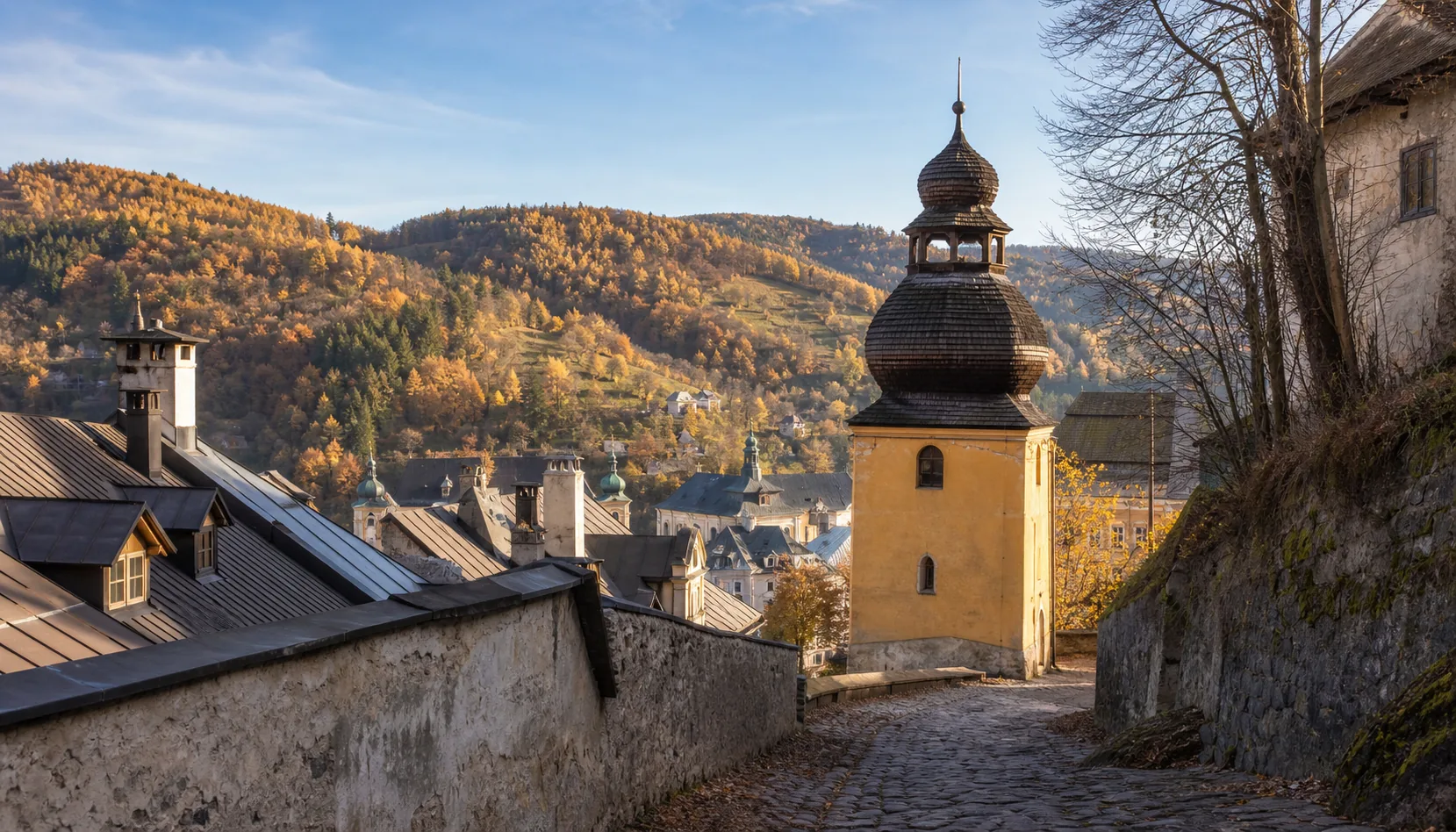
The Klopačka, the little tower whose wooden clapper once called the miners of Banská Štiavnica to their shift, on a lane above the old town
The Klopačka, the little tower whose wooden clapper once called the miners of Banská Štiavnica to their shift, on a lane above the old town.Klopačka — vežička, ktorej drevené klepadlo kedysi zvolávalo štiavnických baníkov na šichtu — stojí na uličke nad starým mestom.

The year in Banská ŠtiavnicaRok v Banskej Štiavnici

One date carries the calendar. Every September the Salamander winds through the streets after dark, a costumed procession named for the shape the line of lamps makes coming down the slope. It is the one weekend when as many people are in the town as it can hold.Kalendár nesie jediný termín. Každý september sa po zotmení vinie ulicami Salamander, kostýmovaný sprievod pomenovaný podľa tvaru, aký robí rad lampášov schádzajúci po svahu. Je to jediný víkend, keď je v meste toľko ľudí, koľko sa doň zmestí.

The rest is shaped by season rather than programme. Ore mining ended in the early 1990s and the town lives on what it used to be — museums, restoration work, schools and visitors — so it is busy from spring to autumn and quiet in winter. Summer brings a shifting set of small festivals, run in good part by incomers who repaired the empty houses after 1993. We do not list them: organisers and dates change, and the town's own listings are the reliable source.Zvyšok určuje sezóna, nie program. Ťažba rudy sa skončila začiatkom deväťdesiatych rokov a mesto žije z toho, čím kedysi bolo — z múzeí, obnovy pamiatok, škôl a návštevníkov — takže od jari do jesene je rušné a v zime tiché. Leto prináša premenlivú sadu malých festivalov, ktoré robia z veľkej časti prisťahovalci, čo si po roku 1993 opravili prázdne domy. Nevymenúvame ich: organizátori a termíny sa menia a spoľahlivým zdrojom sú oznamy mesta.

Where culture livesKde žije kultúra

The Slovak Mining Museum is the central institution and it is not one building. It runs a group of sites across the town and the valley, including the Old Castle and an open-air mining museum where the visit goes underground in a helmet, into a real adit rather than a mock-up. The dispersal is the point: the museum is the town taken apart and explained.Ústrednou inštitúciou je Slovenské banské múzeum a nie je to jedna budova. Spravuje skupinu objektov po meste a údolí, medzi nimi Starý zámok a banské múzeum v prírode, kde sa návšteva v prilbe spúšťa pod zem — do skutočnej štôlne, nie do kulisy. Práve v tej rozptýlenosti je pointa: múzeum je rozobraté a vysvetlené mesto.

Teaching is the town's other identity. A mining school opened in 1735 with the surveyor Samuel Mikovíni as its first professor, and Vienna raised it into an academy for the whole monarchy in 1762 — the first institution anywhere to teach mining and metallurgy as sciences, in laboratories where students did the experiments themselves. In 1919 it moved to Sopron with its teachers, students and collections, leaving the buildings, the botanical garden it planted, and a town that still thinks of itself as a school.Druhou identitou mesta je vyučovanie. Banská škola tu vznikla v roku 1735 s markšajdrom Samuelom Mikovínim ako prvým profesorom a Viedeň ju v roku 1762 povýšila na akadémiu pre celú monarchiu — prvú inštitúciu na svete, ktorá učila baníctvo a hutníctvo ako vedy, v laboratóriách, kde si študenti robili pokusy sami. V roku 1919 sa presťahovala do Šopronu aj s učiteľmi, študentmi a zbierkami; zostali budovy, botanická záhrada, ktorú vysadila, a mesto, ktoré sa dodnes vníma ako škola.

The rest is what any small town keeps — a cultural centre, a library, an art school for children, galleries that come and go with the people running them. A few kilometres away at Svätý Anton a furnished manor house with a hunting museum and a park makes the obvious half-day pairing.Zvyšok je to, čo má každé malé mesto — kultúrne stredisko, knižnica, základná umelecká škola, galérie, ktoré vznikajú a zanikajú s ľuďmi, čo ich vedú. Pár kilometrov odtiaľto ponúka Svätý Anton zariadený kaštieľ s poľovníckym múzeom a parkom — zrejmú polovicu dňa navyše.

The buildings that carry itBudovy, ktoré ju nesú

Trinity Square is the centre and the best single hour here: tilted, irregular, closed by a plague column and ringed by the houses of mine owners, with lanes of Renaissance and Baroque houses dropping away in every direction. No flat ground: the town is built in terraces. In 1690 the mines raised 605 kilograms of gold and 29 tonnes of silver, and the square is what that money looked like once it was spent.Námestie svätej Trojice je stredom mesta a najlepšou hodinou, akú v ňom strávite: šikmé, nepravidelné, uzavreté morovým stĺpom a obkolesené domami majiteľov baní, s uličkami renesančných a barokových domov padajúcimi na všetky strany. Rovná zem tu nie je: mesto stojí na terasách. V roku 1690 bane vydali 605 kilogramov zlata a 29 ton striebra — a námestie je to, ako tie peniaze vyzerali, keď sa minuli.

Two castles look at each other across the roofs. Between 1546 and 1559 the town turned its Romanesque church of the Virgin Mary into a fortress — the Old Castle, a church with gun platforms — and between 1564 and 1571 built the white New Castle on the opposite slope as a watchtower against raids from the south. The Ottomans never took Banská Štiavnica. Above the old centre stands the Klopačka of 1681, whose wooden clapper woke the miners for the shift and announced a death in the pits.Dva hrady sa na seba pozerajú ponad strechy. V rokoch 1546 až 1559 mesto premenilo svoj románsky kostol Panny Márie na pevnosť — Starý zámok, kostol s delovými plošinami — a v rokoch 1564 až 1571 postavilo na náprotivnom svahu biely Nový zámok ako strážnu vežu proti nájazdom z juhu. Osmani Banskú Štiavnicu nikdy nedobyli. Nad starým centrom stojí Klopačka z roku 1681, ktorej drevené kladivo budilo baníkov na šichtu a ohlasovalo smrť v bani.

Above the town a Baroque calvary climbs a volcanic cone in a line of chapels, finished in 1751 on the initiative of the Jesuit František Perger and under repair for years after a century of neglect. What UNESCO inscribed in December 1993 was the town together with its technical monuments — shafts, adits and the water system — because the engineering and the streets cannot be listed apart. A fire in the centre in March 2023 damaged seven buildings.Nad mestom stúpa po sopečnom kuželi barokový kalvárny areál v rade kaplniek, dokončený v roku 1751 z podnetu jezuitu Františka Pergera a po storočí chátrania už roky v obnove. To, čo UNESCO v decembri 1993 zapísalo, bolo mesto spolu s technickými pamiatkami — šachtami, štôlňami a vodohospodárskym systémom — pretože inžinierstvo a ulice sa nedajú zapísať osobitne. Požiar v centre v marci 2023 poškodil sedem budov.

Water the miners builtVoda, ktorú postavili baníci

Deep shafts filled faster than men and horses could empty them, so the answer was to make water do the work. Sixty tajchy were built between the early sixteenth century and the middle of the nineteenth: hillside reservoirs holding some seven million cubic metres, fed by kilometres of contoured channels and released through wheels that drove the pumps. The engineers were Matej Kornel Hell, his son Jozef Karol Hell and Samuel Mikovíni.Hlboké šachty sa zapĺňali rýchlejšie, než ich stíhali vyprázdňovať ľudia a kone, takže odpoveďou bolo dať pracovať samotnú vodu. Medzi začiatkom šestnásteho a polovicou devätnásteho storočia vzniklo šesťdesiat tajchov: nádrží vo svahoch s objemom asi sedem miliónov kubických metrov, napájaných kilometrami jarkov vedených po vrstevniciach a púšťaných na kolesá, ktoré poháňali čerpadlá. Inžiniermi boli Matej Kornel Hell, jeho syn Jozef Karol Hell a Samuel Mikovíni.

Twenty-three of the sixty still hold water and are now swimming lakes ringed by forest — Klinger, Počúvadlo and Veľká Richňava among them — with paths between them following the old channels, so a walk here traces the contour of an eighteenth-century machine. Sitno rises straight above Počúvadlo, the highest hill of the range and the one carrying the most legends.Dvadsaťtri zo šesťdesiatich dodnes držia vodu a sú z nich kúpacie jazerá obkolesené lesom — okrem iných Klinger, Počúvadlo a Veľká Richňava — pričom chodníky medzi nimi vedú po starých jarkoch, takže prechádzka tu kopíruje vrstevnicu stroja z osemnásteho storočia. Priamo nad Počúvadlom sa dvíha Sitno, najvyšší vrch pohoria a ten s najviac povesťami.

← Banská Štiavnica← Banská Štiavnica

WatchPozrite si

Sixteen videos for Culture in Banská Štiavnica.Šestnásť videí — Kultúra v Banskej Štiavnici.