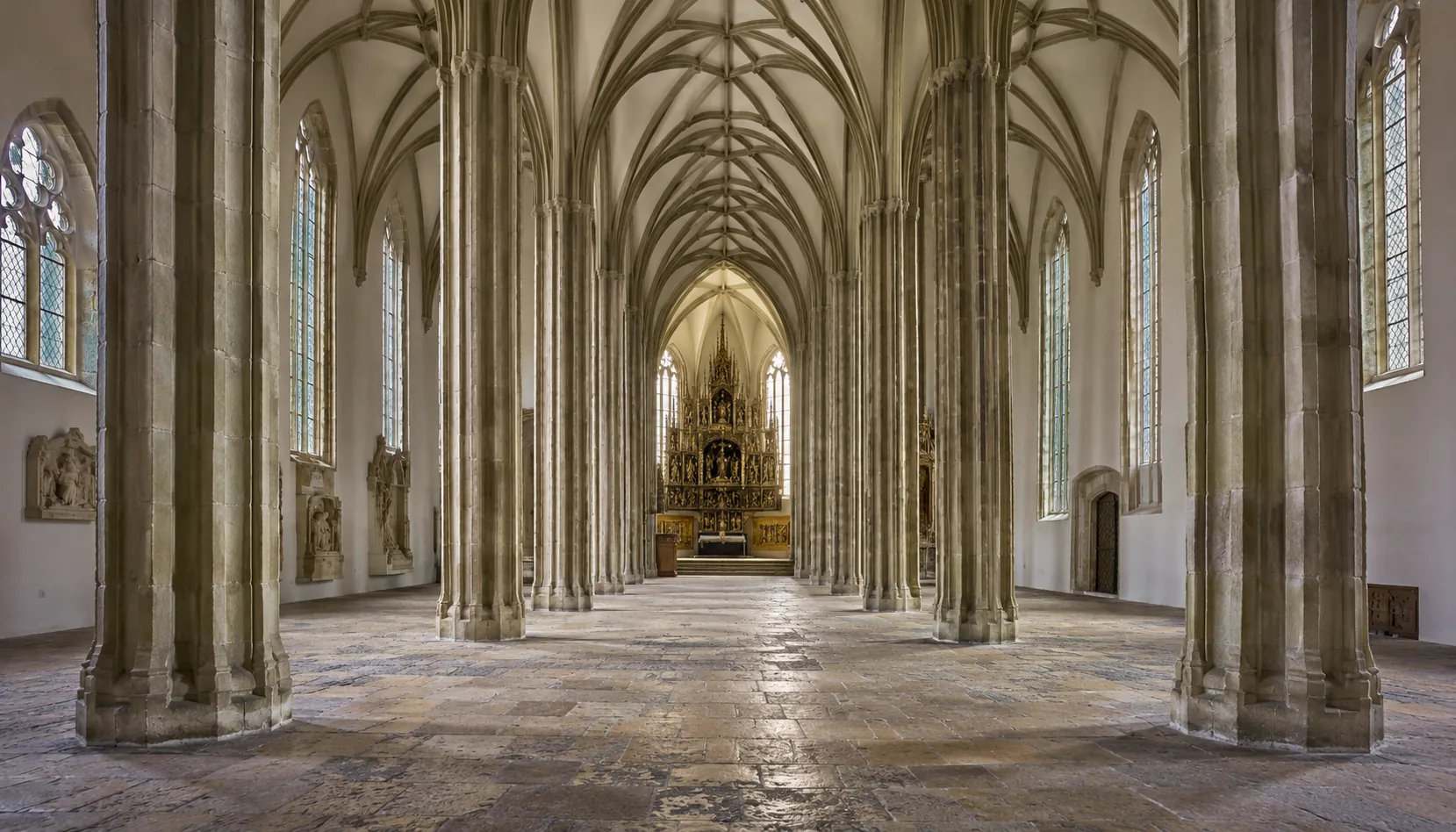
The mining money of the fourteenth and fifteenth centuries went into hall churches, carved altars and town halls, and the poverty of the centuries after them is why so much of it is still standing.Banské peniaze 14. a 15. storočia sa premenili na halové kostoly, vyrezávané oltáre a radnice — a chudoba nasledujúcich storočí je dôvod, prečo z toho toľko stojí dodnes.
The hall interior of a Slovak Gothic churchHalový interiér slovenského gotického kostola
Hall churchesHalové kostoly
The great Gothic churches follow the ore and the trade routes. Košice has St Elisabeth, the largest church in Slovakia and one of the easternmost Gothic cathedrals in Europe; Bardejov has St Egidius on its square; Levoča has St James with the Master Paul altar; Kežmarok, Spišská Nová Ves, Prešov, Bratislava and Banská Bystrica each have their own.Veľké gotické kostoly sledujú rudu a obchodné cesty. Košice majú Dóm svätej Alžbety, najväčší kostol na Slovensku a jednu z najvýchodnejších gotických katedrál v Európe; Bardejov má na námestí Chrám svätého Egídia; Levoča Chrám svätého Jakuba s oltárom Majstra Pavla; a svoj má aj Kežmarok, Spišská Nová Ves, Prešov, Bratislava či Banská Bystrica.
Most are hall churches — nave and aisles the same height, so the interior reads as one wide room rather than a tunnel with side passages. It is the central European form, it suits a merchant congregation that wants to see and hear, and it is the single most recognisable thing about a Slovak Gothic interior.Väčšina z nich sú halové kostoly — hlavná loď aj bočné lode rovnako vysoké, takže vnútro pôsobí ako jedna široká miestnosť, nie ako tunel s bočnými chodbami. Je to stredoeurópska podoba, vyhovuje meštianskemu spoločenstvu, ktoré chce vidieť a počuť — a je najrozpoznateľnejšou črtou slovenského gotického interiéru.
Altars and frescoesOltáre a fresky
Inside them is the carving. Slovakia holds an unusual density of late-Gothic winged altars, because they were never swept away: the Reformation here was moderate, the Counter-Reformation added Baroque furniture around them rather than replacing them, and the towns that owned them were later too poor to modernise. Levoča's altar is the tallest known anywhere, but the ones in Bardejov, Spišská Sobota and a dozen village churches are the same tradition.Vnútri je rezbárstvo. Slovensko má nezvyčajnú hustotu neskorogotických krídlových oltárov, lebo ich nikto nezmietol: reformácia tu bola umiernená, protireformácia okolo nich pridala barokové zariadenie namiesto toho, aby ich nahradila, a mestá, ktoré ich vlastnili, boli neskôr príliš chudobné na modernizáciu. Levočský oltár je najvyšší známy na svete, ale tie v Bardejove, Spišskej Sobote a v desiatke dedinských kostolov patria do tej istej tradície.
The other survival is wall painting. In Gemer — Štítnik, Plešivec, Rimavské Brezovo — and at Žehra below Spiš Castle, medieval fresco cycles were whitewashed over during the Reformation and uncovered in the nineteenth and twentieth centuries, which is exactly why they survived at all.Druhým prežitkom je nástenná maľba. V Gemeri — Štítnik, Plešivec, Rimavské Brezovo — a v Žehre pod Spišským hradom stredoveké fresky počas reformácie zabielili a v 19. a 20. storočí ich znovu odkryli — a práve preto sa vôbec zachovali.
Town halls and wallsRadnice a hradby
Civil Gothic is thinner but real: the town halls at Levoča and Bardejov, the burgher houses behind the arcades on the long Spiš squares, and the town fortifications that survive in stretches at Bardejov, Levoča, Trnava and Kremnica.Svetská gotika je slabšie zastúpená, ale skutočná: radnice v Levoči a Bardejove, meštianske domy za podlubím na dlhých spišských námestiach a mestské opevnenia, ktoré sa v úsekoch zachovali v Bardejove, Levoči, Trnave a Kremnici.
Two rules of thumb for looking: in the north and east the material is dressed stone and the roofs are steep; on the southern lowland the same period builds in brick, and the surviving Gothic there is mostly village church chancels swallowed by later naves.Dve pomôcky pri pozeraní: na severe a východe je materiálom opracovaný kameň a strechy sú strmé; na južnej nížine to isté obdobie stavia z tehly a tamojšia zachovaná gotika je väčšinou presbytérium dedinského kostola pohltené neskoršou loďou.