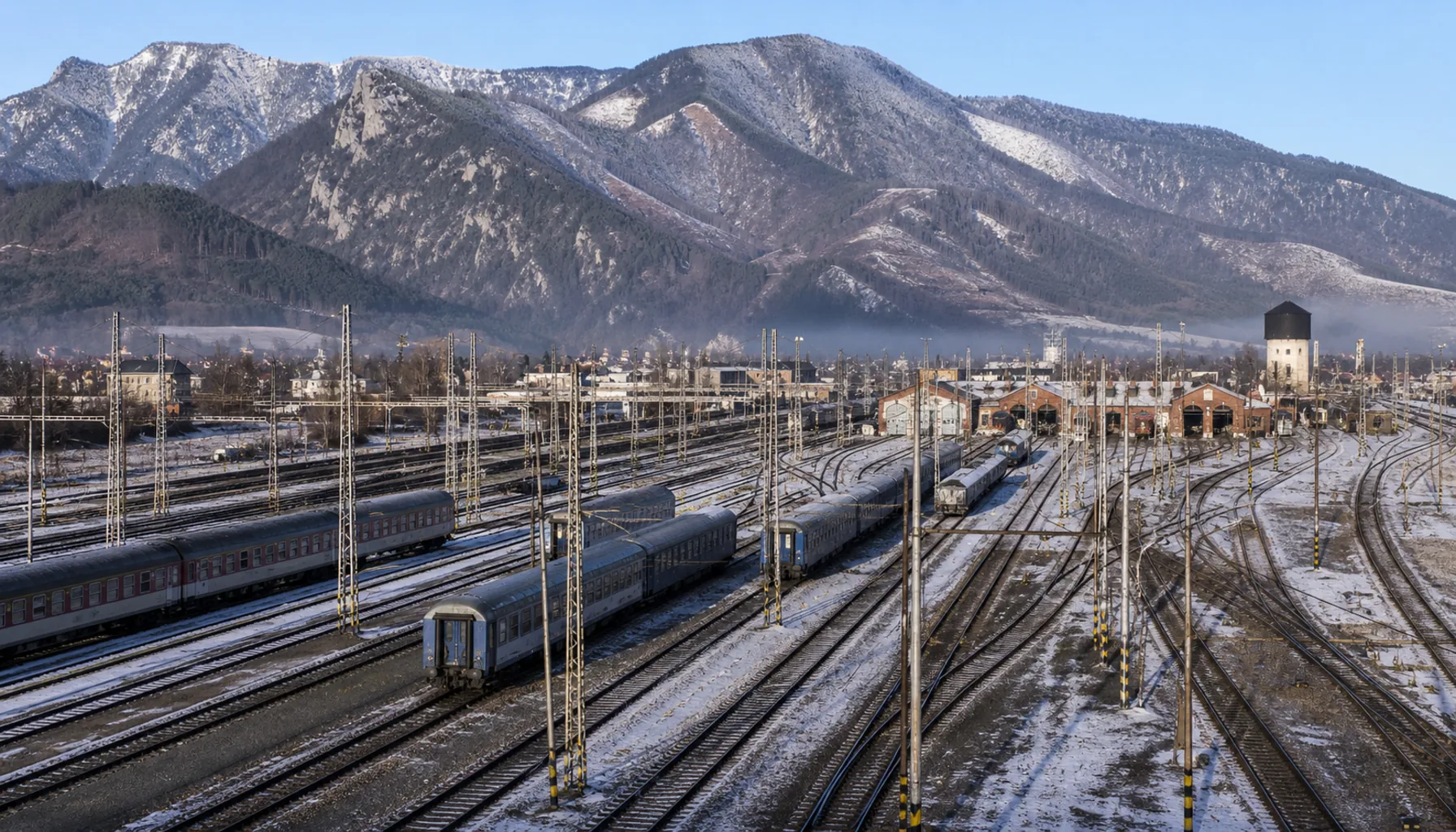
The railway town of the Turiec: a junction where the Košice–Bohumín line meets the line running south to Zvolen, with engine sheds, repair works and a century of railwaymen's housing, immediately north of Martin.Železničiarske mesto Turca: uzol, kde sa košicko-bohumínska trať stretáva s traťou smerujúcou na juh do Zvolena, s rušňovým depom, opravovňami a storočím železničiarskych kolónií, hneď severne od Martina.
The railway yards at Vrútky below the ridges of the Malá FatraŽelezničné koľajisko vo Vrútkach pod hrebeňmi Malej Fatry
Where it standsKde leží
Vrútky sits at the northern end of the Turiec basin, where the river Turiec comes down to meet the Váh and the basin narrows into the valley that carries road and railway on towards Žilina. The bare grassy ridge of the Martinské hole rises to the west; across the Váh to the north begins the Krivánska group of the Malá Fatra, the rockier half of that range.Vrútky ležia na severnom konci Turčianskej kotliny, tam, kde rieka Turiec schádza k Váhu a kotlina sa zužuje do doliny, ktorou pokračuje cesta aj železnica smerom na Žilinu. Na západe sa dvíha holý trávnatý hrebeň Martinských holí, na severe za Váhom sa začína krivánska časť Malej Fatry, skalnatejšia polovica pohoria.
Martin begins where Vrútky ends. The two towns run together along the valley floor and share buses, schools and a labour market, and for two decades in the late twentieth century they shared a town hall as well; Vrútky recovered its own council in 1990.Tam, kde končia Vrútky, sa začína Martin. Obe mestá na dne doliny plynulo prechádzajú jedno do druhého, delia sa o autobusy, školy aj pracovný trh a dve desaťročia na konci dvadsiateho storočia mali aj spoločnú radnicu; vlastné zastupiteľstvo získali Vrútky späť v roku 1990.
The storyHistória
Vrútky was an ordinary Turiec village until the railway arrived. The Košice–Bohumín line, built across the north of the kingdom to link the Silesian coalfields with the east, reached here in the early 1870s, and the line south through Turčianske Teplice and Kremnica to Zvolen and Budapest followed almost at once. A junction of two trunk routes needed engine sheds, sidings, water and workshops, and several hundred men to work them.Vrútky boli obyčajnou turčianskou dedinou, kým neprišla železnica. Košicko-bohumínska trať, stavaná naprieč severom krajiny, aby spojila sliezske uhoľné revíry s východom, sem dorazila začiatkom sedemdesiatych rokov devätnásteho storočia a takmer vzápätí ju doplnila trať na juh cez Turčianske Teplice a Kremnicu do Zvolena a Budapešti. Uzol dvoch hlavných tratí potreboval rušňové depo, odstavné koľaje, vodu a dielne — a niekoľko stoviek ľudí, ktorí to všetko obslúžia.
The town that grew around them was a company town in all but name: terraces of railway housing, a railwaymen's club and cultural house, schools and sports grounds paid for out of railway money. Under its Hungarian name, Ruttka, it was one of the busier junctions of the northern network, and its workforce was Slovak, Czech, Hungarian and German by turns.Mesto, ktoré okolo nich vyrástlo, bolo firemným mestom vo všetkom okrem mena: rady železničiarskych domov, železničiarsky klub a kultúrny dom, školy a ihriská platené zo železničných peňazí. Pod maďarským menom Ruttka patrilo k rušnejším uzlom severnej siete a jeho zamestnanci boli striedavo Slováci, Česi, Maďari aj Nemci.
The workshops repaired steam locomotives and, after them, diesel and electric traction; the trade outlasted every change of state the twentieth century imposed. In the autumn of 1944 the Turiec was insurgent territory during the Slovak National Uprising and the junction was something both sides wanted, and German units took the basin before the uprising withdrew into the mountains.Dielne opravovali parné rušne a po nich motorovú a elektrickú trakciu; toto remeslo prežilo každú zmenu štátu, akú dvadsiate storočie prinieslo. Na jeseň 1944 bol Turiec počas Slovenského národného povstania povstaleckým územím a o uzol stáli obe strany — nemecké jednotky kotlinu obsadili skôr, než sa povstanie stiahlo do hôr.
What to seeČo vidieť
Vrútky is not a monument town and makes no claim to be. What it has is a coherent piece of railway urbanism: the station and its approaches, the depot and its yards, and behind them the grid of railway houses and interwar blocks. It repays a slow walk rather than a checklist.Vrútky nie sú pamiatkovým mestom a ani sa tak netvária. Majú však ucelený kus železničiarskeho urbanizmu: stanicu a jej okolie, depo s koľajiskom a za nimi pravidelnú sieť železničiarskych domov a medzivojnových blokov. Odmenia skôr pomalú prechádzku než odškrtávanie zoznamu.
The country above the town is the usual reason to be here. Marked paths climb west onto the Martinské hole, bare ridges around fourteen hundred metres that hold snow into spring and carry the ski lifts above Martin. A short way up the Váh at Šútovo is the tallest waterfall in the Malá Fatra; downstream the river runs into the Strečno gorge below the castles at Strečno and Starhrad.Bežným dôvodom na návštevu je krajina nad mestom. Značené chodníky stúpajú na západ na Martinské hole, holé hrebene okolo tisícštyristo metrov, ktoré držia sneh do jari a nesú lyžiarske vleky nad Martinom. Kúsok proti prúdu Váhu, v Šútove, je najvyšší vodopád Malej Fatry; po prúde vteká rieka do Strečnianskej tiesňavy pod hradmi Strečno a Starhrad.
Martin's institutions — the National Cemetery, Matica slovenská, the Slovak National Library and the Museum of the Slovak Village on the wooded edge of town — are a few minutes away by bus and are covered elsewhere on this site.Martinské inštitúcie — Národný cintorín, Matica slovenská, Slovenská národná knižnica aj Múzeum slovenskej dediny na zalesnenom okraji mesta — sú pár minút autobusom a venujú sa im iné časti tejto stránky.
Work and industryPráca a priemysel
The railway is still the town's largest single trade. The repair works here overhaul rail vehicles and are the direct descendant of the nineteenth-century locomotive shops; the depot, the operating staff and the permanent-way crews add to that. It is unusual in Slovakia for the industry that founded a town to still be its main one.Železnica je stále najväčším odvetvím mesta. Tunajšie opravovne robia generálne opravy koľajových vozidiel a sú priamym pokračovaním rušňových dielní z devätnásteho storočia; k nim treba prirátať depo, prevádzkových zamestnancov aj traťové čaty. Na Slovensku je nezvyčajné, aby priemysel, ktorý mesto založil, bol dodnes jeho hlavným.
Beyond it most working residents commute the short distance into Martin — to its engineering plants, its university hospital and the medical faculty attached to it — while smaller engineering and joinery firms occupy the industrial ground along the valley floor.Popri nej väčšina pracujúcich obyvateľov dochádza tých pár kilometrov do Martina — do jeho strojárskych závodov, univerzitnej nemocnice a lekárskej fakulty pri nej — a na priemyselných plochách na dne doliny pôsobia menšie strojárske a stolárske firmy.
Getting thereAko sa tam dostať
Vrútky is a junction on the main line between Žilina and Košice and the starting point of the line south through Turčianske Teplice and Kremnica to Zvolen, so nearly everything that runs through the Turiec stops here. Buses to Martin are frequent, and by road the town lies on the route between Žilina and the Turiec, which follows the Váh through the Strečno gorge.Vrútky sú uzlom na hlavnej trati medzi Žilinou a Košicami a začiatkom trate na juh cez Turčianske Teplice a Kremnicu do Zvolena, takže tu zastavuje takmer všetko, čo Turcom prejde. Autobusy do Martina premávajú často a cestne leží mesto na spojnici Žiliny a Turca, ktorá vedie popri Váhu Strečnianskou tiesňavou.
Explore VrútkyObjavujte Vrútky
Every part of this place with a page of its own.Každá časť tohto miesta, ktorá má vlastnú stránku.