Turzovka · the upper KysucaTurzovka · horné Kysuce
A town whose year runs on the church calendar: the hill of Živčáková above it has drawn pilgrims since 1958, and below it lies a long valley town founded on a Thurzó estate in 1598.Mesto, ktorého rok sa riadi cirkevným kalendárom: na Živčákovú nad ním prichádzajú pútnici od roku 1958 a pod ňou leží dlhé údolné mesto, založené na thurzovskom panstve v roku 1598.
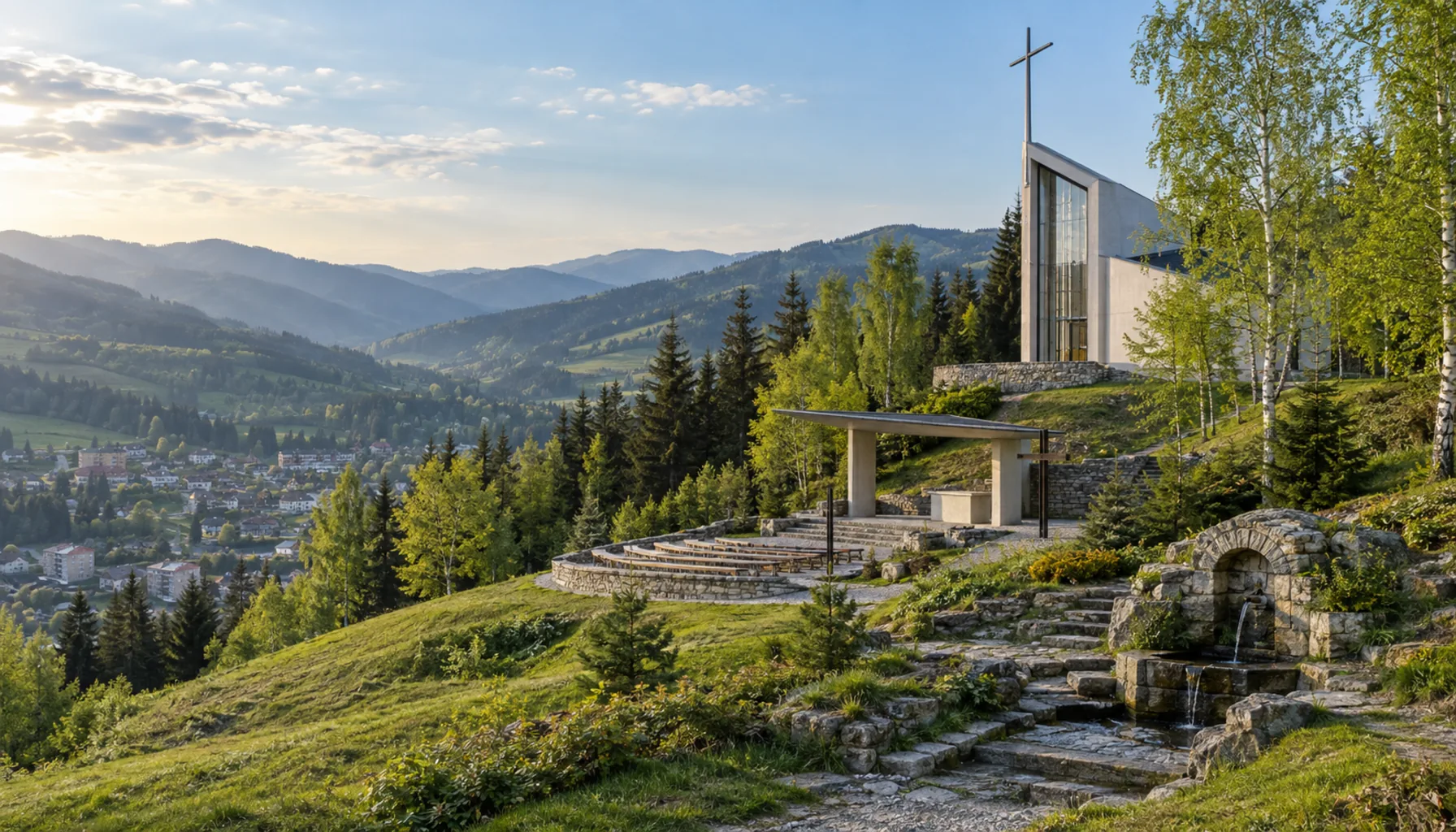
Turzovka's calendar is not the school one. The main pilgrimages to Živčáková, the hill above the town, fall in the warmer half of the year and fill the hillside, and the accommodation, catering and coach trade of the town run on those dates rather than on the holidays. It gives the place a summer shaped unlike any of its neighbours' in the Kysuce. On an ordinary Tuesday the same hill is birch and spruce and a view of the whole valley, with a few people at the spring.Kalendár Turzovky nie je školský. Hlavné púte na Živčákovú, vrch nad mestom, pripadajú na teplejšiu polovicu roka a zaplnia celý svah; ubytovanie, stravovanie aj zájazdová doprava v meste sa riadia týmito dátumami, nie prázdninami. Mesto tým dostáva leto, aké nemá žiadny jeho sused na Kysuciach. V bežný utorok je ten istý vrch brezami, smrekmi a výhľadom na celé údolie, s pár ľuďmi pri prameni.
Everything else is a valley town's ordinary year: the parish feasts, the programme of the cultural centre, and the events of the hillside hamlets, which are villages in everything but name and keep dates of their own. We name no individual festivals here, because a town of this size fixes them year by year and the reliable source is its own listings. What is worth knowing before you plan a visit is the scale of the place - Turzovka's territory is unusually large, and getting from one end of it to the other is a drive rather than a walk.Všetko ostatné je bežný rok údolného mesta: farské sviatky, program kultúrneho domu a podujatia kopaníc, ktoré sú dedinami vo všetkom okrem názvu a majú vlastné termíny. Jednotlivé slávnosti tu nemenujeme, lebo mesto tejto veľkosti si ich určuje rok po roku a spoľahlivým zdrojom sú jeho vlastné oznamy. Pred plánovaním návštevy sa oplatí vedieť, aké je to tu veľké - katastrálne územie Turzovky je nezvyčajne rozsiahle a z jedného konca na druhý sa ide autom, nie pešo.
Turzovka is a nineteenth- and twentieth-century town with a centre rebuilt over the last hundred years, and its indoor culture is the ordinary provision of a place this size: a cultural centre with a hall and a programme, a library, folk and singing groups, and a school of art for children. We do not name them individually - premises and programmes change faster than a page like this does, and the town's own noticeboard is the source to trust.Turzovka je mestom 19. a 20. storočia s centrom prestavaným za posledných sto rokov a jej kultúra pod strechou je bežnou výbavou mesta tejto veľkosti: kultúrne stredisko so sálou a programom, knižnica, folklórne a spevácke skupiny a základná umelecká škola pre deti. Jednotlivo ich nemenujeme - priestory a programy sa menia rýchlejšie než takáto stránka a zdrojom, ktorému treba veriť, je vlastná úradná tabuľa mesta.
The museums are half an hour east. Čadca holds the Kysuce Museum, and from the same direction you reach the open-air museum and the surviving switchback section of the forest railway at Vychylovka; both are covered elsewhere on this site. What Turzovka has instead of a museum quarter is the country itself - the ridges of the Javorníky carrying marked paths west to the Czech border, and Makov at the head of the valley as the local walking and ski base.Múzeá sú pol hodiny na východ. V Čadci sídli Kysucké múzeum a z toho istého smeru sa dostanete k skanzenu a zachovanému úvraťovému úseku lesnej železnice vo Vychylovke; obom sa venujeme inde na tejto stránke. Namiesto múzejnej štvrte má Turzovka samotnú krajinu - hrebene Javorníkov so značkovanými chodníkmi na západ k českej hranici a Makov na konci doliny ako miestnu turistickú a lyžiarsku základňu.
The building people come for is new. On Živčáková there is a spring pilgrims draw water from, an open-air altar and stations up the slope, and a large modern pilgrimage church dedicated to the Virgin Mary, Mother of the Church, consecrated in the 2010s. The devotion goes back to 1958, when Matúš Lašút, a forest worker from the town, reported the first of a series of visions. The distinction the Church draws is worth stating plainly: the Žilina diocese has recognised the place as one of pilgrimage without pronouncing on the apparitions themselves.Budova, pre ktorú sem ľudia chodia, je nová. Na Živčákovej je prameň, z ktorého pútnici naberajú vodu, poľný oltár a zastavenia po svahu a veľký moderný pútnický kostol zasvätený Panne Márii, Matke Cirkvi, posvätený v druhom desaťročí tohto storočia. Úcta sa datuje od roku 1958, keď Matúš Lašút, lesný robotník z mesta, ohlásil prvé zo série videní. Rozlíšenie, ktoré tu Cirkev robí, treba povedať priamo: Žilinská diecéza uznala miesto za pútnické, ale o samotných zjaveniach sa nevyslovila.
In the town below, the parish church and the long main street are what there is, and the oldest thing in Turzovka is not a building at all but a boundary. The settlement was founded in 1598, when the Bytča estate gave out land to forty settlers from Dlhé Pole with twelve years free of dues, and in 1602 Juraj Thurzó - head of the family and later palatine, the highest office in Hungary - issued the charter fixing its bounds and gave the place his name. The Thurzós were Lutherans and an evangelical church stood here by 1614; a Catholic parish is documented before 1674, and Catholic the valley has been since.V meste pod vrchom je farský kostol a dlhá hlavná ulica a najstaršou vecou v Turzovke nie je budova, ale hranica. Osada vznikla v roku 1598, keď bytčianske panstvo rozdalo pôdu štyridsiatim osadníkom z Dlhého Poľa s dvanástimi rokmi oslobodenia od dávok, a v roku 1602 Juraj Turzo - hlava rodu a neskôr palatín, najvyšší úrad v Uhorsku - vydal listinu, ktorá určila jej chotár, a dal miestu svoje meno. Turzovci boli luteráni a evanjelický kostol tu stál už v roku 1614; katolícka farnosť je doložená pred rokom 1674 a katolícke je toto údolie odvtedy.
The other inheritance is emigration, and the craft that went with it. Maria Theresa's census of 1784 counted 4 832 people in 864 houses here, and there were 5 740 by 1801 - far more than thin upland soil could feed. So the men went out to earn: first as seasonal harvest labour in the Hungarian lowland, then as drotári, travelling tinkers who bound cracked clay pots back together with wire and went on to make and sell wire ware. By the early twentieth century some five thousand tinkers were working out of Slovakia's poorest districts, with workshops as far away as Russia and the United States.Druhým dedičstvom je vysťahovalectvo a remeslo, ktoré k nemu patrí. Súpis Márie Terézie z roku 1784 tu narátal 4 832 ľudí v 864 domoch a v roku 1801 ich bolo 5 740 - oveľa viac, než dokázala uživiť chudobná horská pôda. Muži teda chodili zarábať: najprv na sezónne žatevné práce do uhorskej nížiny, potom ako drotári, vandrovní remeselníci, ktorí drôtom zväzovali prasknuté hlinené hrnce a neskôr drôtený tovar aj vyrábali a predávali. Začiatkom 20. storočia pracovalo z najchudobnejších slovenských okresov asi päťtisíc drotárov, s dielňami až v Rusku a Spojených štátoch.
Then the ridges emptied westward. Men went to the anthracite mines of Pennsylvania and the mills of Pittsburgh and Cleveland, meaning to come home and buy land, and the chain pulled cousins and neighbours after them until whole Kysuce hamlets had reassembled themselves in one American county. American quota laws closed that door in the 1920s and the traffic turned towards Moravia and Ostrava instead. It has never really stopped: since 2007 the Czech border beyond Makov has not been a border, and a job on the other side of it is an ordinary arrangement rather than an emigration.Potom sa kopanice vyprázdnili smerom na západ. Muži odchádzali do antracitových baní v Pensylvánii a do hút v Pittsburghu a Clevelande s tým, že sa vrátia a kúpia si pôdu, a reťaz za nimi ťahala bratrancov a susedov, až sa celé kysucké osady poskladali nanovo v jednom americkom okrese. Americké kvótové zákony túto cestu v dvadsiatych rokoch zavreli a prúd sa obrátil na Moravu a do Ostravy. Neprestal dodnes: od roku 2007 už česká hranica za Makovom nie je hranicou a práca na druhej strane je bežné usporiadanie, nie vysťahovanie.
Sixteen videos for Culture in Turzovka.Šestnásť videí — Kultúra v Turzovke.