Turčianske Teplice · Turiec spa townTurčianske Teplice · kúpeľné mesto v Turci
Culture in Turčianske TepliceKultúra v Turčianskych Tepliciach
A bath long before it was a town: the water has been used since the Middle Ages, the domed Blue Bath rebuilt in 1884 is still swum in daily, and the town's best-known name is a painter's.Kúpele boli oveľa skôr ako mesto: voda sa tu využíva od stredoveku, v kupolovom Modrom kúpeli prestavanom v roku 1884 sa dodnes denne pláva a najznámejšie meno mesta patrí maliarovi.
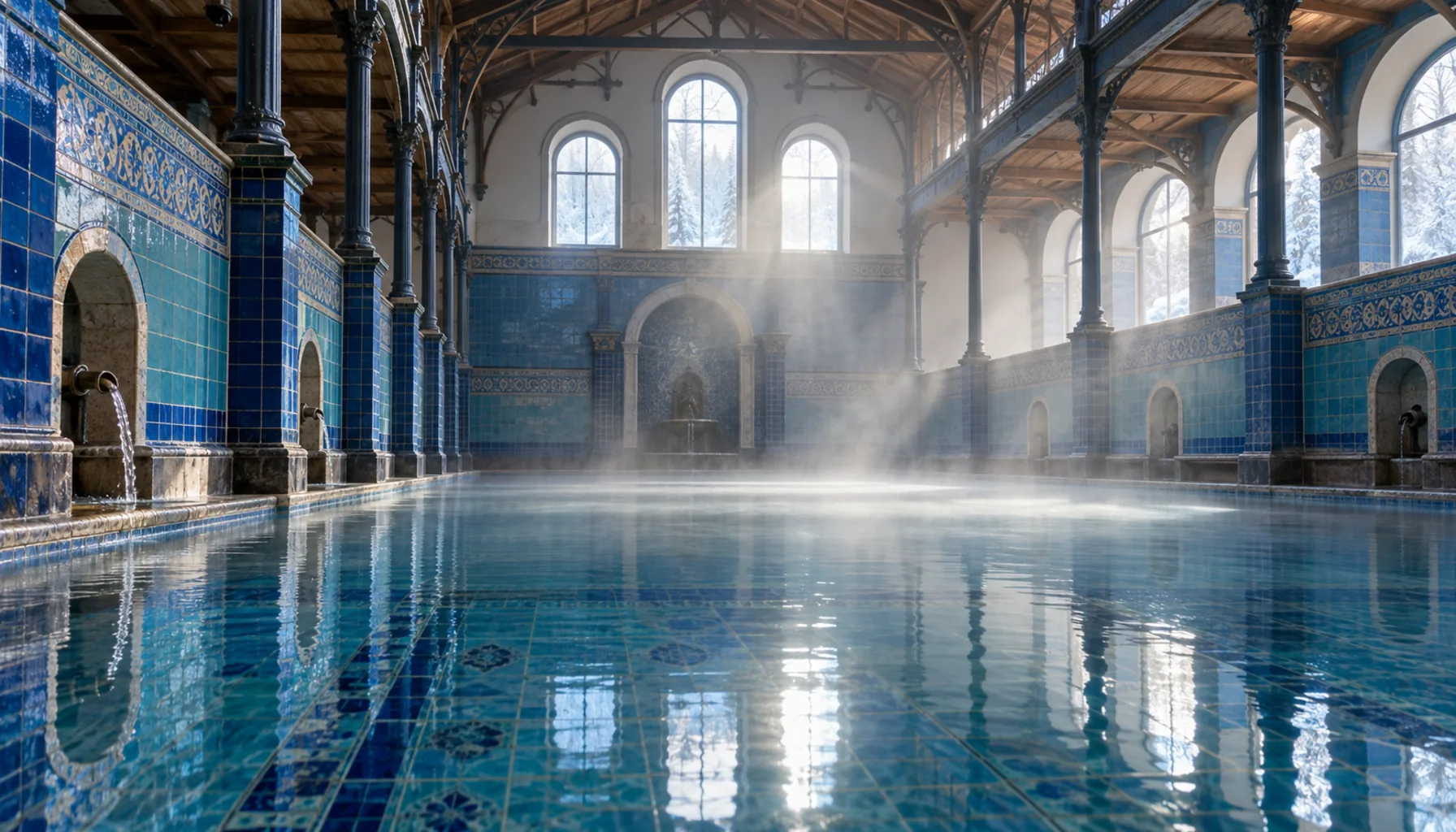
The Blue Bath at Turčianske Teplice: a tiled thermal pool under its nineteenth-century roof, still in daily use.Modrý kúpeľ v Turčianskych Tepliciach: obkladaný termálny bazén pod strechou z 19. storočia, dodnes v každodennej prevádzke.
The year in Turčianske TepliceRok v Turčianskych Tepliciach
The spa sets the year, and the point about a spa year is that it has no season. Treatment here has long been used for disorders of the joints and of the urinary tract, and it runs through the whole calendar, so the town is busy in February as well as in July. Two publics overlap in the same water: patients sent for a prescribed course measured in weeks, and families who come for an afternoon in the thermal pools. The town has been arranging itself around visitors since the railway over the pass was completed in 1872, and it shows.Rok určujú kúpele a na kúpeľnom roku je podstatné, že nemá sezónu. Liečba sa tu oddávna využíva pri ochoreniach kĺbov a močových ciest a beží celý kalendár, takže mesto je rušné vo februári rovnako ako v júli. V tej istej vode sa stretávajú dve rozdielne verejnosti: pacienti na predpísanom pobyte meranom na týždne a rodiny, ktoré prídu na popoludnie do termálnych bazénov. Mesto sa okolo návštevníkov organizuje od roku 1872, keď dokončili železnicu cez sedlo, a je to na ňom vidieť.
Around that runs the ordinary calendar of a district town - parish feasts, the programme of the cultural centre, the school year, concerts in the spa park in warm weather - and the commemorations. Turčianske Teplice was the seat of a revolutionary national committee and of an insurgent military hospital in the autumn of 1944, was liberated on 8 April 1945 and was later awarded the Commemorative Medal of the Slovak National Uprising; its monument to the fallen stands below the hill called Bôr. We name no individual events: the spa and the town both publish their own dates.Okolo toho beží bežný kalendár okresného mesta - farské sviatky, program kultúrneho strediska, školský rok, v teplých mesiacoch koncerty v kúpeľnom parku - a spomienkové podujatia. Turčianske Teplice boli na jeseň 1944 sídlom revolučného národného výboru a povstaleckej vojenskej nemocnice, 8. apríla 1945 ich oslobodili a neskôr dostali Pamätnú medailu Slovenského národného povstania; pamätník padlým stojí pod vrchom Bôr. Jednotlivé podujatia tu nemenujeme: kúpele aj mesto zverejňujú vlastné termíny.
Where culture livesKde žije kultúra
The one indoor stop with a name worth printing is Mikuláš Galanda's. He was born here on 4 May 1895 and became, with Ľudovít Fulla of Ružomberok, one of the two founders of modern Slovak painting; in the early 1930s the pair published their Private Letters together, a manifesto for an art that would be modern and Slovak at once. He died in Bratislava on 5 June 1938, aged forty-three. His birth house has held a permanent exhibition of his work since 1991, and the town gallery carries his name.Jediná zastávka pod strechou, ktorej meno stojí za vytlačenie, patrí Mikulášovi Galandovi. Narodil sa tu 4. mája 1895 a spolu s Ľudovítom Fullom z Ružomberka sa stal jedným z dvoch zakladateľov moderného slovenského maliarstva; začiatkom tridsiatych rokov spolu vydali Súkromné listy, manifest umenia, ktoré malo byť moderné a slovenské zároveň. Zomrel v Bratislave 5. júna 1938 vo veku štyridsaťtri rokov. Jeho rodný dom má od roku 1991 stálu expozíciu jeho diela a mestská galéria nesie jeho meno.
The rest is a district town's ordinary provision - a cultural centre with a hall, a library, a school of art for children, and the spa's own programme for its guests. We do not name them individually, because premises and programmes change faster than a page like this does. For anything larger, Martin is twenty kilometres north and Kremnica, with its mint still working, is over the pass to the south; both are covered elsewhere on this site.Zvyšok je bežná výbava okresného mesta - kultúrne stredisko so sálou, knižnica, základná umelecká škola pre deti a vlastný program kúpeľov pre hostí. Jednotlivo ich nemenujeme, lebo priestory a programy sa menia rýchlejšie než takáto stránka. Za väčším treba dvadsať kilometrov na sever do Martina alebo cez sedlo na juh do Kremnice, kde stále pracuje mincovňa; obom sa venujeme inde na tejto stránke.
The buildings that carry itBudovy, ktoré ju nesú
The Blue Bath is the building. Kremnica put up a Green Bath here in 1728, and in 1884-85 it was rebuilt as a polygonal domed bath house and renamed; the thermal water rises into its round pool from below, through a grating in the floor. For most of its life it was reserved for women. What matters is that it is still in daily use rather than fenced off as a monument - a restoration in 2017 joined it to the hotel next door, and it is marketed now under a newer name, the Golden Bath. The older name is the one that means something.Tou budovou je Modrý kúpeľ. Kremnica tu v roku 1728 postavila Zelený kúpeľ a v rokoch 1884 - 1885 ho prestavali na mnohouholníkovú kupolovú kúpeľnú budovu a premenovali; termálna voda stúpa do okrúhleho bazéna zospodu, cez mrežu v dne. Väčšinu svojej existencie bol vyhradený ženám. Podstatné je, že sa v ňom stále denne kúpe, namiesto toho aby bol ohradený ako pamiatka - rekonštrukcia v roku 2017 ho spojila so susedným hotelom a dnes sa predáva pod novším menom Zlatý kúpeľ. Staršie meno je to, ktoré niečo znamená.
The park and the hotels around it were built for the trains, in the decades when a bath that had drawn guests from the neighbouring counties could suddenly draw them from anywhere in Austria-Hungary. In 1925 the oldest stone bath, the Kamennica, was pulled down and a Grand Hotel put up in its place; the main road through the town was paved in 1934. There is no market square behind all this, because there was never a market town: the modern town was assembled out of the spa settlement and its neighbours - Vieska in 1949, Diviaky with the railway station in 1952, Turčiansky Michal in 1971.Park a hotely okolo neho postavili pre vlaky, v desaťročiach, keď kúpele, ktoré dovtedy priťahovali hostí zo susedných stolíc, mohli zrazu priťahovať hostí z celého Rakúsko-Uhorska. V roku 1925 zbúrali najstarší kamenný kúpeľ Kamennicu a na jeho mieste postavili Grandhotel; hlavnú cestu cez mesto vydláždili v roku 1934. Za tým všetkým nie je žiadne námestie, lebo tu nikdy nebolo mestečko: dnešné mesto poskladali z kúpeľnej osady a susedných obcí - Viesky v roku 1949, Diviak so železničnou stanicou v roku 1952 a Turčianskeho Michala v roku 1971.
The water, and who owned itVoda a jej majitelia
The springs are older than every institution in the town. King Ladislaus IV granted the Háj estate with its hot springs to a Count Peter in 1281 - the first time this water appears in writing, which means it was already known and worth giving away. Clerks then spelt it as they heard it: Thopolcha in 1351, Tepliche in 1399, and in 1402 the Latin Therme Thurocienses, the baths of Turiec. In 1412 Sigismund of Luxembourg took the cure here, which was the best advertising a medieval bath could get.Pramene sú staršie než každá inštitúcia v meste. Kráľ Ladislav IV. daroval v roku 1281 hájske panstvo aj s teplými prameňmi istému grófovi Petrovi - je to prvý raz, čo sa táto voda objavuje v písomnostiach, čo znamená, že už bola známa a stálo za to ju darovať. Pisári ju potom zapisovali, ako ju počuli: Thopolcha v roku 1351, Tepliche v roku 1399 a v roku 1402 latinsky Therme Thurocienses, teplice turčianske. V roku 1412 sa tu liečil Žigmund Luxemburský, čo bola najlepšia reklama, akú stredoveké kúpele mohli dostať.
Then a mining town bought it. Kremnica, rich from gold, acquired the Háj estate in 1533 and owned it outright by 1535, and it held these springs for more than four hundred years - building a new bath in 1549 and the Red-and-White Bath in 1593 and, unusually for the age, opening the water to guests of every rank rather than to nobles alone. Open to everybody did not mean everybody together: a seventeenth-century description counts seven baths here, sorted by social rank. Kremnica gave up its rights on 20 February 1949 and the water passed to the state.Potom ich kúpilo banské mesto. Kremnica, bohatá zo zlata, získala hájske panstvo v roku 1533 a od roku 1535 ho vlastnila celé; tieto pramene držala vyše štyristo rokov - v roku 1549 postavila nový kúpeľ, v roku 1593 Červeno-biely kúpeľ a na svoju dobu nezvyčajne otvorila vodu hosťom každého stavu, nielen šľachte. Otvorené pre všetkých neznamenalo všetkých spolu: opis zo 17. storočia tu počíta sedem kúpeľov rozdelených podľa spoločenského postavenia. Kremnica sa svojich práv vzdala 20. februára 1949 a voda prešla na štát.