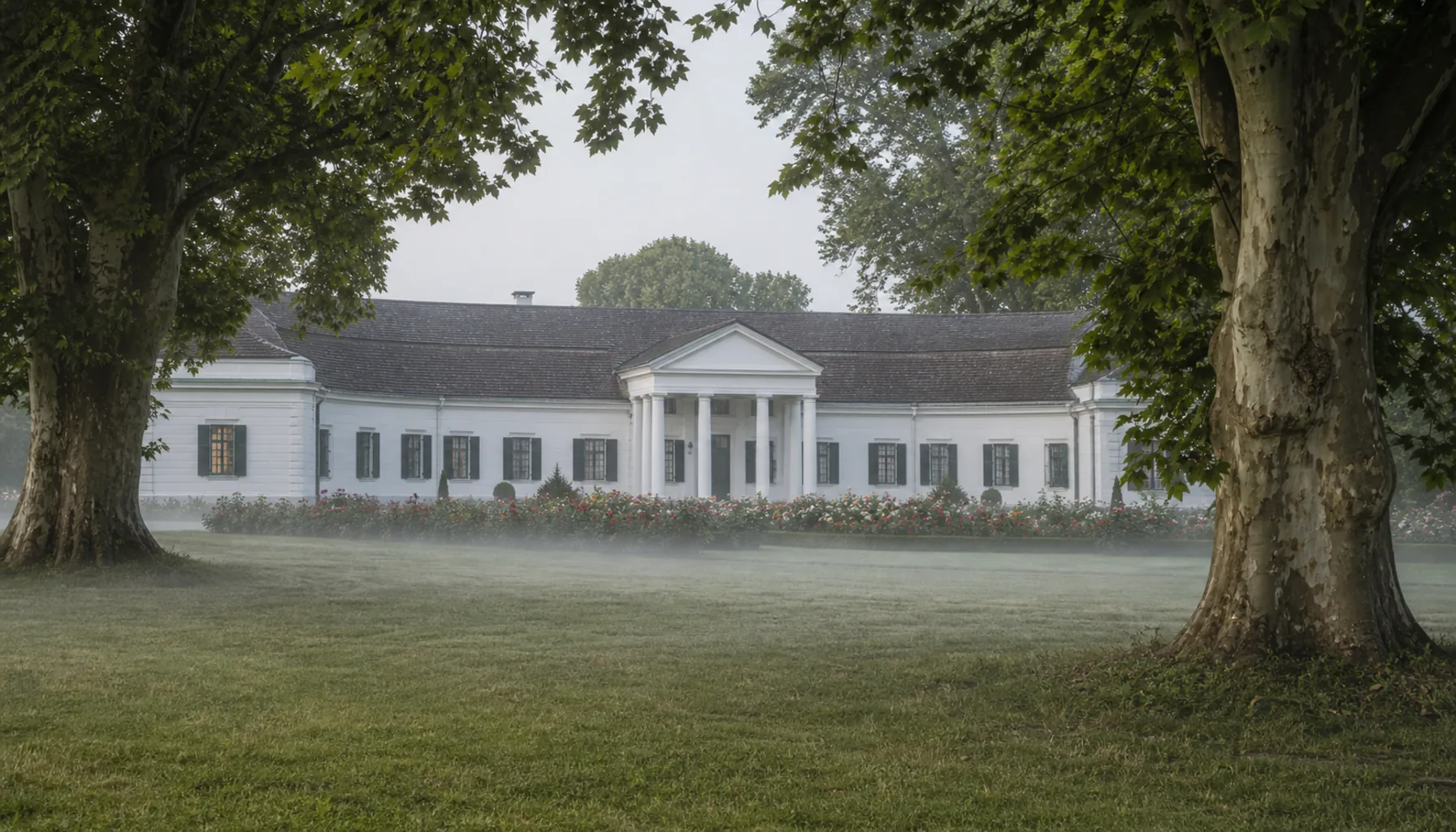
A plain village on the Trnava arable land with a classicist manor house and a large landscape park behind it, run today by the Music Museum of the Slovak National Museum and tied to the Brunsvik family's friendship with Beethoven.Rovinatá obec na trnavskej roli s klasicistickým kaštieľom a veľkým krajinárskym parkom za ním; dnes ho spravuje Hudobné múzeum Slovenského národného múzea a viaže sa k priateľstvu Brunsvikovcov s Beethovenom.
The classicist manor at Dolná Krupá seen from its parkKlasicistický kaštieľ v Dolnej Krupej z parku
Where it standsKde leží
Dolná Krupá lies on the plain north-west of Trnava, a few kilometres short of the Little Carpathians, on some of the deepest arable soil in Slovakia. There is no hill, no gorge and no defensive site: the village exists because of the land around it and the road that carried its crop to the city.Dolná Krupá leží na rovine severozápadne od Trnavy, pár kilometrov pred Malými Karpatmi, na jednej z najúrodnejších pôd na Slovensku. Niet tu kopca, tiesňavy ani obranného miesta: obec jestvuje vďaka pôde okolo nej a ceste, ktorá jej úrodu vozila do mesta.
The hills are close enough to be the horizon from the park, and Smolenice is a few minutes further on by road, which makes the two villages an easy pair in a single day.Kopce sú dosť blízko na to, aby z parku tvorili obzor, a Smolenice sú po ceste ešte pár minút — obe obce sa tak dajú pohodlne stihnúť v jeden deň.
Why it is herePrečo práve tu
The village belonged to the Brunsvik family, Hungarian nobility with estates on both sides of the present border. They rebuilt the house here in classicist form at the end of the eighteenth century and laid out an English landscape park around it — clumps of trees, long open views, walks that reveal the house slowly. The park later became known for its roses.Obec patrila Brunsvikovcom, uhorskej šľachte s majetkami po oboch stranách dnešnej hranice. Koncom osemnásteho storočia tunajšie sídlo prestavali do klasicistickej podoby a okolo neho založili anglický krajinársky park — skupiny stromov, dlhé priehľady, cestičky, ktoré kaštieľ odkrývajú postupne. Park neskôr preslávili ruže.
What makes the family known outside Slovakia is musical. The Brunsviks were among Beethoven's Hungarian patrons and closest friends: Franz Brunsvik received the dedication of the Appassionata sonata, and his sisters Therese and Josephine were central to the composer's life, Josephine being one of the leading candidates for the unnamed beloved of his letter of 1812.Mimo Slovenska je rodina známa vďaka hudbe. Brunsvikovci patrili k Beethovenovým uhorským mecénom a najbližším priateľom: Františkovi Brunsvikovi je venovaná sonáta Appassionata a jeho sestry Terézia a Jozefína boli v skladateľovom živote ústredné, pričom Jozefína je jednou z hlavných kandidátok na nemenovanú milovanú z jeho listu z roku 1812.
How much of that touched Dolná Krupá itself is a separate question. The museum here presents Beethoven's stays at the manor, and the association is old and local. The further tradition that he wrote the Moonlight Sonata in the park has no documentary support, and is best enjoyed as a story rather than repeated as a fact.Nakoľko sa to všetko dotklo samotnej Dolnej Krupej, je iná otázka. Tunajšie múzeum predstavuje Beethovenove pobyty v kaštieli a táto väzba je stará a miestna. Ďalšia tradícia, podľa ktorej tu v parku napísal Mesačnú sonátu, nemá oporu v dokumentoch a je lepšie brať ju ako príbeh než opakovať ju ako fakt.
What you actually seeČo naozaj uvidíte
The manor is a long, low classicist range, white, with a columned portico, standing at the head of its park. Inside, the Music Museum of the Slovak National Museum keeps the permanent exhibition: life here under the Brunsviks and the Choteks who followed them, and a memorial to Beethoven. Opening is seasonal, so check before travelling.Kaštieľ je dlhé nízke klasicistické krídlo, biele, so stĺpovým portikom, stojace v čele parku. Vnútri má Hudobné múzeum Slovenského národného múzea stálu expozíciu: život tu za Brunsvikovcov a po nich za Chotekovcov, a pamiatku na Beethovena. Otvorené je sezónne, tak si to pred cestou overte.
The park is the other half of the visit and is far larger than the house: old limes and planes, long mown rides, and a small classical garden building that the Beethoven tradition has attached itself to. It was laid out to be walked slowly in, and an hour spent in it is not too much.Park je druhou polovicou návštevy a je oveľa väčší než dom: staré lipy a platany, dlhé kosené priehľady a malý klasicistický záhradný objekt, na ktorý sa beethovenovská tradícia viaže. Zakladali ho na pomalú chôdzu a hodina v ňom nie je priveľa.
The village around it is a plain lowland one: a parish church, a long main street of rendered houses with their gables to the road, and flat fields starting immediately behind them.Obec okolo neho je bežná rovinná dedina: farský kostol, dlhá hlavná ulica omietnutých domov so štítmi do cesty a hneď za nimi začínajúce rovné polia.
Living village, not a museumŽivá obec, nie skanzen
Dolná Krupá is a farming village first. The cooperative works the land all around it, and the manor with its park is one institution inside an otherwise ordinary place — a museum with a season and set opening days, not a house you can wander into.Dolná Krupá je predovšetkým poľnohospodárskou obcou. Družstvo obrába pôdu dookola a kaštieľ s parkom je jedinou inštitúciou v inak celkom bežnom mieste — múzeum so sezónou a určenými dňami, nie dom, do ktorého sa dá len tak vojsť.
The park does duty as the village's green space as well as a monument, which is how most people here use it. Concerts at the manor are the right way to hear the house, but they are occasional — check what is on before coming for one.Park je pre obec zeleňou rovnako ako pamiatkou a takto ho tu väčšina ľudí aj používa. Koncerty v kaštieli sú tým správnym spôsobom, ako dom počuť, no bývajú len príležitostne — ak idete kvôli niektorému, pozrite si program vopred.
Getting thereAko sa tam dostať
Buses run from Trnava, about a quarter of an hour away, and by car it is a short signposted turn off the road going north-west out of the city towards Senica. The manor and its park are at the edge of the village and signed from the main street.Autobusy chodia z Trnavy, vzdialenej asi štvrťhodinu, a autom ide o krátku značenú odbočku z cesty vedúcej z mesta na severozápad smerom na Senicu. Kaštieľ s parkom je na okraji obce a smerovky k nemu vedú z hlavnej ulice.
Explore Dolná KrupáObjavujte Dolná Krupá
Every part of this place with a page of its own.Každá časť tohto miesta, ktorá má vlastnú stránku.