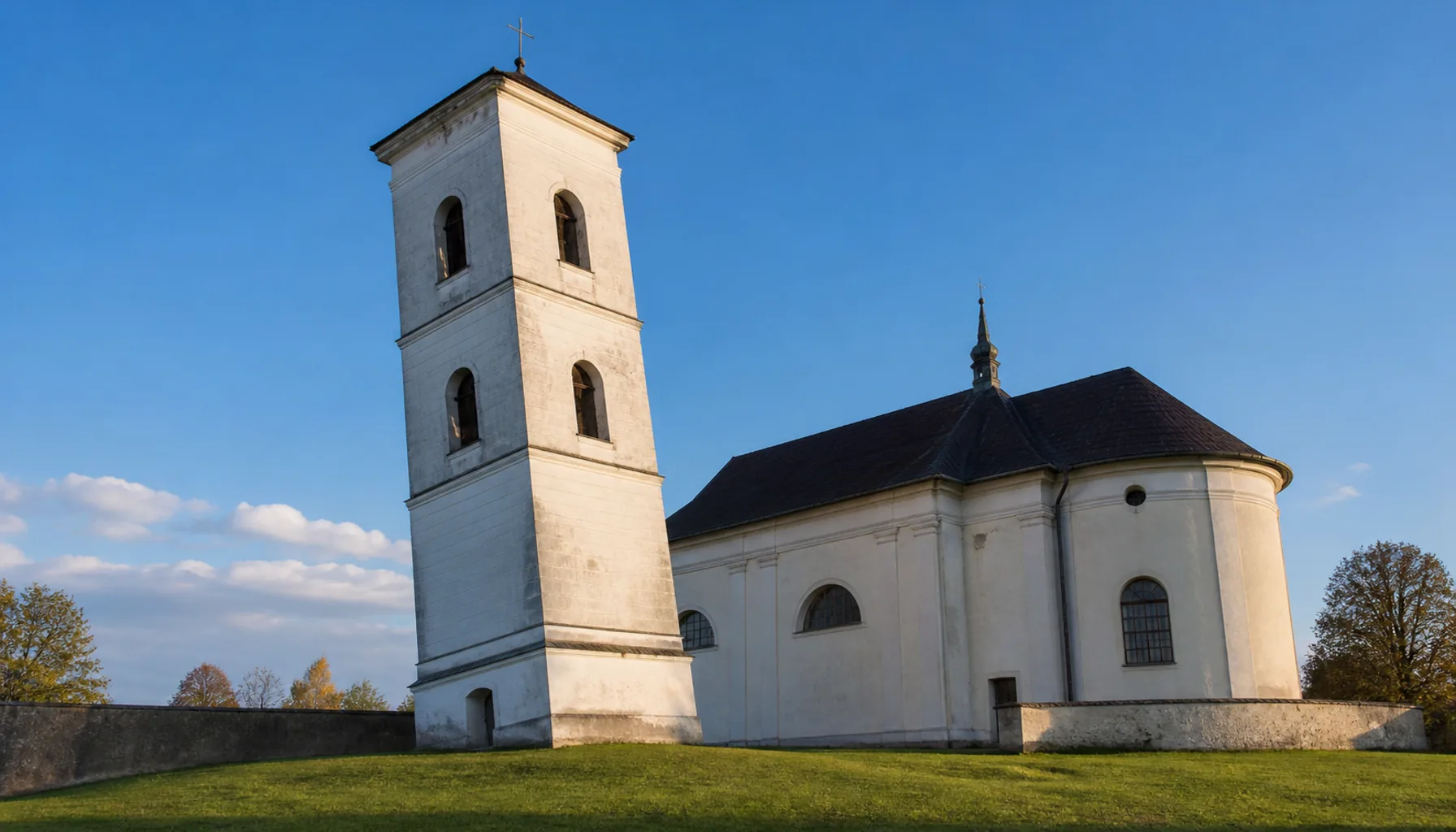
A small town under the last hills of the Little Carpathians with two claims on the record: a Classicist bell tower that leans close to a metre out of true, and a noble kúria long held to be the birthplace of Móric Beňovský, who escaped from Kamchatka and died on Madagascar.Malé mesto pod poslednými kopcami Malých Karpát s dvoma nárokmi na zápis do dejín: klasicistická zvonica naklonená takmer o meter od zvislice a šľachtická kúria, ktorú tradícia dlho označuje za rodný dom Mórica Beňovského — muža, ktorý ušiel z Kamčatky a zomrel na Madagaskare.
The leaning Classicist bell tower beside the church of St Martin at VrbovéNaklonená klasicistická zvonica pri Kostole svätého Martina vo Vrbovom
Where it standsKde leží
Vrbové lies a short distance west of Piešťany, at the point where the Little Carpathians run out into the Váh lowland. Behind the town are the last limestone ridges of the range — oak wood, pasture and vineyards on the warm slopes — and in front of it flat farmland running east towards the river.Vrbové leží kúsok na západ od Piešťan, v mieste, kde sa Malé Karpaty strácajú v považskej nížine. Za mestom sú posledné vápencové hrebene pohoria — dubiny, pasienky a vinohrady na teplých svahoch — a pred ním rovné polia, ktoré sa tiahnu na východ k rieke.
It belongs to the Piešťany district but sits off the main road, and the spa town's traffic passes it by, which is a large part of why it has stayed quiet.Patrí do okresu Piešťany, no leží mimo hlavnej cesty a ruch kúpeľného mesta ho obchádza — a to je veľká časť dôvodu, prečo zostalo tiché.
The storyHistória
Vrbové is documented from the Middle Ages and spent most of its history as a market and craft town on the estate roads under the hills, with vineyards above it and grain below.Vrbové je doložené od stredoveku a väčšinu svojich dejín prežilo ako trhové a remeselnícke mestečko na panských cestách pod kopcami, s vinohradmi nad sebou a obilím pod sebou.
Móric Beňovský was born here in 1746, and his life is hard to summarise and harder to verify. A nobleman of this region, he fought with the Bar Confederation in Poland, was captured and exiled by the Russians to Kamchatka, seized a ship and sailed it as far as Macao, reached France, and was sent to Madagascar, where local chiefs recognised him as a ruler and where French troops killed him in 1786. The memoirs he left made him famous across Europe, and historians have been arguing with them ever since.V roku 1746 sa tu narodil Móric Beňovský, ktorého život sa ťažko zhŕňa a ešte ťažšie overuje. Šľachtic z tohto kraja bojoval v Poľsku na strane barskej konfederácie, Rusi ho zajali a poslali do vyhnanstva na Kamčatku, odkiaľ sa zmocnil lode a doplavil sa až do Macaa; dostal sa do Francúzska a odtiaľ na Madagaskar, kde ho miestni náčelníci uznali za vládcu a kde ho v roku 1786 zabili francúzski vojaci. Pamäti, ktoré po sebe zanechal, ho preslávili po celej Európe a historici s nimi odvtedy polemizujú.
The bell tower beside the church of St Martin is younger than visitors expect: its foundation stone was laid in 1832 and a master mason from Čachtice finished it in 1835. It began to lean after long rains in October 1930, and surveys in the late nineteen-nineties and in 2000 put the tilt at close to a metre from vertical. It is an accident of groundwater and foundations, not a design.Zvonica pri Kostole svätého Martina je mladšia, než návštevníci čakajú: základný kameň položili v roku 1832 a murársky majster z Čachtíc ju dokončil v roku 1835. Nakláňať sa začala po dlhotrvajúcich dažďoch v októbri 1930 a merania na konci 90. rokov a v roku 2000 určili odklon takmer meter od zvislice. Je to nehoda podzemnej vody a základov, nie zámer staviteľa.
What to seeČo vidieť
The leaning tower is what people come for. It stands beside the church of St Martin near the centre — a plain Classicist bell tower not far short of forty metres to the tip of its cross, visibly out of true against the church behind it, and best read from a little distance, where the vertical of the church gives the eye something to compare it with.Ľudia sem chodia pre naklonenú zvonicu. Stojí pri Kostole svätého Martina neďaleko centra — jednoduchá klasicistická veža vysoká tesne pod štyridsať metrov po vrchol kríža, viditeľne vychýlená oproti kostolu za sebou; najlepšie ju vidno z odstupu, kde má oko na porovnanie zvislicu kostola.
The kúria at the junction of the main square and Beňovský street is the second stop. Restored in the late nineteen-nineties, it now holds the town library and a historical exhibition, with a memorial to Beňovský close by. The plaque calling it his birthplace was put up in 1908, and the identification rests on nineteenth-century tradition rather than on a document — which makes the house more interesting, not less.Druhou zastávkou je kúria na rozhraní hlavného námestia a Beňovského ulice. Po obnove na konci 90. rokov v nej sídli mestská knižnica a historická expozícia a neďaleko stojí Beňovského pamätník. Tabuľu, ktorá dom označuje za jeho rodný, osadili v roku 1908 a samotné určenie stojí na tradícii 19. storočia, nie na listine — čo dom robí zaujímavejším, nie menej zaujímavým.
Marked paths climb into the hills behind the town, and Čachtice Castle — the ruin above the village of the same name, tied to the Báthory story — is a short drive north. Piešťany, with its spa island and its bridge, is close enough that Vrbové makes an easy half-day out of it.Značené chodníky stúpajú do kopcov za mestom a Čachtický hrad — zrúcanina nad rovnomennou obcou, spojená s príbehom Báthoryčky — je kúsok autom na sever. Piešťany s kúpeľným ostrovom a mostom sú tak blízko, že Vrbové z nich zvládnete ako pohodlný poldenný výlet.
Work and industryPráca a priemysel
Farming and fruit-growing are the base — arable land on the flat, orchards and vineyards on the slopes, worked by the local co-operative and by small growers — with light manufacturing in the town itself. For much of the twentieth century the largest employer was a knitwear works that traded as Trikota.Základom je poľnohospodárstvo a ovocinárstvo — orná pôda na rovine, sady a vinohrady na svahoch, ktoré obrába miestne družstvo aj drobní pestovatelia — a v samotnom meste k tomu ľahká výroba. Veľkú časť 20. storočia bol najväčším zamestnávateľom pletiarsky závod, ktorý niesol meno Trikota.
Today most people work elsewhere. Piešťany is minutes away, Trnava and the plants along the motorway are within an easy commute, and tourism in Vrbové is an afternoon's business rather than an overnight one.Dnes väčšina ľudí pracuje inde. Piešťany sú na pár minút, Trnava a závody pri diaľnici v pohodlnej dochádzkovej vzdialenosti a cestovný ruch je vo Vrbovom vecou popoludnia, nie nocľahu.
Getting thereAko sa tam dostať
Buses from Piešťany are the usual way in, and Piešťany is also the nearest station with a regular train service. By car, Vrbové is a few minutes off the road between Piešťany and Nové Mesto nad Váhom, with the D1 motorway close by.Bežne sa sem chodí autobusom z Piešťan a Piešťany sú aj najbližšou stanicou s pravidelnou vlakovou dopravou. Autom je Vrbové pár minút od cesty medzi Piešťanmi a Novým Mestom nad Váhom, diaľnica D1 je nablízku.
Explore VrbovéObjavujte Vrbové
Every part of this place with a page of its own.Každá časť tohto miesta, ktorá má vlastnú stránku.