Poprad · under the High TatrasPoprad · pod Vysokými Tatrami
Culture in PopradKultúra v Poprade
Five old Spiš towns inside one modern one, a gallery in a converted power station, and a medieval square that survived because the railway went somewhere else.Päť starých spišských miest v jednom modernom, galéria v prestavanej elektrárni a stredoveké námestie, ktoré sa zachovalo preto, že železnica išla inokade.
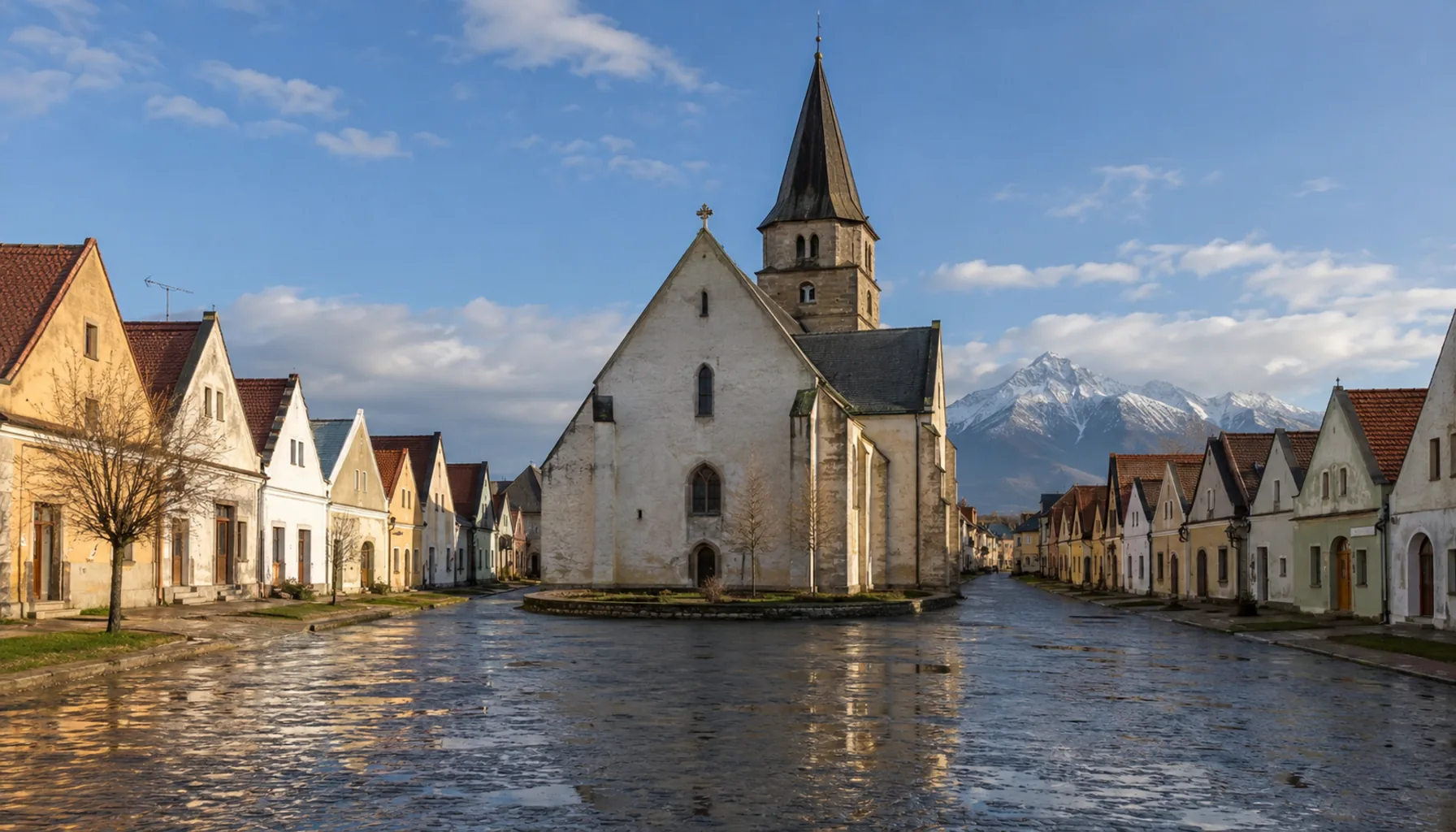
The medieval square of Spišská Sobota, the best-preserved of the four old Spiš towns absorbed into Poprad.Stredoveké námestie Spišskej Soboty, najzachovalejšieho zo štyroch starých spišských miest, ktoré pohltil Poprad.
The year in PopradRok v Poprade
Poprad is the practical capital of the sub-Tatra basin, and its year has two halves that barely overlap. One is the town's own — markets, a town day, the church year, the school calendar. The other belongs to the mountains, fills the hotels and the trains, and legally belongs to the neighbouring town of Vysoké Tatry. Most visitors meet Poprad as a transfer between the two, which undersells the place but is honest about how the year actually works here.Poprad je praktickým hlavným mestom Podtatranskej kotliny a jeho rok má dve polovice, ktoré sa takmer neprekrývajú. Jedna patrí mestu — trhy, mestské dni, cirkevný rok, školský kalendár. Druhá patrí horám, plní hotely a vlaky a správne patrí susednému mestu Vysoké Tatry. Väčšina návštevníkov pozná Poprad ako prestup medzi nimi; mestu to krivdí, ale o tom, ako tu rok naozaj vyzerá, to hovorí pravdu.
Because the modern town is a merger of five older ones, what is on is dispersed. Poprad's main square, Spišská Sobota's long medieval square and the smaller centres at Veľká, Matejovce and Stráže each still work as a place with its own church and its own audience, and a summer weekend can have something running in more than one of them. We name no individual festival here: in a district town programmes change from year to year, and the town's own listings are the only reliable source.Keďže dnešné mesto vzniklo z piatich starších, podujatia sú rozptýlené. Popradské hlavné námestie, dlhé stredoveké námestie Spišskej Soboty aj menšie centrá vo Veľkej, v Matejovciach a v Strážach stále fungujú ako miesta s vlastným kostolom a vlastným publikom a cez letný víkend sa môže niečo diať na viacerých naraz. Konkrétne festivaly tu nemenujeme: v okresnom meste sa program mení rok čo rok a jediným spoľahlivým zdrojom sú mestské oznamy.
Where culture livesKde žije kultúra
The Tatra Gallery has the best building in town: a converted power station a short walk from the main square, an unusually good space for exhibitions and a rare case of a Slovak industrial building given a second life on its own terms. The regional museum covers the basin and the mountains together, and its ancestry runs back to the Carpathian Museum that the Hungarian Carpathian Society — founded up at Smokovec in 1873 — opened in Poprad in 1881. Mountain science and mountain tourism have been part of this town's furniture from the beginning.Tatranská galéria má v meste najlepšiu budovu: prestavanú elektráreň na pár minút chôdze od hlavného námestia, neobvykle dobrý priestor na výstavy a zriedkavý prípad slovenskej priemyselnej stavby, ktorá dostala druhý život za vlastných podmienok. Regionlné múzeum pokrýva kotlinu aj hory a jeho rodokmeň vedie ku Karpatskému múzeu, ktoré v Poprade otvoril v roku 1881 Uhorský karpatský spolok, založený v roku 1873 hore v Smokovci. Horská veda a horský turizmus patria k inventáru tohto mesta od začiatku.
Below that sit the ordinary institutions of a regional centre: a cultural centre with a hall, a library, a cinema, music and art schooling for children. We name none of them, on the standing principle that premises and programmes change faster than a page like this does. The other half of what Poprad offers is not an institution at all — geothermal water drawn from deep boreholes fills a bathing complex on the edge of the centre, with the peaks on the skyline, and that is what a great many people here actually do on a Sunday.Pod tým sú bežné inštitúcie regionálneho centra: kultúrne stredisko so sálou, knižnica, kino, hudobné a výtvarné školy pre deti. Žiadnu z nich nemenujeme, a to zo stálej zásady, že priestory a programy sa menia rýchlejšie než takáto stránka. Druhá polovica popradskej ponuky nie je inštitúcia vôbec — geotermálna voda z hlbokých vrtov plní kúpalisko na okraji centra, so štítmi na obzore, a to je to, čo tu veľa ľudí v nedeľu naozaj robí.
The buildings that carry itBudovy, ktoré ju nesú
Spišská Sobota is the single best reason to give the town an extra hour: a monument reserve inside a modern town, one long medieval square of gabled burgher houses, a free-standing Renaissance bell tower, and the church of St George, whose winged high altar is attributed to the workshop of Master Pavol of Levoča. Opening of the church interior is limited; ask locally. A small town could afford a carver of that rank because it sat on the trade road north to Poland and, like every Spiš town, held its privileges in writing and bargained as an equal.Spišská Sobota je jediný najlepší dôvod venovať mestu hodinu navyše: pamiatková rezervácia vnútri moderného mesta, jedno dlhé stredoveké námestie štítových meštianskych domov, samostatne stojaca renesančná zvonica a kostol svätého Juraja s krídlovým hlavným oltárom pripisovaným dielni Majstra Pavla z Levoče. Interiér kostola býva prístupný len obmedzene; treba sa spýtať na mieste. Malé mesto si rezbára tejto triedy mohlo dovoliť preto, že ležalo na obchodnej ceste na sever do Poľska a ako každé spišské mesto malo svoje výsady na papieri a vyjednávalo ako rovný s rovným.
What saved that square was an accident. When the Košice–Bohumín railway was driven along the basin in 1871 the station went up on Poprad's ground rather than Spišská Sobota's, and the freight, the sawmills and the workshops followed the tracks. The rich medieval neighbour stopped growing and was consequently still standing a century later, when the small one had become the largest town under the Tatras. In the centre proper, St Giles's church and its detached bell tower carry the older layer, and the wooded hill of Kvetnica on the southern edge is where the town walks.To námestie zachránila náhoda. Keď v roku 1871 viedli kotlinou železnicu Košice–Bohumín, stanica vyrstla na popradskom, nie na spišskosobotskom chotári, a náklad, píly a dielne išli za koľajami. Bohatý stredoveký sused prestal rásť — a práve preto stál ešte o storočie neskôr, keď sa z malého suseda stalo najväčšie mesto pod Tatrami. V samotnom centre nesie staršiu vrstvu kostol svätého Egídia so samostatnou zvonicou a zalesnená Kvetnica na južnom okraji je mestskou vychádzkovou horou.
Five towns, one namePäť miest, jedno meno
Poprad, Spišská Sobota, Veľká, Matejovce and Stráže pod Tatrami were five separate Spiš towns, growing in the same wave of settlement after 1241 and named in documents from the thirteenth century — Poprad itself on 16 March 1256, in a donation deed of King Béla IV. They were joined in stages: Spišská Sobota and Veľká in 1945, Stráže pod Tatrami in 1960, Matejovce in 1974. Each is still legible on the ground, which is unusual; mergers of this kind normally erase what they absorb.Poprad, Spišská Sobota, Veľká, Matejovce a Stráže pod Tatrami boli päť samostatných spišských miest, ktoré rstli v tej istej vlne osídľovania po roku 1241 a v listinách sa objavujú od trinásteho storočia — samotný Poprad 16. marca 1256 v darovacej listine kráľa Bela IV. Spájali sa postupne: Spišská Sobota a Veľká v roku 1945, Stráže pod Tatrami v roku 1960 a Matejovce v roku 1974. Každé z nich je v teréne dodnes čitateľné, čo je nezvyčajné; takéto zlúčenia zväčša zmažú to, čo pohltia.
The towns were German-speaking for most of their history — Poprad's German name, Deutschendorf, means simply German Village — and that community ended with the Second World War. What it built stayed: the squares, the churches, the bell towers, and the habit of a town paying for its own architecture. The other inheritance is industrial and older than any chimney here: the town's first factory was a paper mill working from 1692, and Poprad has been a working industrial town ever since.Mestá boli väčšinu svojich dejín nemecky hovoriace — nemecký názov Popradu, Deutschendorf, znamená jednoducho Nemecká Ves — a táto komunita sa skončila s druhou svetovou vojnou. To, čo postavila, zostalo: námestia, kostoly, zvonice a zvyk, že si mesto svoju architektúru platí samo. Druhé dedičstvo je priemyselné a staršie než ktorýkoľvek tunajší komín: prvou popradskou továrňou bola papiereň, ktorá pracovala od roku 1692 a Poprad je odvtedy priemyselným mestom.