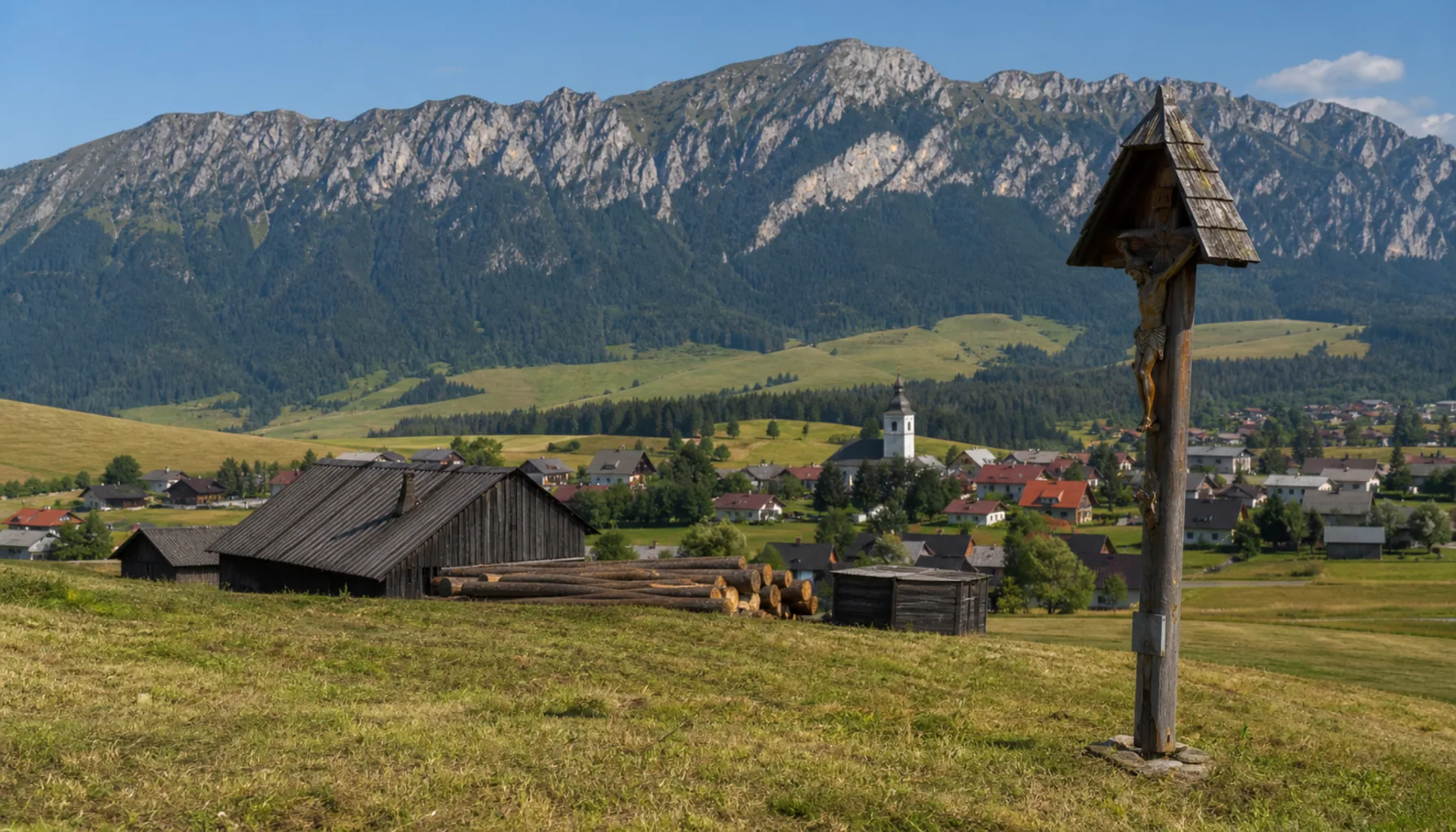
A large Goral village under the wall of the Belianske Tatry where folk costume is still ordinary Sunday clothing rather than a performance — and where almost nothing old survives, because the village has never stopped rebuilding.Veľká goralská obec pod stenou Belianskych Tatier, kde je kroj stále bežným nedeľným oblečením, nie predstavením — a kde sa takmer nič staré nezachovalo, lebo obec nikdy neprestala stavať nanovo.
Hay meadows and a wayside cross above Lendak, under the limestone wall of the Belianske TatryLúky a prícestný kríž nad Lendakom pod vápencovou stenou Belianskych Tatier
Where it standsKde leží
Lendak sits high on the northern edge of the Poprad basin, at the eastern foot of the Belianske Tatry, between Spišská Belá and the road that climbs on to Ždiar and the Polish border. The limestone wall of the range stands directly above the last fields; the other way the ground falls off towards Kežmarok.Lendak leží vysoko na severnom okraji Popradskej kotliny, na východnom úpätí Belianskych Tatier, medzi Spišskou Belou a cestou, ktorá stúpa ďalej na Ždiar a k poľskej hranici. Vápencová stena pohoria stojí priamo nad poslednými poľami, na druhú stranu sa terén zvažuje ku Kežmarku.
It is one of the largest villages in Slovakia by population and among the youngest: large families are normal, and new houses have been going up on every side for decades.Patrí k najväčším obciam na Slovensku podľa počtu obyvateľov a k najmladším. Veľké rodiny sú tu bežné a nové domy pribúdajú na všetkých stranách už desaťročia.
Why it is herePrečo práve tu
A settlement has stood here since the Middle Ages, on land too high and too cold for grain to be reliable. What kept it alive is what keeps upland villages alive here: sheep and cattle on the mountain pasture, potatoes, the forest, and building work away from home.Osada tu stojí od stredoveku, na pôde príliš vysoko položenej a chladnej na to, aby sa dalo spoľahnúť na obilie. Pri živote ju držalo to, čo horské dediny drží všade: ovce a dobytok na horských pasienkoch, zemiaky, les a stavebná robota mimo domu.
The village is Goral: the dialect, many of the surnames and much of the custom belong to the highland culture that runs along both sides of the Tatras rather than to the Spiš towns below, and the church calendar still organises the year.Obec je goralská: nárečie, mnohé priezviská aj veľká časť zvykov patria k horalskej kultúre, ktorá sa tiahne po oboch stranách Tatier, nie k spišským mestám v kotline pod ňou, a cirkevný kalendár tu stále organizuje rok.
What did not happen here matters as much as what did. Lendak never became a folk-architecture reserve like Ždiar over the hill, because it never stopped rebuilding: the old timber village was replaced by the one people wanted to live in. Costume and custom were carried on instead — and carried on by everybody, not by a folklore group.Rovnako dôležité je to, čo sa tu nestalo. Z Lendaku sa nikdy nestala rezervácia ľudovej architektúry ako zo Ždiaru za kopcom, lebo sa tu nikdy neprestalo stavať: starú drevenú dedinu nahradila taká, v akej ľudia chceli bývať. Namiesto toho sa ďalej niesli kroj a zvyky — a niesli ich všetci, nie folklórny súbor.
What you actually seeČo naozaj uvidíte
On an ordinary weekday: a big working village on a slope, new and rebuilt houses, yards of stacked firewood, hay meadows above the last street and the grey Belianske ridge closing the sky. There is no old lane to walk, no reserve, no museum house.V bežný všedný deň: veľká fungujúca obec na svahu, nové a prestavané domy, dvory s naukladaným drevom, lúky nad poslednou ulicou a sivý hrebeň Belianskych Tatier, ktorý uzatvára oblohu. Niet tu starej uličky na prechádzku, niet rezervácie ani múzejného domu.
On a Sunday morning, or on a feast day, the costume comes out and walks to mass — men in white cloth trousers with worked seams, women in embroidered bodices and headscarves, children dressed like their parents. Weddings, first communions and processions bring out the full wardrobe. None of it is timetabled for visitors and none of it is announced.V nedeľu ráno alebo na sviatok sa objaví kroj a ide sa v ňom na omšu — muži v bielych súkenných nohaviciach s vyšívanými švíkmi, ženy vo vyšívaných živôtikoch a šatkách, deti oblečené ako rodičia. Svadby, prvé sväté prijímania a procesie vytiahnu celú parádnu výbavu. Nič z toho nie je pre návštevníkov naplánované a nič sa neohlasuje.
The mountains above are scenery rather than walking country: most of the Belianske Tatry are closed to the public as a strict reserve, and the one marked route across them starts from Ždiar and opens only for part of the year. Everyday outings go to the field tracks, the show cave at Tatranská Kotlina, and over the hill to Bachledova dolina and the ski ground at Ždiar.Hory nad obcou sú skôr kulisou než turistickým terénom: väčšina Belianskych Tatier je ako prísna rezervácia pre verejnosť uzavretá a jediná značená trasa cez ne vychádza zo Ždiaru a otvorená býva len časť roka. Bežné výlety vedú na poľné cesty, do sprístupnenej jaskyne v Tatranskej Kotline a za kopec do Bachledovej doliny a na ždiarske zjazdovky.
Living village, not a museumŽivá obec, nie skanzen
Nothing in Lendak is on show. The church is a parish church with a full congregation, not a monument to tour; the costume is worn by people on their way somewhere, and photographing them at close range on their way into mass is the one thing not to do. Come on an ordinary day and accept that you will see a village rather than a spectacle.V Lendaku nie je nič na obdiv. Kostol je farským kostolom s plnými lavicami, nie pamiatkou na prehliadku; kroj majú na sebe ľudia, ktorí niekam idú, a fotiť ich zblízka cestou na omšu je práve to, čo sa nerobí. Príďte vo všedný deň a zmierte sa s tým, že uvidíte obec, nie predstavenie.
Work is farming and forestry, the building trades, and jobs in Kežmarok, Poprad and the Tatra resorts, with long-term work abroad on top. Places to eat and sleep are in the tourist villages next door.Pracuje sa v poľnohospodárstve a lesníctve, v stavebníctve a v Kežmarku, Poprade a tatranských strediskách, k tomu je tu veľa dlhodobej práce v zahraničí. Kde sa najesť a prespať, nájdete v susedných turistických obciach.
Getting thereAko sa tam dostať
There is no railway. Buses run from Kežmarok, Spišská Belá and Poprad, and by car it is a short turn off the road from Kežmarok under the Belianske Tatry to Tatranská Kotlina and Ždiar. The nearest station is Poprad-Tatry.Železnica sem nevedie. Autobusy premávajú z Kežmarku, zo Spišskej Belej a z Popradu a autom je obec krátkou odbočkou z cesty, ktorá vedie z Kežmarku popod Belianske Tatry do Tatranskej Kotliny a na Ždiar. Najbližšia stanica je Poprad-Tatry.
Explore LendakObjavujte Lendak
Every part of this place with a page of its own.Každá časť tohto miesta, ktorá má vlastnú stránku.