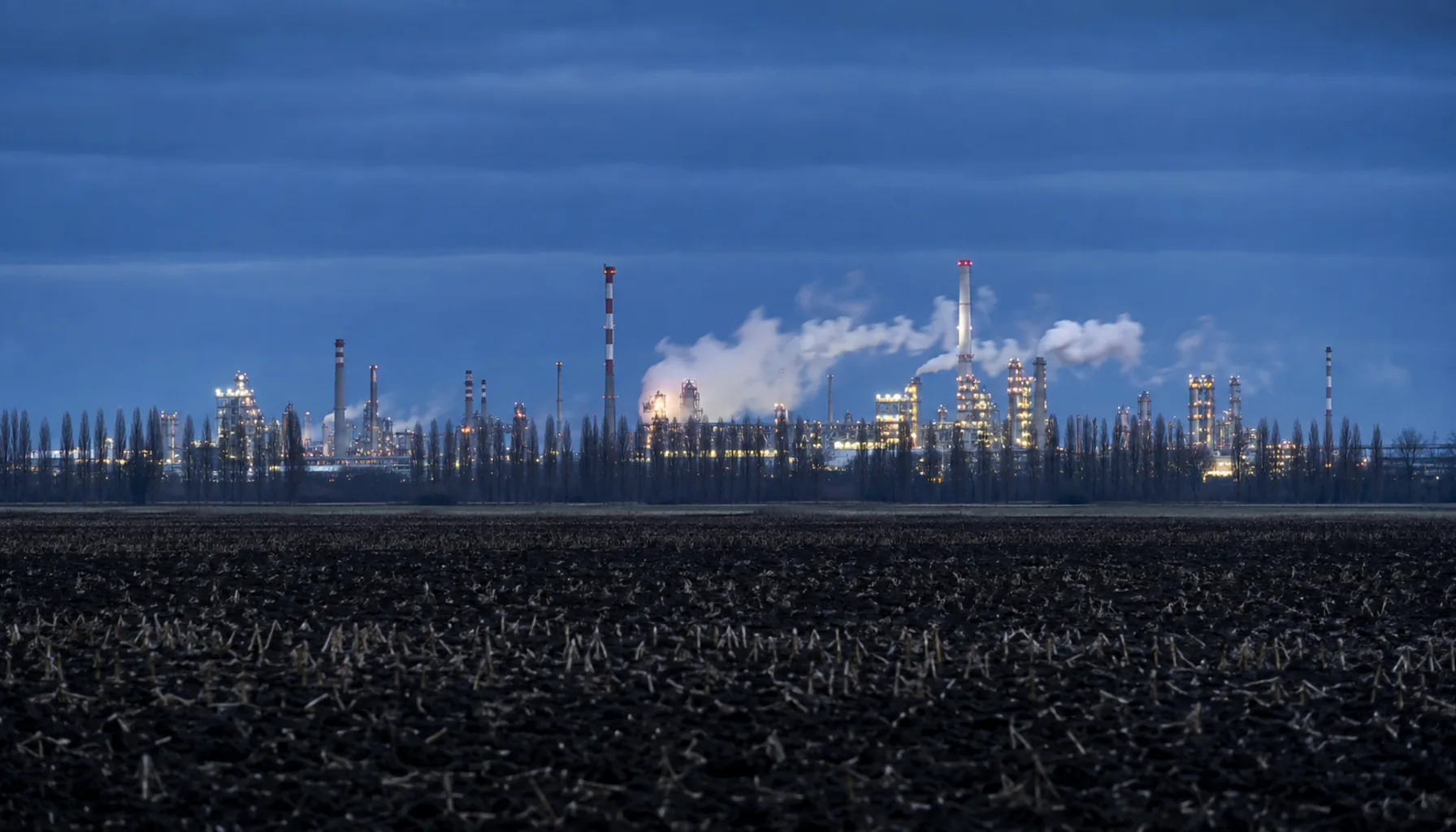
Šaľa keeps its culture in the older half of itself — a manor house on the left bank with a park around it — while most of the town lives in the half a chemical works built after 1958.Šaľa drží svoju kultúru v staršej polovici seba samej — v kaštieli na ľavom brehu Váhu s parkom okolo neho — kým väčšina mesta býva v tej polovici, ktorú po roku 1958 postavil chemický závod.
The Duslo chemical works at Šaľa, visible from far out across the flat fields of the lowland.Chemický závod Duslo v Šali, ktorý vidno zďaleka ponad rovinu Podunajskej nížiny.
The year in ŠaľaRok v Šali
The oldest thing in the Šaľa calendar is the fair. Ferdinand I raised the town to a market town in 1536, which at a river crossing was worth real money, and the right had to be granted all over again in 1692, because the Ottoman century had left thirty houses standing out of three hundred. A fair is not a festival, but for four centuries it was the date everybody in the district knew.Najstaršou vecou v šalianskom kalendári je jarmok. Ferdinand I. povýšil Šaľu v roku 1536 na mestečko s trhovým právom, čo pri prechode cez rieku znamenalo skutočné peniaze, a v roku 1692 sa to právo muselo udeliť odznova: po osmanskom storočí zostalo z troch stoviek domov tridsať. Jarmok nie je festival, ale štyri storočia to bol dátum, ktorý v okolí poznal každý.
What the town keeps now is the ordinary calendar of a Slovak district town: town days in the summer, a market before Christmas, church feasts, exhibitions and concerts in the manor house, and a season on the embankment and at the gravel lakes that begins when the weather allows it. We name no individual event, because programmes in a town this size are set a season ahead and announced locally.Dnes si mesto drží obyčajný kalendár slovenského okresného mesta: letné mestské dni, trh pred Vianocami, cirkevné sviatky, výstavy a koncerty v kaštieli a sezónu na nábreží a pri štrkoviskách, ktorá sa začne vtedy, keď to dovolí počasie. Jednotlivé podujatia tu nemenujeme, pretože programy sa v meste tejto veľkosti robia na sezónu dopredu a ohlasujú sa miestne.
One thing is worth knowing before you look: Šaľa has a substantial Hungarian-speaking population and a good deal of what is on is announced in both languages. Read only one and you will see only part of the programme. The town's own listings are the source that keeps up.Jedno sa oplatí vedieť vopred: v Šali žije početné maďarsky hovoriace obyvateľstvo a značná časť programu sa ohlasuje v oboch jazykoch. Kto číta len jeden, uvidí len časť. Oznamy samotného mesta sú zdroj, ktorý stíha.
Where culture livesKde žije kultúra
The manor house in the centre is the town's cultural building: it takes exhibitions and events, and the park around it is the piece of open ground the old town still has. What you walk into is a Baroque house with older fabric inside — it began as a water castle ringed by arms of the Váh and was rebuilt in the later sixteenth century as a Renaissance manor strong enough to be defended, because by then it stood on the second line behind the Ottoman frontier.Kultúrnou budovou mesta je kaštieľ v centre: konajú sa v ňom výstavy a podujatia a park okolo neho je jediná väčšia voľná plocha, ktorú staré mesto má. Vchádzate do barokového domu so starším jadrom — začínal ako vodný hrad obkolesený ramenami Váhu a v druhej polovici šestnásteho storočia ho prestavali na renesančný kaštieľ dosť pevný na to, aby sa dal brániť, pretože vtedy už stál na druhej línii za osmanskou hranicou.
The rest is what a town of this size keeps and what we will not name for you: a cultural centre with a hall and a programme, a library, a school of art for children, amateur choirs, folk groups, and a younger scene that comes and goes with the people running it. Premises change, names change, and a printed list ages badly.Zvyšok je to, čo si drží mesto tejto veľkosti a čo vám nebudeme menovať: kultúrne stredisko so sálou a programom, knižnicu, základnú umeleckú školu pre deti, amatérske spevácke zbory, folklórne súbory a mladšiu scénu, ktorá prichádza a odchádza s ľuďmi, čo ju robia. Priestory sa menia, názvy sa menia a vytlačený zoznam starne zle.
The buildings that carry itBudovy, ktoré ju nesú
The church of St Margaret was built between 1828 and 1837, and that late date is the key to the whole old core. A survey taken in 1715, after Rákóczi's uprising had finished crossing and re-crossing the lower Váh, found thirteen farming households and sixteen landless labourers in the entire town. Everything you can see was raised by people repopulating an emptied place. Šaľa looks nineteenth-century because the eighteenth century went on recovering.Kostol svätej Margity postavili v rokoch 1828 až 1837 a ten neskorý dátum je kľúčom k celému starému jadru. Súpis z roku 1715, keď povstanie Františka II. Rákócziho prestalo prechádzať sem a tam cez dolný Váh, našiel v celom meste trinásť roľníckych domácností a šestnásť bezzemkov. Všetko, čo tu vidno, postavili ľudia, ktorí zaľudňovali vyprázdnené miesto. Šaľa vyzerá na devätnáste storočie preto, že celé osemnáste sa spamätávala.
The Franciscan monastery and the manor house complete the core, and between the three of them you have the whole of the town's built heritage inside about ten minutes of walking. That is not a criticism. A frontier town cut to a tenth of itself in three years of raiding does not have a medieval quarter, and pretending otherwise would be dishonest.Františkánsky kláštor a kaštieľ jadro dopĺňajú a v týchto troch stavbách máte celé stavebné dedičstvo mesta na desať minút chôdze. Nie je to výčitka. Pohraničné mesto, ktoré za tri roky nájazdov kleslo na desatinu seba samého, nemá stredovekú štvrť a tváriť sa opačne by bolo nečestné.
The other half of the town's architecture is younger than most of the people living in it. Construction of the chemical works began in 1958 and the housing followed the plant; the blocks, the new grid of streets and an industrial skyline visible from far across the lowland are as much a part of what Šaľa is as the manor house. Reading the two halves against each other is the most interesting hour a visitor can spend here.Druhá polovica tunajšej architektúry je mladšia než väčšina ľudí, ktorí v nej bývajú. Stavba chemického závodu sa začala v roku 1958 a bývanie nasledovalo závod; panelové domy, nová sieť ulíc a priemyselná silueta viditeľná zďaleka cez nížinu patria k tomu, čím Šaľa je, rovnako ako kaštieľ. Prečítať si obe polovice vedľa seba je najzaujímavejšia hodina, akú tu návštevník môže stráviť.
Six years of a Jesuit collegeŠesť rokov jezuitského kolégia
In 1586 the Šaľa estate passed to the Jesuits, and in 1598 they moved their college here from Kláštor pod Znievom in Turiec. For six years, until 1604, a market town on the lower Váh ran one of the leading Catholic schools in the whole Kingdom of Hungary.V roku 1586 prešlo šalianske panstvo do rúk jezuitov a v roku 1598 sem presťahovali svoje kolégium z Kláštora pod Znievom v Turci. Šesť rokov, do roku 1604, viedlo mestečko na dolnom Váhu jednu z popredných katolíckych škôl v celom Uhorskom kráľovstve.
There is little of it left to see, but it tells you what a river crossing was worth in the sixteenth century. The order needed somewhere safe behind the Ottoman line, with a defensible house, an income and a road; Šaľa had all three. Institutions of that period moved according to where the frontier happened to be that year.Veľa z toho vidieť nie je, no hovorí to, čo v šestnástom storočí znamenal prechod cez rieku. Rád potreboval bezpečné miesto za osmanskou líniou, s brániteľným domom, príjmom a cestou; Šaľa mala všetky tri. Inštitúcie tej doby sa sťahovali podľa toho, kadiaľ v ktorom roku viedla hranica.
The college moved on and the town went back to being what it had been, a market town with a manor at its centre, for the next three and a half centuries. Nothing marks the episode on the ground, which is exactly why it is worth carrying with you.Kolégium sa presunulo ďalej a mesto sa na ďalšie tri a pol storočia vrátilo k tomu, čím bolo: trhovým mestečkom s kaštieľom v strede. Túto epizódu v teréne nič nepripomína — a práve preto sa ju oplatí nosiť v hlave.