Kolárovo · Rye Island, the Little DanubeKolárovo · Žitný ostrov, Malý Dunaj

Culture in KolárovoKultúra v Kolárove

A market village that grew into a town where the Little Danube meets the Váh, and whose set pieces are a covered wooden footbridge and a working floating mill rather than a castle or a square.Trhová dedina, ktorá vyrástla na mesto pri ústí Malého Dunaja do Váhu a ktorej hlavnými pamiatkami nie sú hrad či námestie, ale krytý drevený most a fungujúci lodný mlyn.

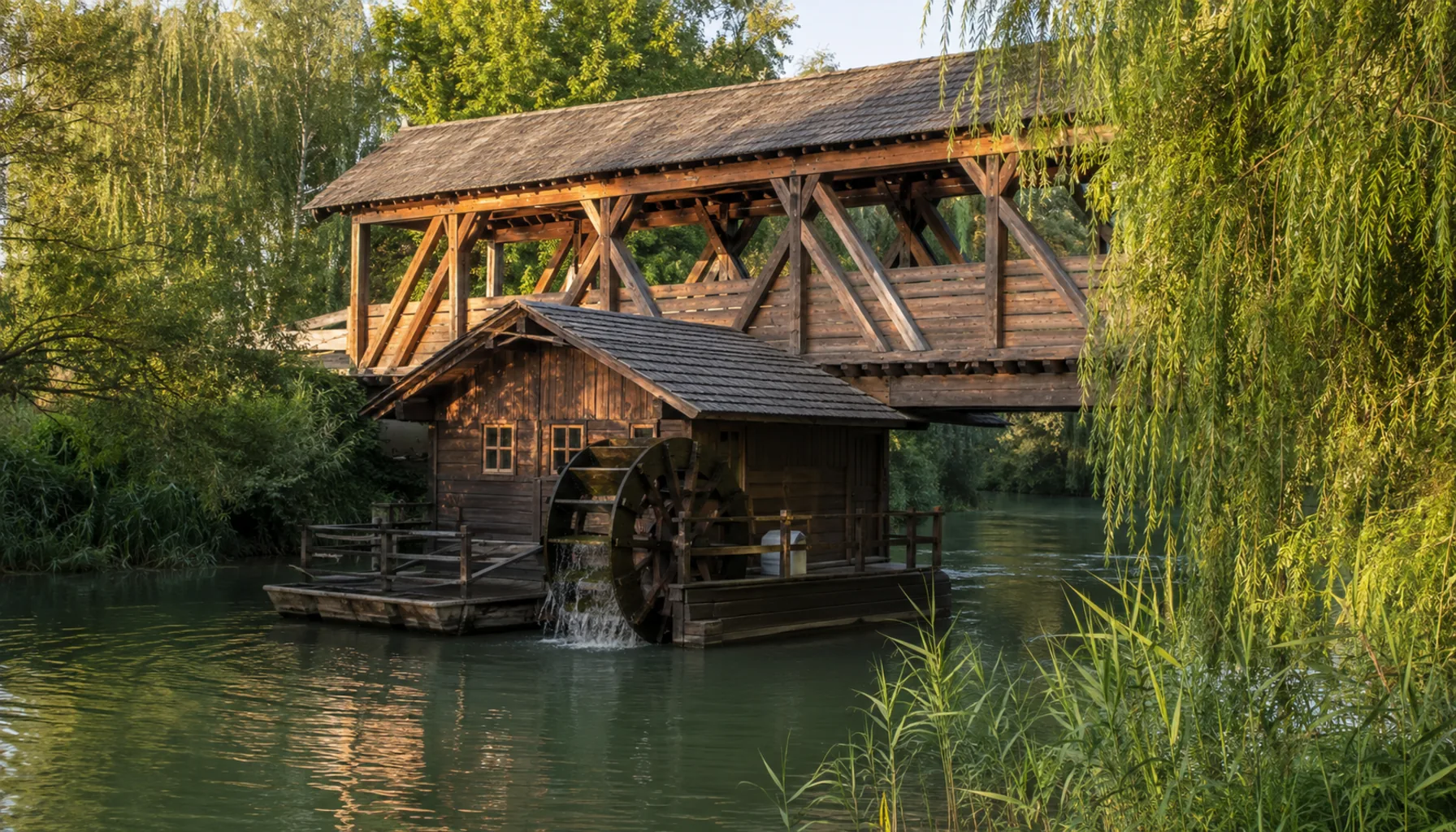
The covered wooden footbridge over the Little Danube at Kolárovo, with the replica floating mill moored below it
The covered wooden footbridge over the Little Danube at Kolárovo, with the replica floating mill moored below it.Krytý drevený most cez Malý Dunaj v Kolárove a replika plávajúceho mlyna zakotvená pod ním.

The year in KolárovoRok v Kolárove

The town has held the right to annual fairs since 1551, when Guta — the older name most people here still use — was given the privileges of a market town, confirmed again in 1557. A fair granted by charter is not the fair held today, but the habit is old and unbroken: a lowland town of this size keeps a market calendar, a patronal feast and a summer programme on the recreation ground across the river. We name no dates; they are set a season at a time.Právo na výročné jarmoky má mesto od roku 1551, keď Gúta — staršie meno, ktoré tu väčšina ľudí používa dodnes — dostala výsady zemepanského mestečka, potvrdené znovu v roku 1557. Jarmok udelený listinou nie je ten dnešný, no zvyk je starý a neprerušený: nížinné mesto tejto veľkosti si drží jarmočný kalendár, hody a letný program na rekreačnej ploche za riekou. Termíny tu neuvádzame, určujú sa od sezóny k sezóne.

The parish church is dedicated to the Assumption, so the patronal feast falls in mid-August, in the middle of the harvest — which is when a farming town has both the money and the reason to celebrate. The other fixed points in the year belong to the water: the canoeing season on the Little Danube, the thermal pool at the edge of town, and fishing on the gravel lakes and backwaters.Farský kostol je zasvätený Nanebovzatiu Panny Márie, takže hody pripadajú na polovicu augusta, doprostred žatvy — teda na čas, keď má poľnohospodárske mesto na oslavu peniaze aj dôvod. Ostatné pevné body roka patria vode: sezóne na Malom Dunaji, termálnemu kúpalisku na okraji mesta a rybárčeniu na štrkoviskách a mŕtvych ramenách.

The floating mill and the wooden bridge are what most visitors come for. The mill's opening is seasonal, so check before you plan a day around it; the bridge is open all year and carries walkers and cyclists only.Väčšina návštevníkov prichádza za lodným mlynom a dreveným mostom. Mlyn je otvorený sezónne, takže si to overte skôr, než okolo neho postavíte celý deň; most je prístupný po celý rok a vedú po ňom len chodci a cyklisti.

Where culture livesKde žije kultúra

The everyday infrastructure is the standard Slovak set: a cultural centre with a hall and a programme, a public library, amateur choirs and folk groups, and a school of art for children. We name none of them individually, because premises, ensembles and programmes change faster than a page like this does.Každodenná infraštruktúra je štandardná slovenská: kultúrne stredisko so sálou a programom, mestská knižnica, amatérske spevácke zbory a folklórne skupiny a základná umelecká škola pre deti. Menovite tu neuvádzame ani jednu z nich — priestory, telesá aj programy sa menia rýchlejšie než takáto stránka.

The town's principal exhibit is not in a building at all. A working replica of a ship mill — two hulls with a paddle wheel turning between them, the milling gear housed inside — was built in 1980 and moored on the Little Danube, in the pattern of the mills that ground grain here until the twentieth century. It is the most honest thing Kolárovo could have put on display, because it is the machine the town actually lived by rather than a case of objects about it.Hlavný exponát mesta vôbec nie je v budove. Funkčná replika lodného mlyna — dva trupy s lopatkovým kolesom otáčajúcim sa medzi nimi a mlynským zariadením vnútri — vznikla v roku 1980 a je zakotvená na Malom Dunaji podľa vzoru mlynov, ktoré tu mleli obilie ešte v dvadsiatom storočí. Poctivejší exponát si Kolárovo vybrať nemohlo: je to stroj, z ktorého mesto naozaj žilo, nie vitrína o ňom.

The buildings that carry itBudovy, ktoré ju nesú

The medieval church burned down in 1715, and the Baroque church of the Assumption was built to replace it in 1723-24 and enlarged later in the century. A statue of St Vendelín, the patron saint of herdsmen, went up in 1835. This was cattle and reed country rather than vineyard country, and the saints a town chooses tell you plainly what it did for a living.Stredoveký kostol v roku 1715 zhorel a jeho barokovú náhradu, Kostol Nanebovzatia Panny Márie, postavili v rokoch 1723 – 1724 a neskôr v storočí rozšírili. V roku 1835 tu vztýčili sochu svätého Vendelína, patróna pastierov. Toto bol kraj dobytka a trstiny, nie viníc, a svätci, ktorých si mesto vyberie, jasne hovoria, z čoho žilo.

The town itself became a town in the modern period rather than the medieval one, and the centre shows it: wide streets, single-storey houses, and a scale set by carts rather than by burghers. There is no square of the sort an inland trading town would have built, because Kolárovo is a very large lowland market village that kept growing.Mestom sa Kolárovo stalo až v novoveku, nie v stredoveku, a jeho centrum to prezrádza: široké ulice, prízemné domy a mierka určená vozmi, nie meštianstvom. Námestie, aké by si postavilo vnútrozemské obchodné mesto, tu nenájdete — Kolárovo je veľmi veľká nížinná trhová dedina, ktorá jednoducho rástla ďalej.

There was a fort, and its story is worth having straight. Local tradition says earthworks and a small fort called Békavár, Frog Castle, were thrown up in the marshes around 1349 on a queen's orders; the tradition names Queen Mary, who was not born until 1370, so either the date or the name is wrong. The works were strengthened between 1548 and 1594 as the Ottoman frontier came close, and modernised in a hurry between 1662 and 1664 after Nové Zámky fell. They were not destroyed by the Turks: on 12 July 1708, during Ferenc Rákóczi II's uprising against the Habsburgs, the kuruc general János Bottyán took the fort, marched its garrison off to Nové Zámky and had the works demolished.Pevnosť tu bola a jej príbeh stojí za to povedať presne. Miestna tradícia hovorí, že okolo roku 1349 dala kráľovná v močiaroch vybudovať valy a malú pevnôstku zvanú Békavár, Žabí hrad; tradícia menuje kráľovnú Máriu, ktorá sa narodila až v roku 1370, takže nesedí buď dátum, alebo meno. Opevnenie posilňovali v rokoch 1548 až 1594, ako sa blížila osmanská hranica, a narýchlo modernizovali v rokoch 1662 až 1664 po páde Nových Zámkov. Nezničili ho Turci: 12. júla 1708, počas povstania Františka II. Rákócziho proti Habsburgovcom, pevnosť dobyl kurucký generál János Bottyán, posádku odviedol do Nových Zámkov a opevnenie dal zbúrať.

What the town chose to rebuildČo sa mesto rozhodlo obnoviť

Kolárovo has lost a great deal. Turkish troops plundered it in 1573 and burned it in 1669; soldiers moving through after the June 1849 campaign upstream fired on it; and in June 1965 the great flood of the Rye Island destroyed 768 houses here and badly damaged 1,568 more, leaving barely a hundred undamaged. The town was rebuilt with help sent from Prague, Bratislava and Brno, and had its town status restored on 14 October 1967.Kolárovo prišlo o veľa. V roku 1573 ho vyplienili turecké vojská, v roku 1669 vypálili; po júnovom ťažení roku 1849 proti prúdu doň strieľali prechádzajúci vojaci; a v júni 1965 veľká povodeň na Žitnom ostrove zničila v meste 768 domov a ďalších 1 568 ťažko poškodila — nepoškodených zostala sotva stovka. Mesto obnovili s pomocou, ktorá prišla z Prahy, Bratislavy a Brna, a 14. októbra 1967 mu vrátili štatút mesta.

It has lost things quietly too. The branch railway from Komárno reached Guta on 19 April 1914, three months before the empire went to war, and there are no regular passenger trains now. The ship mills went out of use, and reed cutting, worked for generations into mats, thatch and board, is done on a smaller scale.Prichádzalo aj potichu. Odbočka železnice z Komárna dorazila do Gúty 19. apríla 1914, tri mesiace pred vstupom ríše do vojny, a pravidelné osobné vlaky dnes nejazdia. Lodné mlyny vyšli z používania a rezanie trstiny, ktorú tu po generácie spracúvali na rohože, došky a dosky, prežíva v menšom rozsahu.

What the town did after 1989 is the point. Rather than build something new, it rebuilt the things that had made it: the floating mill already moored on the river, and then, in the early 1990s, the covered wooden footbridge over the Little Danube — 86 metres of timber under a shingled roof, with not one concrete pier in it, commonly called the longest all-wooden river bridge in Europe. A town that decides its own best exhibit is its water is telling you what it thinks it is.Podstatné je, čo mesto urobilo po roku 1989. Namiesto niečoho nového obnovilo to, čo ho vytvorilo: lodný mlyn už kotvil na rieke a začiatkom deväťdesiatych rokov k nemu pribudol krytý drevený most cez Malý Dunaj — 86 metrov dreva pod šindľovou strechou a ani jeden betónový pilier, bežne označovaný za najdlhší celodrevený most cez rieku v Európe. Mesto, ktoré si za svoj najlepší exponát zvolí vlastnú vodu, tým hovorí, čím sa cíti byť.

← Kolárovo← Kolárovo

WatchPozrite si

Sixteen videos for Culture in Kolárovo.Šestnásť videí — Kultúra v Kolárove.