Hurbanovo · Danubian LowlandHurbanovo · Podunajská nížina
The culture of Hurbanovo is an observatory: a private one built in a landowner's park in 1871, handed to the state on the single condition that it never leave the town, and the country's central observatory still.Kultúrou Hurbanova je hvezdáreň: súkromná, postavená v roku 1871 v parku zemepána, odovzdaná štátu s jedinou podmienkou, že mesto nikdy neopustí — a dodnes ústredná hvezdáreň krajiny.
The calendar that makes this town different is an observing calendar. The Slovak Central Observatory holds public sessions at its site on the edge of town, but what happens depends on the season and the sky — so this is one of the few places where arranging a visit in advance is necessity rather than politeness.Kalendár, ktorý toto mesto odlišuje, je pozorovací. Slovenská ústredná hvezdáreň má vo svojom areáli na okraji mesta verejné pozorovania, ale čo sa uskutoční, závisí od ročného obdobia a od oblohy — takže toto je jedno z mála miest, kde je dohodnúť si návštevu vopred nutnosťou, nie zdvorilosťou.
The rest is the ordinary year of a lowland town and we are not going to put names or dates on it: a town day, markets, a Christmas programme, church feasts, school and sports fixtures, and whatever the cultural centre books into its hall — announced locally, close to the date, and liable to change.Zvyšok je bežný rok nížinného mesta a nebudeme mu dávať názvy ani termíny: dni mesta, trhy, vianočný program, cirkevné sviatky, školské a športové podujatia a to, čo si do sály objedná kultúrne stredisko — oznamuje sa to miestne, krátko pred termínom, a môže sa to zmeniť.
The timings that carry real weight here are astronomical rather than civic: eclipses, meteor showers and bright comets bring people to the observatory who would not otherwise come to Hurbanovo, and the site's own announcements are where they appear.Termíny, ktoré tu majú naozaj váhu, sú astronomické, nie mestské: zatmenia, meteorické roje a jasné kométy privádzajú do hvezdárne ľudí, ktorí by do Hurbanova inak neprišli — a objavujú sa v jej vlastných oznamoch.
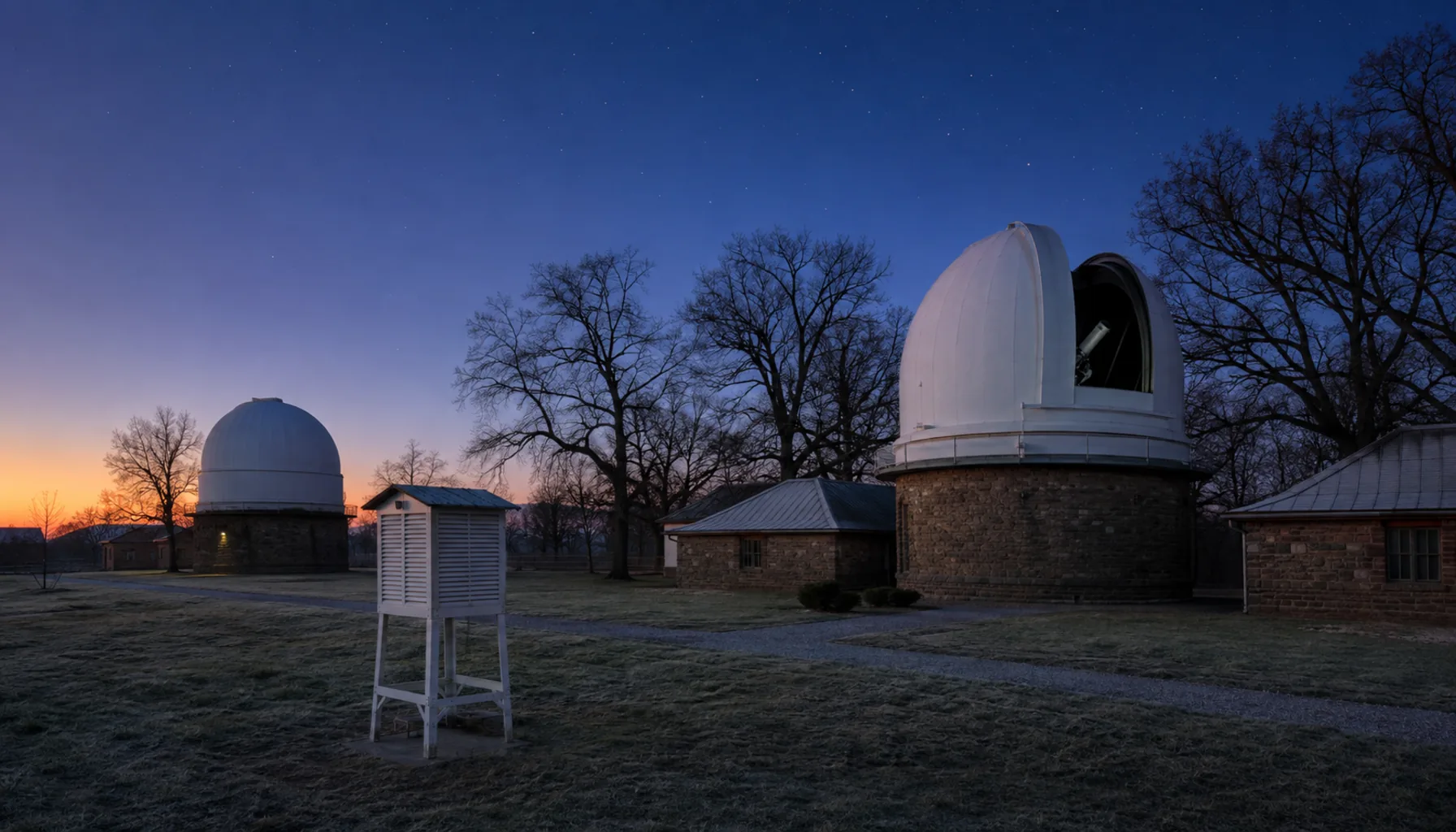
The observatory is the answer, and has been for a century and a half. In 1871 Mikuláš Konkoly-Thege, who owned the estate here, built one in his own park — not a gentleman's toy but one of the first astrophysical observatories in Europe, working on starlight, the Sun and meteors, published where other astronomers would read it. A meteorological station went up beside it, and the weather has been recorded here without a break ever since.Odpoveďou je hvezdáreň a je ňou už poldruha storočia. V roku 1871 si ju Mikuláš Konkoly-Thege, ktorý tu vlastnil panstvo, postavil vo vlastnom parku — nie ako hračku pre pána, ale ako jedno z prvých astrofyzikálnych observatórií v Európe: pracovalo sa tu na svetle hviezd, na Slnku a na meteoroch a výsledky vychádzali tam, kde ich iní astronómovia čítali. Vedľa nej vyrástla meteorologická stanica a počasie sa tu odvtedy zaznamenáva bez prerušenia.
On 18 May 1899 he handed it to the state on one condition: that it stay in Hurbanovo. That condition is why the town still has an observatory. Most of the instruments went to Budapest after 1918, but from 1919 it was run as a state astrophysical observatory under Prague, observing restarted in 1962, and in 1969 Hurbanovo became the seat of the Slovak Central Observatory.18. mája 1899 ju odovzdal štátu s jedinou podmienkou: že zostane v Hurbanove. Práve tá podmienka je dôvod, prečo mesto hvezdáreň dodnes má. Väčšina prístrojov po roku 1918 odišla do Budapešti, ale od roku 1919 fungovala ako štátne astrofyzikálne observatórium pod Prahou, pozorovať sa začalo znova v roku 1962 a v roku 1969 sa Hurbanovo stalo sídlom Slovenskej ústrednej hvezdárne.
What you visit is the historic buildings among old trees, the domes, the meteorological enclosure and an exhibition on the founder and the instruments that worked here. Everything else is the standard equipment of a small town — a cultural centre, a library, a school of art for children — and we name none of them, for the usual reason: programmes and premises change faster than a page like this does.To, čo si prezriete, sú historické budovy medzi starými stromami, kupoly, meteorologická záhrada a expozícia o zakladateľovi a o prístrojoch, ktoré tu pracovali. Všetko ostatné je bežné vybavenie malého mesta — kultúrne stredisko, knižnica, základná umelecká škola — a nemenujeme ich, a to z obvyklého dôvodu: programy a priestory sa menia rýchlejšie než takáto stránka.
The centre of Hurbanovo is the manor house the Konkoly-Thege family built, the park around it and the parish church, and that is close to the whole of it — a stop with one very good reason to stop, not a sightseeing town. Even the name is recent: the village first appears in 1329 as Gyalla, later Ógyalla and Stará Ďala, and was renamed in 1948 after Jozef Miloslav Hurban, who had nothing to do with the place.Centrum Hurbanova tvorí kaštieľ, ktorý postavila rodina Konkoly-Thege, park okolo neho a farský kostol — a tým je to takmer vyčerpané: je to zastávka s jedným veľmi dobrým dôvodom zastaviť, nie mesto na prehliadku pamiatok. Aj meno je mladé: obec sa prvý raz spomína v roku 1329 ako Gyalla, neskôr Ógyalla a Stará Ďala, a dnešný názov dostala v roku 1948 po Jozefovi Miloslavovi Hurbanovi, ktorý s týmto miestom nemal nič spoločné.
The park connects it all. A family that owned flat, warm farmland put a house and a landscape park on it, and then an observatory in the park — which is how a private estate became a national institution without ever moving. The old trees you walk under were planted for the house; the domes stand among them.Všetko spája park. Rodina, ktorá vlastnila rovinatú teplú pôdu, na ňu postavila dom a krajinársky park — a do parku potom hvezdáreň. Tak sa zo súkromného panstva stala celoštátna inštitúcia bez toho, aby sa čo i len pohla z miesta. Staré stromy, pod ktorými prechádzate, sadili pre kaštieľ; kupoly stoja medzi nimi.
The other landmark is industrial and visible long before the sign — the brewery built at the end of the 1960s, which makes Zlatý Bažant and belongs today to the Heineken group. It is the largest employer in the town, and its tanks are the second silhouette in a place otherwise defined by domes.Druhou dominantou je priemyselná stavba, ktorú vidno dávno pred tabuľou s názvom mesta — pivovar postavený na konci šesťdesiatych rokov, ktorý varí Zlatý Bažant a dnes patrí skupine Heineken. Je najväčším zamestnávateľom v meste a jeho tanky sú druhou siluetou v mieste, ktoré inak určujú kupoly.
Hurbanovo turns up in the record books more often than a town its size should, for two reasons. The first is real: this is one of the hottest, flattest and driest corners of Slovakia, with nothing in the landscape to interrupt the sun.Hurbanovo sa v knihách rekordov objavuje častejšie, než by mestu jeho veľkosti prislúchalo, a dôvody sú dva. Prvý je vecný: je to jeden z najteplejších, najplochejších a najsuchších kútov Slovenska, kde slnku v krajine nestojí nič v ceste.
The second is that somebody has been standing here with a thermometer since the 1870s. The station he founded beside his observatory holds one of the longest continuous weather records in the country, and a long record is what makes a record day countable at all. On 20 July 2007 it measured 40.3 degrees Celsius, the highest temperature ever recorded in Slovakia — a mark that stood until the summer of 2026, when Kamenica nad Hronom reached 41.4.Druhý je ten, že tu od sedemdesiatych rokov 19. storočia niekto stojí s teplomerom. Stanica, ktorú založil vedľa svojej hvezdárne, má jeden z najdlhších neprerušených radov meraní počasia v krajine — a práve dlhý rad meraní robí z rekordného dňa niečo spočítateľné. 20. júla 2007 namerala 40,3 stupňa Celzia, najvyššiu teplotu, aká bola kedy na Slovensku zaznamenaná; platilo to do leta 2026, keď Kamenica nad Hronom dosiahla 41,4.
That is local culture as much as meteorology. A town knows itself partly by what it is known for, and Hurbanovo is known for a century and a half of paying attention — to the sky at night, and to the air temperature at two in the afternoon.Je to miestna kultúra rovnako ako meteorológia. Mesto sa pozná aj podľa toho, čím je známe — a Hurbanovo je známe poldruha storočím pozornosti: k nočnej oblohe a k teplote vzduchu o druhej popoludní.
Sixteen videos for Culture in Hurbanovo.Šestnásť videí — Kultúra v Hurbanove.