The town where Slovakia's temperature records are set and its central observatory keeps watch — a nineteenth-century private observatory that grew into a national institution, and a brewery whose beer travels further than any other Slovak one.Mesto, v ktorom padajú slovenské teplotné rekordy a kde sídli ústredná hvezdáreň — pôvodne súkromné observatórium z 19. storočia, z ktorého sa stala národná inštitúcia, a pivovar, ktorého pivo cestuje ďalej než ktorékoľvek iné slovenské.
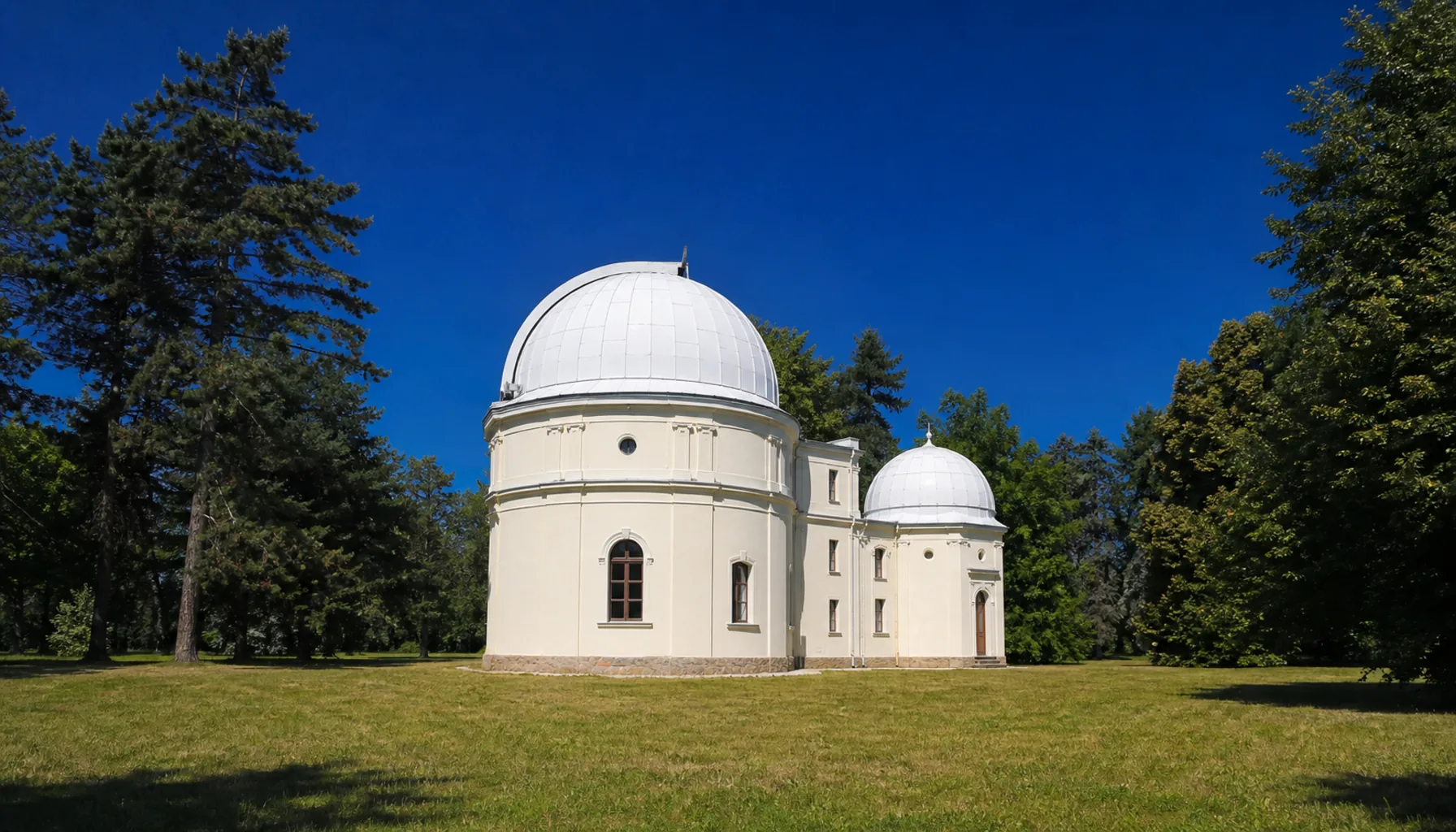
The domes of the Slovak Central Observatory in its park at HurbanovoKupoly Slovenskej ústrednej hvezdárne v parku v Hurbanove
Where it standsKde leží
Hurbanovo sits in the middle of the Danubian Lowland between Nové Zámky and Komárno, on flat, warm, dry farmland a short way north of the Danube. Nothing in the landscape interrupts the sun, which turns out to be a large part of why the town matters at all.Hurbanovo leží uprostred Podunajskej nížiny medzi Novými Zámkami a Komárnom, na rovinatej, teplej a suchej poľnohospodárskej pôde kúsok na sever od Dunaja. V krajine nie je nič, čo by zacláňalo slnku — a práve to je veľká časť dôvodu, prečo na tomto meste vôbec záleží.
By the record books it is one of the hottest places in the country: 40.3 degrees Celsius was recorded at the Hurbanovo station in July 2007, and that stood as the national record until the hot summer of 2026, when Kamenica nad Hronom measured 41.4 degrees. Like its neighbours the town is bilingual, its older name Stará Ďala — Ógyalla in Hungarian — is still heard, and the present one was given in 1948 after Jozef Miloslav Hurban.Podľa meteorologických záznamov je to jedno z najteplejších miest v krajine: 40,3 stupňa Celzia namerala hurbanovská stanica v júli 2007 a bol to slovenský rekord až do horúceho leta 2026, keď v Kamenici nad Hronom namerali 41,4 stupňa. Ako susedné mestá je aj toto dvojjazyčné, staršie meno Stará Ďala — po maďarsky Ógyalla — tu ešte počuť a dnešný názov dostalo v roku 1948 podľa Jozefa Miloslava Hurbana.
The storyHistória
The observatory began as a private one. Mikuláš Konkoly-Thege, a landowner and astronomer of the family that held the estate here, equipped an observatory in his own park in the early 1870s and ran it as a serious research station — spectroscopy, solar observation, meteor work — publishing his results and corresponding with the observatories of Europe.Hvezdáreň vznikla ako súkromná. Mikuláš Konkoly-Thege, zemepán a astronóm z rodu, ktorý tu držal panstvo, zriadil začiatkom 70. rokov 19. storočia observatórium vo vlastnom parku a viedol ho ako vážne výskumné pracovisko — spektroskopia, pozorovanie Slnka, meteory — publikoval výsledky a dopisoval si s európskymi hvezdárňami.
He handed the observatory over to the state at the end of the century and it became one of the recognised astrophysical stations of the Hungarian kingdom. He also founded the meteorological station beside it, which has measured ever since and holds one of the longest continuous weather records in Slovakia.Koncom storočia observatórium odovzdal štátu a stalo sa jedným z uznávaných astrofyzikálnych pracovísk Uhorska. Založil pri ňom aj meteorologickú stanicu, ktorá odvtedy nepretržite meria a drží jeden z najdlhších súvislých radov meteorologických pozorovaní na Slovensku.
Most of the instruments went to Budapest after 1918 and the site passed through decades of uncertainty, but the buildings and the park survived. In the socialist period the Slovak Central Observatory was established here, the state body responsible for coordinating observatories and public astronomy in the country, and it remains so.Väčšina prístrojov po roku 1918 odišla do Budapešti a pracovisko prešlo desaťročiami neistoty, budovy a park však prežili. V socialistickom období tu vznikla Slovenská ústredná hvezdáreň — štátna inštitúcia zodpovedná za koordináciu hvezdární a verejnej astronómie v krajine — a je ňou dodnes.
What to seeČo vidieť
The observatory and its park are the reason to come. The historic buildings stand among old trees on the edge of the town, with the domes, the meteorological enclosure and an exhibition on the founder and the instruments that worked here. Public observing sessions and events are held for visitors, but they depend on the season and the sky — arrange a visit in advance.Hvezdáreň a jej park sú dôvodom, prečo sem prísť. Historické budovy stoja medzi starými stromami na okraji mesta, s kupolami, meteorologickou záhradou a expozíciou o zakladateľovi a o prístrojoch, ktoré tu pracovali. Pre návštevníkov sa konajú verejné pozorovania a podujatia, závisia však od sezóny a od oblohy — návštevu si dohodnite vopred.
The manor house the Konkoly-Thege family built, the park around it and the parish church make up the rest of the centre. Hurbanovo is not a sightseeing town and does not pretend to be; it is a stop with one very good reason to stop.Kaštieľ, ktorý postavil rod Konkoly-Thege, park okolo neho a farský kostol tvoria zvyšok centra. Hurbanovo nie je turistické mesto a ani sa tak netvári; je to zastávka s jedným veľmi dobrým dôvodom zastaviť.
A short drive away are the fortress at Komárno, the Roman fort site at Iža on the Danube bank and the thermal baths at Patince; the Danube villages here lie one after another along a single flat road.Na krátku cestu autom sú odtiaľ pevnosť v Komárne, rímsky tábor pri Iži na brehu Dunaja a termálne kúpele v Patinciach; podunajské obce tu ležia jedna za druhou na jedinej rovinatej ceste.
Work and industryPráca a priemysel
Brewing is the town's industry. The brewery built here at the end of the 1960s makes Zlatý Bažant, the Slovak beer best known abroad, and belongs today to the Heineken group; it is the largest employer in the town and its tanks show up long before you reach the sign.Priemyslom mesta je pivovarníctvo. Pivovar postavený tu koncom 60. rokov varí Zlatého Bažanta, v zahraničí najznámejšie slovenské pivo, a dnes patrí do skupiny Heineken; je najväčším zamestnávateľom v meste a jeho tanky vidno dávno predtým, než človek príde k tabuli.
Around it are the co-operatives farming the surrounding land, food processing and haulage, with commuting to Komárno and Nové Zámky making up the rest. The observatory is a small employer but a disproportionately important one for the town's sense of itself.Okolo neho hospodária na okolitej pôde družstvá, ďalej je tu potravinárstvo a doprava a zvyšok dopĺňa dochádzanie do Komárna a Nových Zámkov. Hvezdáreň je malým zamestnávateľom, no pre to, ako mesto vníma samo seba, neúmerne dôležitým.
Getting thereAko sa tam dostať
Hurbanovo is on the railway between Nové Zámky and Komárno, with regional trains stopping in both directions, and on the road linking the same two towns. Buses run from both, and Komárno is near enough that either town works as a base for the other.Hurbanovo leží na železnici medzi Novými Zámkami a Komárnom, kde v oboch smeroch zastavujú regionálne vlaky, a na ceste, ktorá spája tie isté dve mestá. Autobusy premávajú z oboch a Komárno je dosť blízko na to, aby jedno mesto poslúžilo ako základňa pre druhé.
Explore HurbanovoObjavujte Hurbanovo
Every part of this place with a page of its own.Každá časť tohto miesta, ktorá má vlastnú stránku.