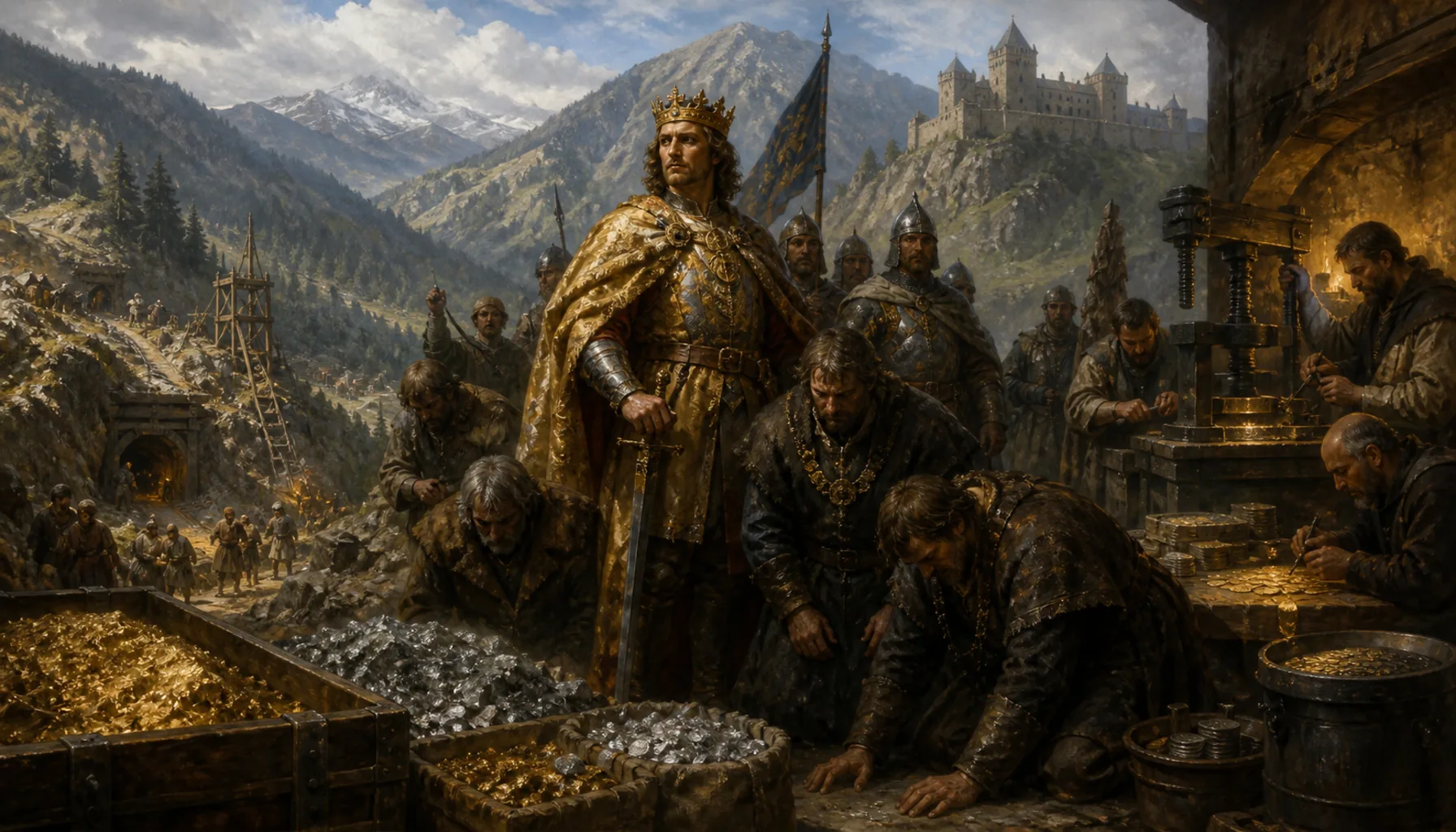
1328 – 1335Gold, silver, and a mint that never stoppedZlato, striebro a mincovňa, ktorá nikdy nezastala
SlovakiaSlovensko
Gold, silver, and a mint that never stoppedZlato, striebro a mincovňa, ktorá nikdy nezastala
Charles Robert paid for his victory over the oligarchs with the mountains. The ore under central Slovakia — silver at Banská Štiavnica, gold at Kremnica, copper at Banská Bystrica — made the Hungarian crown one of the richest in Europe, and the king took a share of everything that came out of the ground. On 17 November 1328 he granted Kremnica the privileges of a free royal town and the right to strike coin; the Kremnica ducats became one of the most trusted currencies in medieval Europe, and that mint has been working ever since, one of the oldest still in operation anywhere in the world. In 1335 he sat down at Visegrád with the kings of Bohemia and Poland and agreed a trade route that let their merchants bypass Vienna's staple rights. The castles on the crags now had something to guard besides themselves: the road the metal travelled.Víťazstvo nad oligarchami zaplatil Karol Róbert horami. Rudy pod stredným Slovenskom — striebro v Banskej Štiavnici, zlato v Kremnici, meď v Banskej Bystrici — urobili z uhorskej koruny jednu z najbohatších v Európe a kráľ mal podiel na všetkom, čo sa vyťažilo. 17. novembra 1328 udelil Kremnici výsady slobodného kráľovského mesta a právo raziť mince; kremnické dukáty patrili k najdôveryhodnejším platidlám stredovekej Európy a tamojšia mincovňa razí bez prestávky dodnes — je jednou z najstarších fungujúcich mincovní na svete. Roku 1335 si vo Visegráde sadol s českým a poľským kráľom a dohodli obchodnú cestu, ktorá ich kupcom umožnila obísť viedenské právo skladu. Hrady na bralách tak zrazu mali čo strážiť okrem seba samých: cestu, po ktorej putoval kov.
ReferencesZdroje
Where this came fromOdkiaľ to pochádza
Sources consulted while researching this page. Follow them to read further — and to check us.Zdroje, z ktorých sme pri príprave tejto stránky vychádzali. Kliknite a čítajte ďalej — aj si nás overte.
Černová massacre — Wikipediadate, 15 killed and 12 seriously wounded, gendarmes' own nationalitydate, 15 killed and 12 seriously wounded, gendarmes' own nationality
Magyarization — Wikipediathe 1907 Apponyi education laws, the closing of the Slovak grammar schools and of Matica slovenská in April 1875the 1907 Apponyi education laws, the closing of the Slovak grammar schools and of Matica slovenská in April 1875
Žiadosti slovenského národa — Wikipédia10 May 1848, fourteen points, the arrest warrants of May–June 184810 May 1848, fourteen points, the arrest warrants of May–June 1848
Slovak Uprising of 1848–49 — Wikipediathe three volunteer campaigns and the disbanding of the corps on 21 November 1849the three volunteer campaigns and the disbanding of the corps on 21 November 1849
Pittsburgh Agreement — Wikipediathe Cleveland Agreement of 22 October 1915 and the text of the Pittsburgh promisesthe Cleveland Agreement of 22 October 1915 and the text of the Pittsburgh promises
Slovak–Hungarian War — Wikipediathe 'Little War' of March 1939 and the 1,697 km² ceded on 4 April 1939the 'Little War' of March 1939 and the 1,697 km² ceded on 4 April 1939
Slovak National Uprising — Wikipediainsurgent numbers, territory held, the fall of Banská Bystrica on 27 October 1944insurgent numbers, territory held, the fall of Banská Bystrica on 27 October 1944
Kremnička and Nemecká massacres — Wikipedia747 victims at Kremnička, about 900 at Nemecká, the units responsible747 victims at Kremnička, about 900 at Nemecká, the units responsible
Masaker v Kľakovskej doline — Wikipédia21 January 1945, 148 civilians including 48 children under eighteen21 January 1945, 148 civilians including 48 children under eighteen
Battle of the Dukla Pass — Wikipedia8 September – 28 October 1944 and the casualty figures8 September – 28 October 1944 and the casualty figures
Kalinov — Wikipédiathe first village in Slovakia liberated, 21 September 1944the first village in Slovakia liberated, 21 September 1944
Slovak Greek Catholic Church — Wikipediathe staged Prešov assembly of April 1950, Bishop Gojdič, the 1968 restorationthe staged Prešov assembly of April 1950, Bishop Gojdič, the 1968 restoration