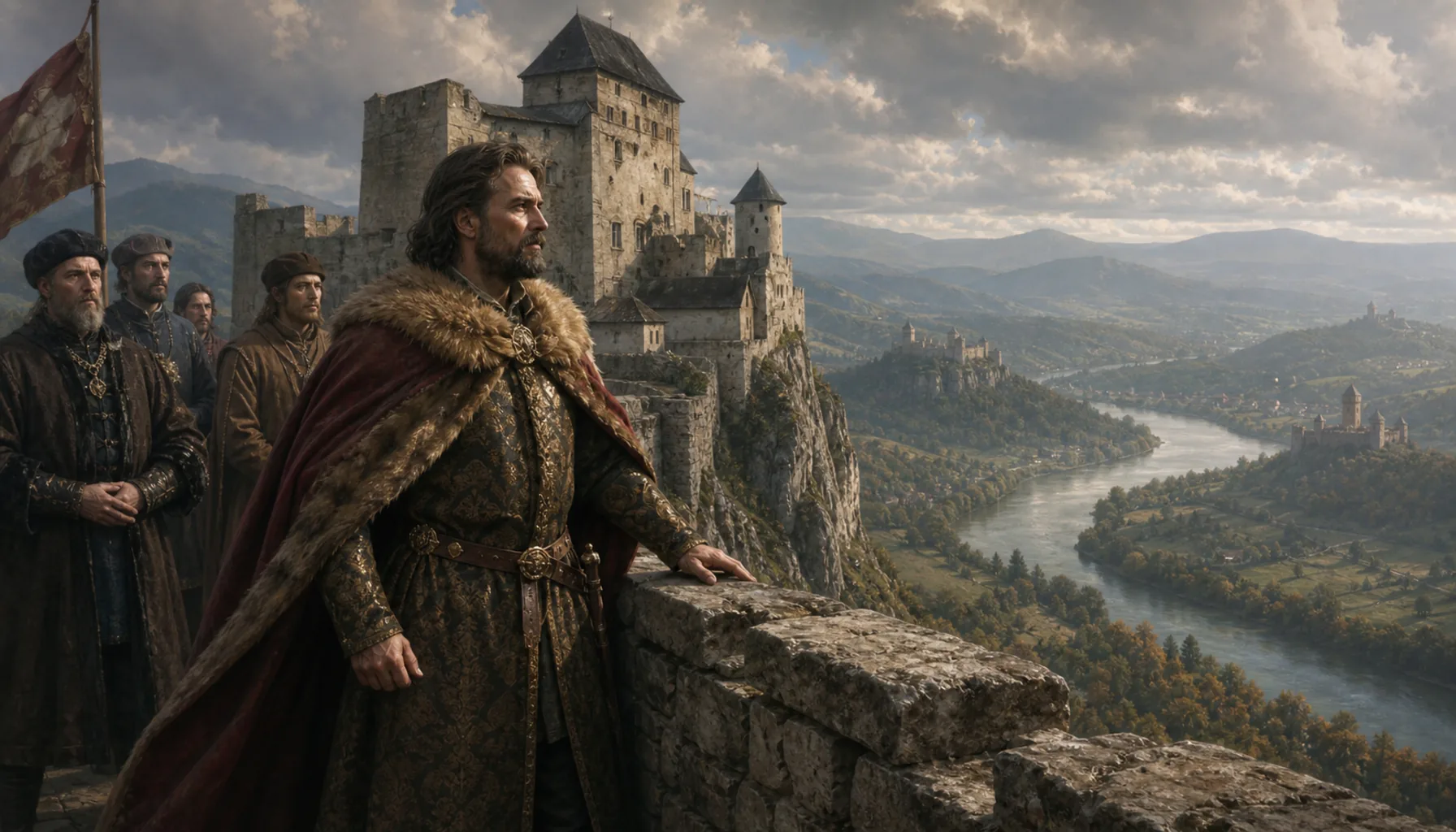
c. 1300 – 1321Matúš Čák, the lord of the Váh and the TatrasMatúš Čák, pán Váhu a Tatier
SlovakiaSlovensko
Matúš Čák, the lord of the Váh and the TatrasMatúš Čák, pán Váhu a Tatier
From the castle on the rock above Trenčín, Matúš Čák ruled some fourteen counties of the north-west as if they were his own country, with his own court, his own officials and dozens of castles in his hand. He took royal office when it suited him — he was palatine twice — and ignored the king when it did not. On 15 June 1312 the new king, Charles Robert of Anjou, beat Čák's army and his allies the sons of Amadé Aba at Rozhanovce near Košice, in what the chroniclers describe as the bloodiest battle in the kingdom since Mohi; after it Čák could never attack the king again, though his lands stayed his until he died on 18 March 1321, and the royal army took the whole domain back within months. Slovak tradition remembers him as the lord of the Váh and the Tatras, which is flattering; to the king he was a rebel, and both descriptions are true.Z hradu na skale nad Trenčínom vládol Matúš Čák zhruba štrnástim stoliciam severozápadu tak, akoby to bola jeho vlastná krajina: mal vlastný dvor, vlastných úradníkov a v rukách desiatky hradov. Kráľovské úrady prijímal, keď sa mu to hodilo — dvakrát bol palatínom — a keď sa mu to nehodilo, kráľa jednoducho obchádzal. 15. júna 1312 porazil nový kráľ Karol Róbert z Anjou jeho vojsko aj jeho spojencov, synov Omodeja Abu, pri Rozhanovciach neďaleko Košíc; kronikári ju opisujú ako najkrvavejšiu bitku v kráľovstve od Muhi. Čák už potom na kráľa zaútočiť nedokázal, panstvo si však udržal až do smrti 18. marca 1321 a kráľovské vojsko ho obsadilo do niekoľkých mesiacov. Slovenská tradícia ho volá pánom Váhu a Tatier, čo znie lichotivo; pre kráľa to bol vzbúrenec — a pravdivé je oboje.
ReferencesZdroje
Where this came fromOdkiaľ to pochádza
Sources consulted while researching this page. Follow them to read further — and to check us.Zdroje, z ktorých sme pri príprave tejto stránky vychádzali. Kliknite a čítajte ďalej — aj si nás overte.
Černová massacre — Wikipediadate, 15 killed and 12 seriously wounded, gendarmes' own nationalitydate, 15 killed and 12 seriously wounded, gendarmes' own nationality
Magyarization — Wikipediathe 1907 Apponyi education laws, the closing of the Slovak grammar schools and of Matica slovenská in April 1875the 1907 Apponyi education laws, the closing of the Slovak grammar schools and of Matica slovenská in April 1875
Žiadosti slovenského národa — Wikipédia10 May 1848, fourteen points, the arrest warrants of May–June 184810 May 1848, fourteen points, the arrest warrants of May–June 1848
Slovak Uprising of 1848–49 — Wikipediathe three volunteer campaigns and the disbanding of the corps on 21 November 1849the three volunteer campaigns and the disbanding of the corps on 21 November 1849
Pittsburgh Agreement — Wikipediathe Cleveland Agreement of 22 October 1915 and the text of the Pittsburgh promisesthe Cleveland Agreement of 22 October 1915 and the text of the Pittsburgh promises
Slovak–Hungarian War — Wikipediathe 'Little War' of March 1939 and the 1,697 km² ceded on 4 April 1939the 'Little War' of March 1939 and the 1,697 km² ceded on 4 April 1939
Slovak National Uprising — Wikipediainsurgent numbers, territory held, the fall of Banská Bystrica on 27 October 1944insurgent numbers, territory held, the fall of Banská Bystrica on 27 October 1944
Kremnička and Nemecká massacres — Wikipedia747 victims at Kremnička, about 900 at Nemecká, the units responsible747 victims at Kremnička, about 900 at Nemecká, the units responsible
Masaker v Kľakovskej doline — Wikipédia21 January 1945, 148 civilians including 48 children under eighteen21 January 1945, 148 civilians including 48 children under eighteen
Battle of the Dukla Pass — Wikipedia8 September – 28 October 1944 and the casualty figures8 September – 28 October 1944 and the casualty figures
Kalinov — Wikipédiathe first village in Slovakia liberated, 21 September 1944the first village in Slovakia liberated, 21 September 1944
Slovak Greek Catholic Church — Wikipediathe staged Prešov assembly of April 1950, Bishop Gojdič, the 1968 restorationthe staged Prešov assembly of April 1950, Bishop Gojdič, the 1968 restoration