Banská Bystrica region · VillagesBanskobystrický kraj · Obce
Hronský BeňadikHronský Beňadik
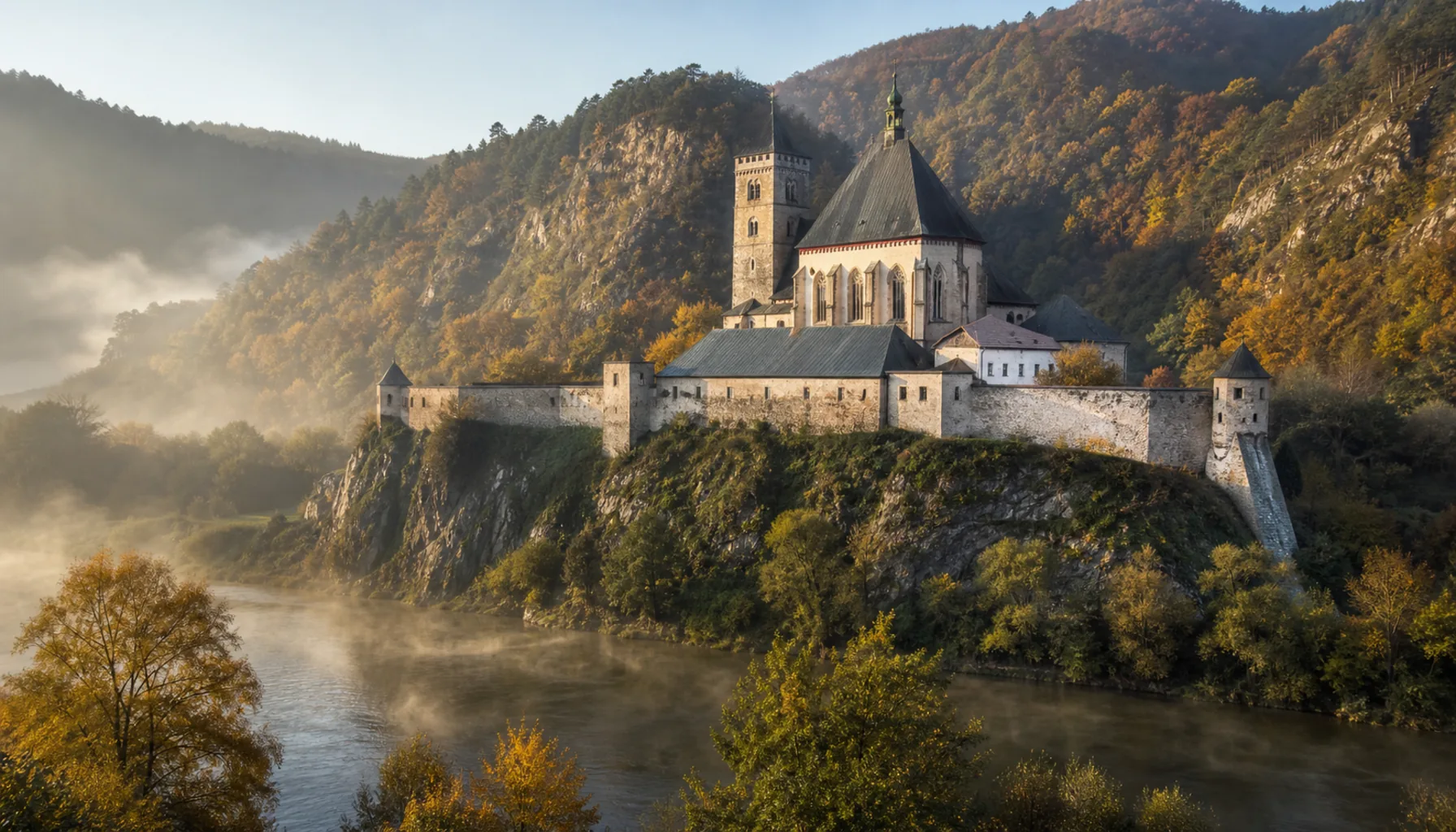
A Benedictine abbey founded in 1075 on a terrace above the Hron, rebuilt in Gothic, then walled and bastioned against the Ottomans — the most important monastic complex on the river, and the reason the village carries the saint's name.Benediktínske opátstvo založené v roku 1075 na terase nad Hronom, prestavané v gotike a potom obohnané hradbami a baštami proti Turkom — najvýznamnejší kláštorný areál na rieke a dôvod, prečo obec nesie meno svätca.
The fortified Benedictine abbey at Hronský Beňadik on its terrace above the HronOpevnené benediktínske opátstvo v Hronskom Beňadiku na terase nad Hronom
Where it standsKde leží
Hronský Beňadik stands where the Hron leaves the mountains. Just downstream the river squeezes through the Slovenská brána, the Slovak Gate, a narrows between the Pohronský Inovec and the Štiavnica Hills; above the village the valley belongs to mining country, below it the ground opens towards the Tekov lowland.Hronský Beňadik stojí tam, kde Hron opúšťa hory. Hneď pod obcou sa rieka pretláča cez Slovenskú bránu, úžinu medzi Pohronským Inovcom a Štiavnickými vrchmi; nad obcou patrí dolina banskému kraju, pod ňou sa krajina otvára k Tekovskej nížine.
The abbey sits on a rock terrace above the water, in full view of the road and the railway that share the valley floor with it.Opátstvo sedí na skalnej terase nad vodou, dobre viditeľné z cesty aj zo železnice, ktoré si s riekou delia dno doliny.
Why it is herePrečo práve tu
The gate is the answer to why anything important is here. Whoever held the narrows held the route between the lowland and the mining towns, and in 1075 King Géza I founded a Benedictine abbey on it. Its founding charter is among the oldest documents to name settlements in this part of the kingdom, and the abbey went on to serve as a place of authentication, issuing and keeping legal records for a wide district.Odpoveďou na to, prečo je tu čokoľvek dôležité, je práve brána. Kto držal túto úžinu, držal cestu medzi nížinou a banskými mestami — a v roku 1075 tu kráľ Gejza I. založil benediktínske opátstvo. Jeho zakladacia listina patrí k najstarším dokumentom, ktoré v tejto časti kráľovstva menujú osady, a kláštor neskôr pôsobil ako hodnoverné miesto, ktoré pre široké okolie vydávalo a uschovávalo právne písomnosti.
The Romanesque church was replaced in the fourteenth century by the Gothic one that still stands, and at some point in the Middle Ages the house acquired the relic venerated here as a drop of the Blood of Christ. That brought pilgrims, and pilgrims brought money.Románsky kostol v štrnástom storočí nahradil gotický, ktorý stojí dodnes, a kláštor niekedy v stredoveku získal relikviu uctievanú tu ako kvapku Kristovej krvi. Tá privádzala pútnikov a pútnici prinášali peniaze.
Then the frontier moved. After the Ottoman advance the complex was fortified in the sixteenth century — curtain walls, bastions, a gate tower — and held as a strongpoint covering the road up to Kremnica and Banská Štiavnica. That is why a monastery here looks like a small castle.Potom sa posunula hranica. Po tureckom postupe areál v šestnástom storočí opevnili — hradbami, baštami, vstupnou vežou — a držali ho ako oporný bod kryjúci cestu hore ku Kremnici a Banskej Štiavnici. Preto kláštor vyzerá ako malý hrad.
What you actually seeČo naozaj uvidíte
The Gothic church is the core: a tall three-aisled building with a carved west portal and a chapel built for the relic, all inside the later ring of defences. The fortification is the second thing you notice and the reason the place reads as a fortress from the road — walls, a bastion, a walled courtyard, monastic ranges round a cloister.Jadrom je gotický kostol: vysoká trojloďová stavba s kamenárskym západným portálom a s kaplnkou postavenou pre relikviu, a to všetko vnútri neskoršieho pásu opevnenia. Druhou vecou, ktorú si všimnete, je práve opevnenie — a je dôvodom, prečo areál z cesty pôsobí ako pevnosť: hradby, bašta, obohnané nádvorie, kláštorné krídla okolo rajského dvora.
Much of the medieval furnishing has gone the way such things go, dispersed to museums and galleries over the last two centuries, so what carries a visit is the architecture, the vaulting and the position above the river. Restoration has been under way a long time and parts of the complex show it.Veľká časť stredovekého zariadenia dopadla tak, ako to už býva — za posledné dve storočia sa rozišla po múzeách a galériách — takže návštevu nesie architektúra, klenby a poloha nad riekou. Obnova prebieha už dlho a na niektorých častiach areálu to vidieť.
Below the walls the village is ordinary: a few streets of a Hron-valley settlement, a station and the main road. The Slovak Gate itself is best taken in from the road or the train a couple of kilometres downstream.Pod hradbami je obec obyčajná: niekoľko ulíc sídla v doline Hrona, stanica a hlavná cesta. Samotnú Slovenskú bránu si najlepšie prezriete z cesty alebo z vlaku pár kilometrov po prúde.
Living village, not a museumŽivá obec, nie skanzen
The complex is in church hands and in use: a parish church with services, and pilgrimages to the relic on their own days. Visits inside are guided and seasonal, and out of season the church is locked like any other — do not build a journey around getting in without checking first.Areál je v cirkevných rukách a v používaní: farský kostol s bohoslužbami a púte k relikvii vo svojich dňoch roka. Prehliadky vnútra sú so sprievodcom a sezónne a mimo sezóny je kostol zamknutý ako každý iný — nestavajte cestu na tom, že sa dostanete dnu, kým si to neoveríte.
The village around it is a working one with a railway station and a busy road, no tourist street and little laid on for visitors. Come for the abbey, look at the gorge, and expect to find a parish rather than an attraction.Obec okolo neho je fungujúca, so železničnou stanicou a rušnou cestou, bez turistickej ulice a bez veľkej ponuky pre návštevníkov. Príďte za opátstvom, pozrite si tiesňavu a počítajte s tým, že nájdete farnosť, nie atrakciu.
Getting thereAko sa tam dostať
The railway between Nové Zámky and Zvolen runs through the village and has a station here, which is the easiest approach; the main road down the Hron between Žarnovica and Levice passes below the abbey, and buses run along the valley from Nová Baňa and Levice.Cez obec vedie železnica z Nových Zámkov do Zvolena a má tu stanicu, čo je najľahší spôsob príchodu; popod opátstvo prechádza hlavná cesta dolinou Hrona medzi Žarnovicou a Levicami a dolinou premávajú autobusy z Novej Bane a z Levíc.
Explore Hronský BeňadikObjavujte Hronský Beňadik
Every part of this place with a page of its own.Každá časť tohto miesta, ktorá má vlastnú stránku.