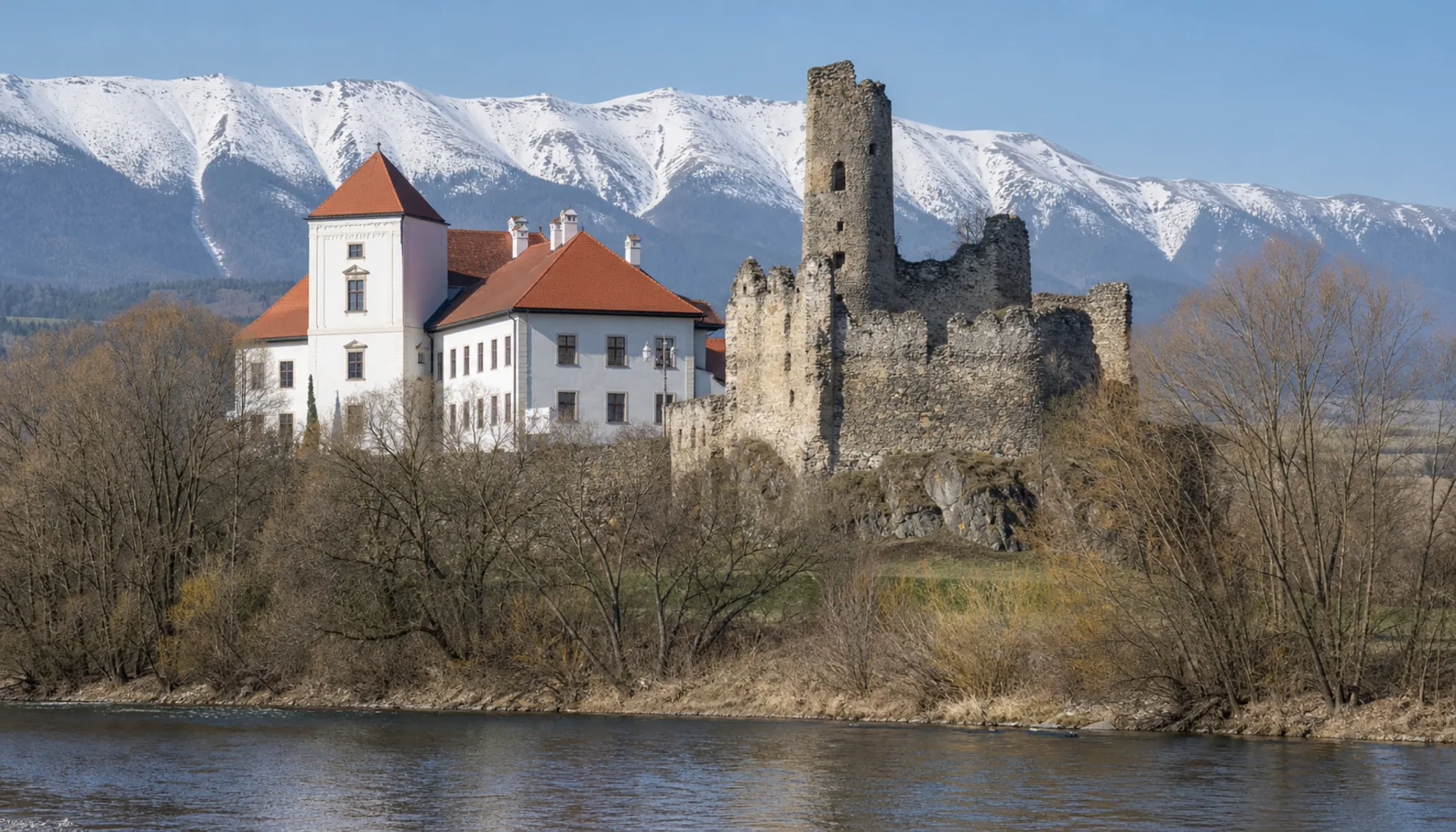
A small town at the meeting of the Váh and the Belá in eastern Liptov, with a ruined castle and its manor house on the river bank and a tradition of forestry teaching going back to a school founded in 1796.Malé mesto na sútoku Váhu a Belej vo východnom Liptove, so zrúcaninou hradu a kaštieľom na brehu rieky a s tradíciou lesníckeho školstva siahajúcou k škole založenej v roku 1796.
The castle ruin and manor house at Liptovský Hrádok above the VáhZrúcanina hradu a kaštieľ v Liptovskom Hrádku nad Váhom
Where it standsKde leží
Liptovský Hrádok stands at the eastern end of the Liptov basin, where the Belá comes down out of the Western Tatras and joins the Váh. The Low Tatras close the basin to the south and the Western Tatras stand across it to the north, and the valleys that open from the town — the Belá towards Pribylina and Podbanské, the Váh towards Kráľova Lehota and the Čierny Váh — are the reason it exists at all.Liptovský Hrádok leží na východnom konci Liptovskej kotliny, tam, kde Belá schádza zo Západných Tatier a vlieva sa do Váhu. Na juhu kotlinu uzatvárajú Nízke Tatry, na severe nad ňou stoja Západné Tatry, a doliny, ktoré sa od mesta otvárajú — Belá k Pribyline a Podbanskému, Váh ku Kráľovej Lehote a k Čiernemu Váhu — sú dôvodom, prečo vôbec vzniklo.
Liptovský Mikuláš, the district town and the busier of the two, is about ten kilometres west along the Váh.Liptovský Mikuláš, okresné mesto a z tejto dvojice to rušnejšie, je asi desať kilometrov na západ popri Váhu.
The storyHistória
The castle came first. It was built in the fourteenth century on a rock above the Váh to watch the road east towards the Spiš and the tracks north into the mountains, and it gave the town its name — hrádok, a small castle. In the following centuries a Renaissance manor house was built against it inside the walls, so the site now carries a ruin and a residence together.Najskôr bol hrad. Postavili ho v štrnástom storočí na skale nad Váhom, aby strážil cestu na východ smerom na Spiš a chodníky na sever do hôr, a dal mestu meno — hrádok, teda malý hrad. V nasledujúcich storočiach k nemu vo vnútri hradieb pristavali renesančný kaštieľ, takže miesto dnes nesie zrúcaninu aj sídlo naraz.
The estate that went with the castle was largely forest, and the forest is what shaped the town. In 1796 a forestry school was founded here, one of the first in the Kingdom of Hungary, to train the men who would run those woods; forestry teaching and forestry research have been part of Liptovský Hrádok ever since, and the town's secondary forestry school is the direct continuation of it.Panstvo, ktoré k hradu patrilo, tvoril prevažne les — a práve les mesto sformoval. V roku 1796 tu založili lesnícku školu, jednu z prvých v Uhorsku, aby vychovala ľudí, ktorí budú tie lesy spravovať; lesnícke školstvo a lesnícky výskum sú od tých čias súčasťou Liptovského Hrádku a stredná lesnícka škola v meste je ich priamym pokračovaním.
The railway along the Váh arrived in the early 1870s and made industry possible. The twentieth century added an electrical works making telephone and telecommunications equipment, together with the sawmilling and timber trades that a valley of spruce supports.Železnica popri Váhu prišla začiatkom sedemdesiatych rokov devätnásteho storočia a umožnila priemysel. Dvadsiate storočie pridalo elektrotechnický závod na telefónnu a spojovaciu techniku a k nemu píly a drevárske remeslá, aké dolina plná smreka uživí.
What to seeČo vidieť
The castle and manor complex on the bank of the Váh is the town's monument: medieval walls and a tower standing as a ruin, with the restored manor house set against them. Restoration has been going on in stages for years and what is open changes with it, so check before you plan a visit around it.Pamiatkou mesta je hradno-kaštieľsky areál na brehu Váhu: stredoveké múry a veža stoja ako zrúcanina a k nim je pristavaný obnovený kaštieľ. Obnova prebieha po etapách už roky a podľa toho sa mení aj to, čo je prístupné — pred cestou si to overte.
The Belá valley behind the town is the real draw. Pribylina, ten kilometres up it, holds the Museum of the Liptov Village, an open-air museum built largely to rescue buildings from the villages drowned by the Liptovská Mara reservoir; an early Gothic church and a manor house are among them. The road continues to Podbanské at the foot of the Western Tatras.Skutočným lákadlom je dolina Belej za mestom. Pribylina desať kilometrov v nej uchováva Múzeum liptovskej dediny, skanzen, ktorý vznikol najmä preto, aby zachránil stavby z obcí zatopených nádržou Liptovská Mara; medzi nimi je aj včasnogotický kostol a kaštieľ. Cesta pokračuje na Podbanské pod Západné Tatry.
The Belá itself is one of the last largely unregulated rivers in Slovakia, a braided gravel-bed torrent protected for that reason, and the walk along it is easy and unexpectedly wild. South-east of the town the Čierny Váh valley climbs to the country's largest pumped-storage power station, and the road over the Čertovica pass to Brezno leaves the basin just beyond it.Samotná Belá je jednou z posledných takmer neregulovaných riek na Slovensku, divočiaci štrkonosný tok chránený práve preto, a prechádzka popri nej je ľahká a nečakane divoká. Juhovýchodne od mesta stúpa dolina Čierneho Váhu k najväčšej prečerpávacej vodnej elektrárni v krajine a hneď za ňou opúšťa kotlinu cesta cez Čertovicu do Brezna.
Work and industryPráca a priemysel
Forestry and wood are the base: the state forest administration, sawmilling, joinery and the schools that supply them with people. Engineering and electronics occupy the twentieth-century industrial ground on the edge of town, and the Čierny Váh power station up the valley employs a small and very specialised workforce.Základom je lesníctvo a drevo: štátna správa lesov, píly, stolárstvo a školy, ktoré im dodávajú ľudí. Na priemyselných plochách z dvadsiateho storočia na okraji mesta pôsobí strojárstvo a elektrotechnika a elektráreň na Čiernom Váhu hore dolinou zamestnáva malý počet veľmi špecializovaných ľudí.
Tourism here is seasonal and mostly passing. Liptov's big attractions lie west of the town at Jasná, in the Demänová valley and at the aquaparks, and Liptovský Hrádok's own share of the trade is the traffic moving through it towards the Western Tatras.Cestovný ruch je tu sezónny a väčšinou prechodný. Veľké liptovské atrakcie ležia západne od mesta — Jasná, Demänovská dolina a aquaparky — a Liptovskému Hrádku z toho pripadá najmä doprava, ktorá ním prechádza smerom k Západným Tatrám.
Getting thereAko sa tam dostať
The town is a stop on the main railway along the Váh between Žilina, Poprad and Košice, and it sits on the main road running the length of the Liptov basin. Buses go up the Belá valley to Pribylina and Podbanské, and south over the Čertovica pass to Brezno.Mesto je zastávkou na hlavnej trati popri Váhu medzi Žilinou, Popradom a Košicami a leží na hlavnej ceste, ktorá vedie celou Liptovskou kotlinou. Autobusy premávajú hore dolinou Belej do Pribyliny a na Podbanské a na juh cez Čertovicu do Brezna.
Explore Liptovský HrádokObjavujte Liptovský Hrádok
Every part of this place with a page of its own.Každá časť tohto miesta, ktorá má vlastnú stránku.