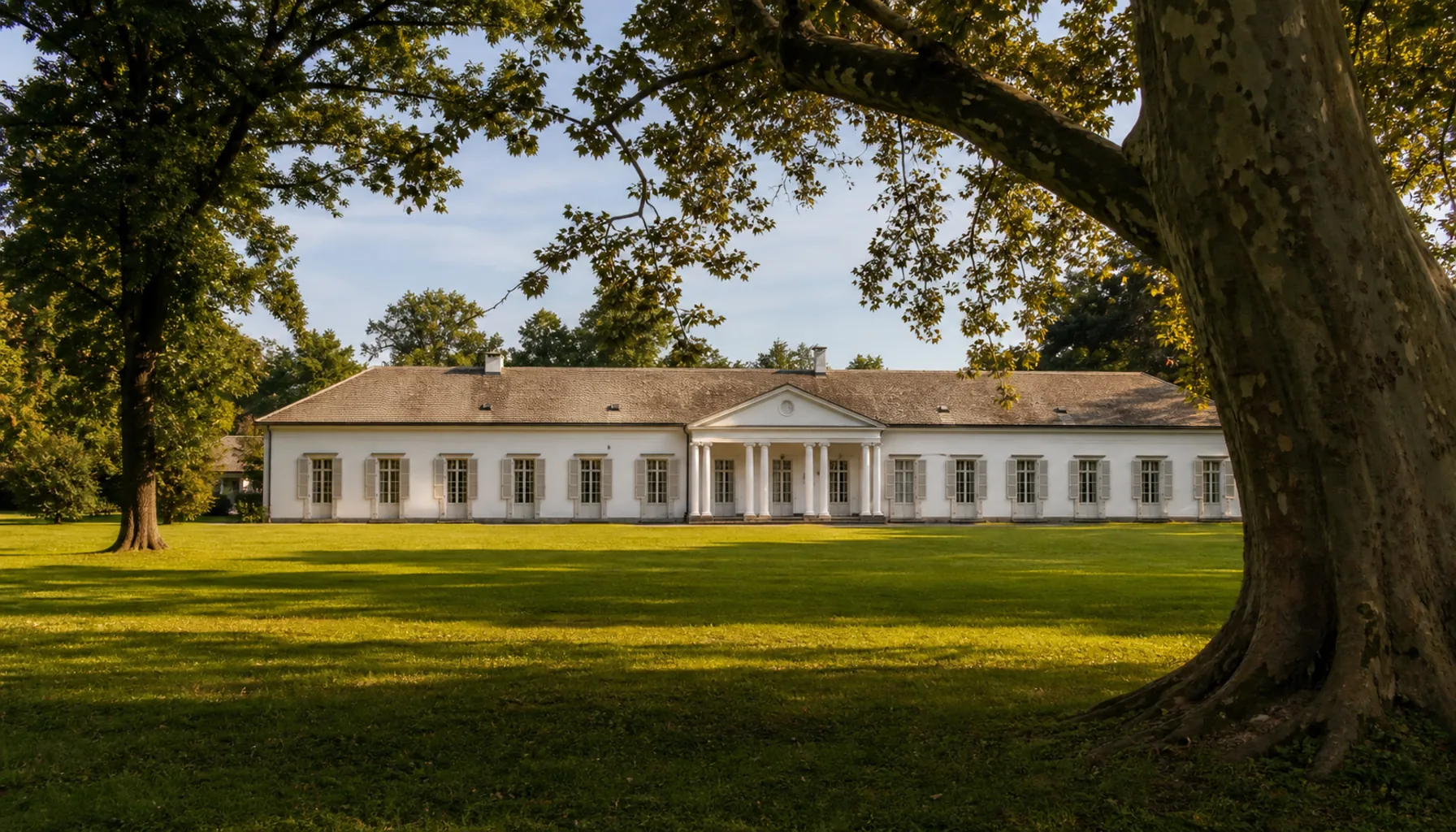
A large lowland estate village south of Nitra, built around a classicist manor house and its park — an eighteenth-century landowner's seat that is still the centre of the place, and still in use rather than on show.Veľká nížinná panská obec južne od Nitry, postavená okolo klasicistického kaštieľa a jeho parku — sídlo zemepána z 18. storočia, ktoré je stále stredobodom obce, a stále sa používa, nielen vystavuje.
The classicist manor house at Mojmírovce seen across its parkKlasicistický kaštieľ v Mojmírovciach cez park
Where it standsKde leží
Mojmírovce lie about fifteen kilometres south of Nitra, out on the flat of the Danubian lowland where the fields run to the horizon and the only relief is a line of trees along a road or a drainage canal. It is a large village by Slovak standards, with a wide main street and long plots behind the houses.Mojmírovce ležia asi pätnásť kilometrov južne od Nitry, na rovine Podunajskej nížiny, kde polia siahajú k obzoru a jediným zlomom je rad stromov popri ceste alebo odvodňovacom kanáli. Na slovenské pomery je to veľká obec so širokou hlavnou ulicou a dlhými dvormi za domami.
Until 1948 the village was called Urmín, which is the name on older maps and in the Hungarian-language literature; the present name was taken from Mojmír, the first known ruler of Great Moravia.Do roku 1948 sa obec volala Urmín — pod týmto menom ju nájdete na starších mapách a v maďarskej literatúre; dnešný názov je odvodený od Mojmíra, prvého známeho veľkomoravského panovníka.
Why it is herePrečo práve tu
This is estate country. The soil south of Nitra is among the best arable in Slovakia, and the villages on it grew as the working settlements of large landed properties rather than as market towns of their own. Mojmírovce belonged for generations to the Hunyady family, and what that family built is the reason the village has a page here.Toto je krajina veľkostatkov. Pôda južne od Nitry patrí k najlepšej ornej na Slovensku a obce na nej vyrastali ako pracovné osady veľkých panstiev, nie ako vlastné trhové mestečká. Mojmírovce po generácie patrili Huňadyovcom a práve to, čo tento rod postavil, je dôvodom, prečo tu obec má vlastnú stránku.
The manor went up in the eighteenth century and was given its present classicist form towards the end of it: a long symmetrical range with a columned centre, service courtyards behind it, and an English landscape park laid out around it. On a lowland with no hill and no gorge to give a place its shape, a house and a park of that size are the landscape.Kaštieľ vznikol v 18. storočí a dnešnú klasicistickú podobu dostal na jeho konci: dlhé súmerné krídlo so stĺporadím v strede, hospodárske dvory za ním a okolo neho anglický krajinársky park. V nížine, kde niet kopca ani tiesňavy, ktoré by miestu dali tvar, sú dom a park takejto veľkosti tou krajinou.
The estate had a name in the nineteenth century for farming that tried new methods, and farming has never stopped being the village's business: the agricultural co-operative that works these fields is still one of the larger employers here.Panstvo malo v 19. storočí povesť hospodárstva, ktoré skúšalo nové postupy, a poľnohospodárstvo nikdy neprestalo byť živnosťou obce: družstvo, ktoré tieto polia obrába, je tu dodnes jedným z väčších zamestnávateľov.
What you actually seeČo naozaj uvidíte
The manor is the reason to stop: a long white classicist front behind a forecourt, and behind that the park — mature limes and planes over mown grass, in the English manner rather than the clipped French one. It reads best from the park side, where the range is longest.Kaštieľ je dôvodom, prečo zastaviť: dlhé biele klasicistické priečelie za čestným dvorom a za ním park — vzrastlé lipy a platany nad pokosenou trávou, v anglickom duchu, nie vo francúzskom strihu. Najlepšie sa číta z parkovej strany, kde je krídlo najdlhšie.
The building is in commercial use as a hotel, restaurant and events venue. That means the exterior and much of the park are easy to see, and the interiors belong to people who have booked something; there is no museum here and no guided tour of the kind the state-run manors offer.Budova sa komerčne využíva ako hotel, reštaurácia a miesto pre podujatia. Exteriér a veľkú časť parku si teda pozriete ľahko, interiéry však patria tým, ktorí si niečo objednali; múzeum tu nie je a nie sú tu ani prehliadky so sprievodcom, aké ponúkajú štátne kaštiele.
Beyond the manor the village is worth ten minutes on foot: the parish church, the width of the street, and the older houses standing gable-end to the road, which is the building line of a lowland Slovak village.Okrem kaštieľa vydá obec na desať minút pešo: farský kostol, šírka ulice a staršie domy postavené štítom k ceste — to je stavebná čiara nížinnej slovenskej dediny.
Living village, not a museumŽivá obec, nie skanzen
Mojmírovce is not a heritage village and does not present itself as one. It is a large, well-off, ordinary place that commutes to Nitra and farms the land around it, and the manor is a business rather than a monument. Walk in the park and look at the house; go inside if you are eating or staying, and not otherwise.Mojmírovce nie sú pamiatkovou obcou a ani sa tak neprezentujú. Je to veľká, pomerne zámožná a celkom bežná obec, ktorá dochádza za prácou do Nitry a obrába pôdu okolo seba, a kaštieľ je podnik, nie pamiatka. Prejdite sa parkom a pozrite si dom; dnu choďte, ak sa tam stravujete alebo bývate, inak nie.
Because access follows a hotel's programme rather than a monument's opening hours, a wedding or a conference can close the grounds for a day. If seeing the house matters to you, ring ahead.Keďže sa prístup riadi programom hotela, a nie otváracími hodinami pamiatky, svadba alebo konferencia môžu areál na deň uzavrieť. Ak vám na obhliadke domu záleží, zavolajte vopred.
Getting thereAko sa tam dostať
Buses run frequently from Nitra, which is also the nearest station; the village has none of its own. By car it is a straight run south from the city across the fields, signposted from the roads towards Šurany and Nové Zámky.Z Nitry premávajú autobusy často a Nitra je aj najbližšou stanicou; obec vlastnú nemá. Autom sa ide priamo na juh z mesta cez polia, so značením z ciest smerom na Šurany a Nové Zámky.
Explore MojmírovceObjavujte Mojmírovce
Every part of this place with a page of its own.Každá časť tohto miesta, ktorá má vlastnú stránku.