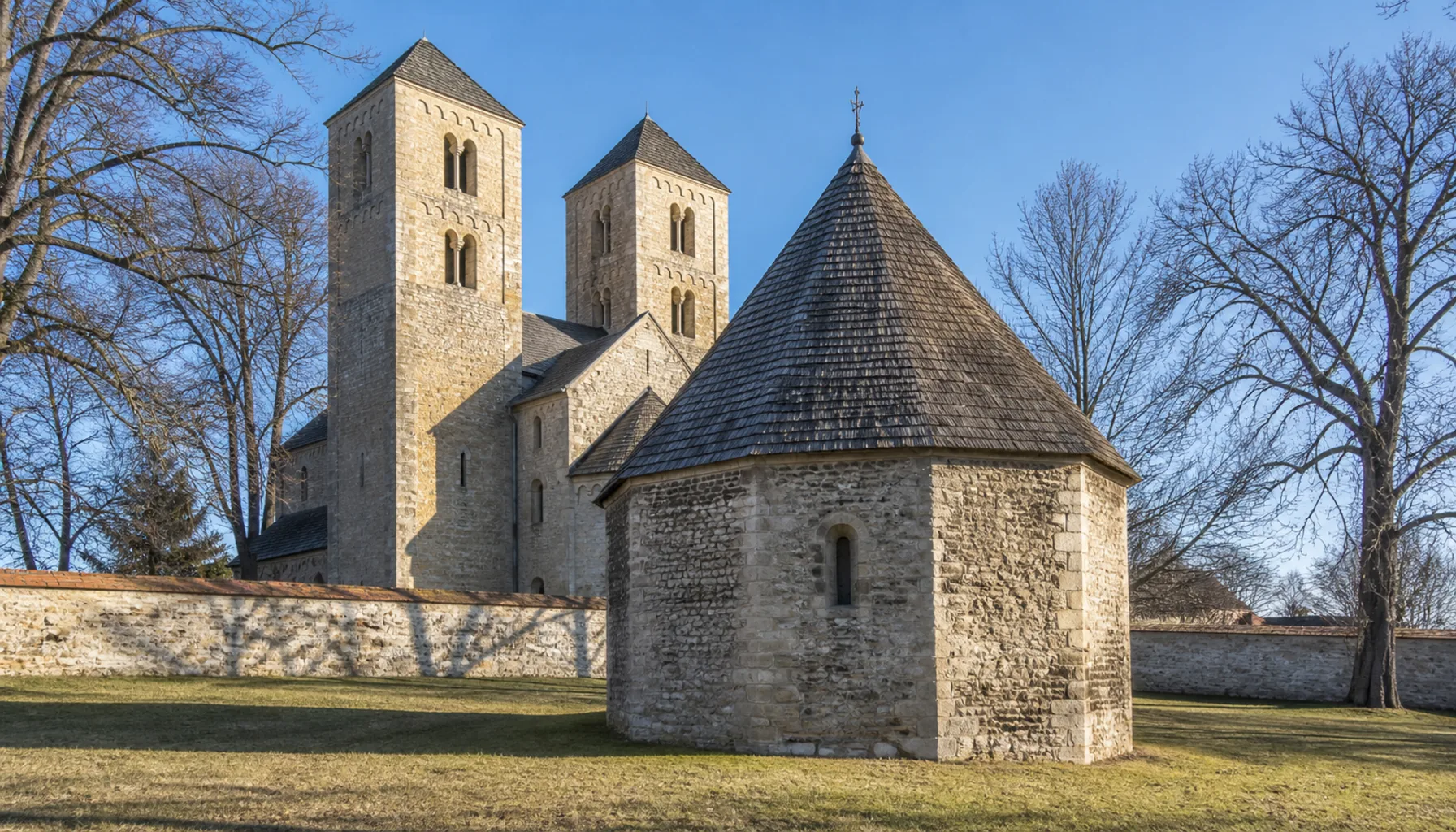
One of the most important Romanesque sites in Slovakia stands in a lowland village on the Hron: a twin-towered priory church, a round rotunda a few steps from it with twelve niches painted with the apostles inside, and around both the earth ramparts of a far older fortified place.V nížinnej obci na Hrone stojí jedna z najvýznamnejších románskych lokalít na Slovensku: dvojvežový kláštorný kostol, pár krokov od neho okrúhla rotunda s dvanástimi výklenkami s maľbami apoštolov vnútri a okolo oboch zemné valy oveľa staršieho opevneného miesta.
The Romanesque rotunda at Bíňa, with the twin towers of the priory church behind itRománska rotunda v Bíni a za ňou dvojvežový kláštorný kostol
Where it standsKde leží
Bíňa lies on the lower Hron, in the warm, flat, intensively farmed country between Želiezovce and Štúrovo, a short way from the river and not far from where the Danube plain opens out. This is lowland Slovakia at its most open: arable, lines of poplars, villages strung along low terraces.Bíňa leží na dolnom Hrone, v teplej a rovinatej, intenzívne obrábanej krajine medzi Želiezovcami a Štúrovom, kúsok od rieky a neďaleko miesta, kde sa otvára Podunajská rovina. Toto je nížinné Slovensko v najotvorenejšej podobe: polia, topoľové aleje, obce roztiahnuté po nízkych terasách.
Slovak and Hungarian are both everyday languages in this district, and the village goes commonly by both of its names.V tomto okrese sú slovenčina aj maďarčina bežnými jazykmi každodenného života a obec sa bežne označuje oboma svojimi menami.
Why it is herePrečo práve tu
The oldest thing at Bíňa is not a building but the ground itself. The village sits inside a system of earth ramparts and ditches enclosing a very large area — among the biggest early medieval earthworks in Slovakia. Who raised them, and exactly when, is argued over; the ninth to the eleventh century is the range usually given.Najstaršie, čo v Bíni je, nie je stavba, ale samotný terén. Obec leží vnútri sústavy zemných valov a priekop, ktoré uzatvárajú veľmi rozsiahle územie — patria k najväčším včasnostredovekým opevneniam na Slovensku. Kto ich nasypal a kedy presne, je predmetom sporu; obvykle sa uvádza rozpätie 9. až 11. storočia.
A place that mattered went on mattering. Early in the thirteenth century a Premonstratensian priory was founded here by a magnate of the Hunt-Poznan kindred, and its church — of the Assumption of Our Lady — is what survives: three aisles, a west front with two towers, a carved Romanesque portal beneath them.Miesto, ktoré raz bolo dôležité, dôležitým aj ostalo. Začiatkom 13. storočia tu veľmož z rodu Hont-Poznanovcov založil premonštrátsky kláštor a zachoval sa jeho kostol — Nanebovzatia Panny Márie: tri lode, západné priečelie s dvoma vežami a pod nimi kamenársky zdobený románsky portál.
Beside it stands the rotunda: small and round, its wall hollowed into twelve niches painted with the apostles — an interior with no parallel in the country. Its date and its purpose are both open — the twelfth century is the common attribution, and the readings run from baptistery to burial chapel. Later centuries went over the church with Gothic and Baroque work, but the Romanesque bones are still the point.Vedľa neho stojí rotunda: malá a okrúhla, so stenou členenou dvanástimi výklenkami s maľbami apoštolov — interiér, ktorý nemá na Slovensku obdobu. Jej datovanie aj účel zostávajú otvorené — bežne sa kladie do 12. storočia a výklady siahajú od baptistéria po pohrebnú kaplnku. Ďalšie storočia kostol prekryli gotikou a barokom, no podstatné na ňom zostáva románske jadro.
What you actually seeČo naozaj uvidíte
The church is the set piece. The west front is broad and high, with the two towers and the portal beneath them, and inside the three aisles are carried on heavy piers. Not everything you are looking at is thirteenth-century — the vaults and the furnishing are later — but the proportions and the stonework of the west end are.Kostol je hlavnou pamiatkou. Západné priečelie je široké a vysoké, s dvoma vežami a portálom pod nimi, vnútri nesú tri lode ťažké piliere. Nie všetko, na čo sa pozeráte, je z 13. storočia — klenby aj zariadenie sú mladšie — no proporcie a kamenárska práca západnej časti áno.
The rotunda is a few steps away in the churchyard: a low stone drum, round and plain outside, and one round room with twelve wall niches and a small apse inside. It is very small, very plain and very old, and walking round it takes three minutes. Most of the interest is in the fact of it.Rotunda je od neho na pár krokov, v areáli kostola: nízky kamenný valec, zvonku okrúhly a jednoduchý, vnútri jediná okrúhla miestnosť s dvanástimi výklenkami v stene a malou apsidou. Je veľmi malá, veľmi jednoduchá a veľmi stará a obísť ju trvá tri minúty. Väčšina jej zaujímavosti spočíva v tom, že vôbec je.
The earthworks are the hardest thing here to see and the most rewarding to know about. On the ground they read as long banks, grassed or grown over, running through the village and around it; they are clearer in winter than under a standing crop, and the scale only comes across on a map.Valy sa tu vidia najťažšie a najviac sa oplatí o nich vedieť. V teréne sa javia ako dlhé zatrávnené alebo zarastené násypy, ktoré prechádzajú obcou a obchádzajú ju; v zime sú čitateľnejšie než pod stojacou úrodou a ich rozsah vynikne až na mape.
Living village, not a museumŽivá obec, nie skanzen
Bíňa is a working farming village and the church is a working parish church, not a monument with a ticket desk. It and the rotunda are normally locked outside services. Access is by arrangement with the parish, and the reliable time to find a door open is around Mass.Bíňa je fungujúcou poľnohospodárskou obcou a kostol je fungujúcim farským kostolom, nie pamiatkou s pokladnicou. Kostol aj rotunda bývajú mimo bohoslužieb zamknuté. Vstup treba dohodnúť s farnosťou a najspoľahlivejšie je nájsť otvorené okolo omše.
The churchyard is in use for burials. Most of the length of the ramparts is private farmland — look at them from the roads and the field tracks rather than by walking across somebody's crop.Cintorín sa naďalej používa na pochovávanie. Väčšina dĺžky valov je súkromnou pôdou — obzerajte si ich z ciest a poľných chodníkov, nie prechádzkou cez cudziu úrodu.
Getting thereAko sa tam dostať
There is no station in the village. Buses run from Štúrovo and Nové Zámky, and by car Bíňa is a short signposted turn off the road that follows the lower Hron; from the main route along the Danube it is an easy detour.V obci nie je stanica. Autobusy premávajú zo Štúrova a z Nových Zámkov a autom je Bíňa krátkou značenou odbočkou z cesty, ktorá sleduje dolný Hron; z hlavného ťahu popri Dunaji je to nenáročná zachádzka.
Explore BíňaObjavujte Bíňa
Every part of this place with a page of its own.Každá časť tohto miesta, ktorá má vlastnú stránku.