June 1992 – 1 January 1993A split nobody was asked aboutRozdelenie, na ktoré sa nikto nepýtal
SlovakiaSlovensko
A split nobody was asked aboutRozdelenie, na ktoré sa nikto nepýtal
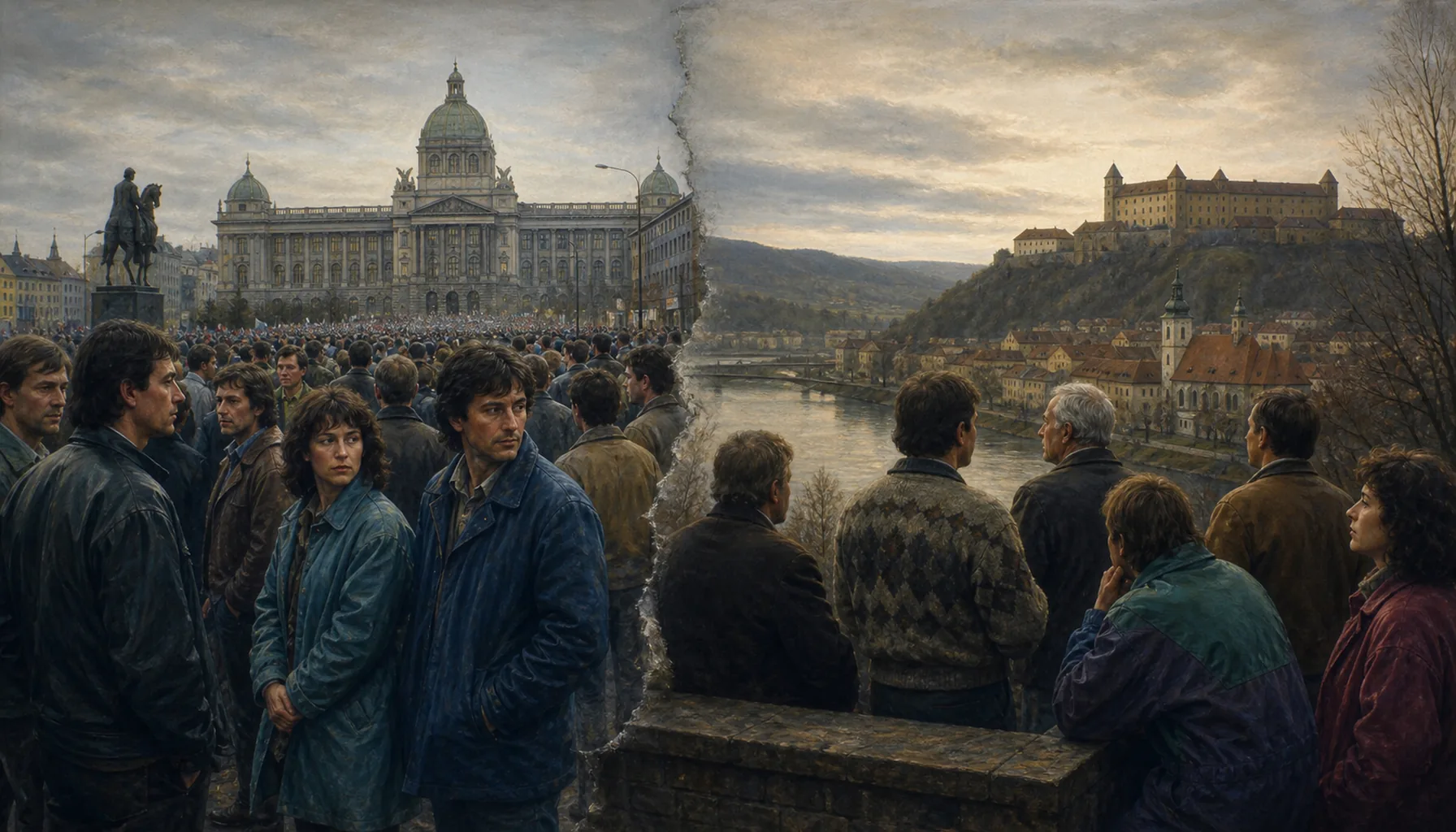
Freedom immediately reopened the old question of what Slovakia was to be inside the shared state. After the elections of June 1992 Václav Klaus had won in the Czech lands and Vladimír Mečiar in Slovakia on programmes that could not be combined, and the two men agreed to divide the country rather than govern it together. The Federal Assembly voted the dissolution through on 25 November 1992. There was never a referendum, and the opinion polls of the time showed that majorities of both Czechs and Slovaks would have preferred to keep the federation. At midnight on 1 January 1993 Czechoslovakia ended without a shot being fired — the Velvet Divorce — and the Slovak Republic began, with Bratislava as its capital; it joined the United Nations that same January, and Michal Kováč took office as its first president on 2 March 1993.Sloboda hneď otvorila starú otázku, čím má Slovensko v spoločnom štáte byť. Po voľbách v júni 1992 vyhral v českých krajinách Václav Klaus a na Slovensku Vladimír Mečiar s programami, ktoré sa nedali spojiť, a obaja sa radšej dohodli štát rozdeliť, než ho spolu spravovať. Federálne zhromaždenie odhlasovalo zánik federácie 25. novembra 1992. Referendum sa nikdy nekonalo a vtedajšie prieskumy ukazovali, že väčšina Čechov aj Slovákov by federáciu radšej zachovala. O polnoci 1. januára 1993 sa Česko-Slovensko skončilo bez jediného výstrelu — „zamatový rozvod“ — a začala sa Slovenská republika s hlavným mestom Bratislavou; ešte v januári vstúpila do Organizácie Spojených národov a 2. marca 1993 sa jej prvým prezidentom stal Michal Kováč.
ReferencesZdroje
Where this came fromOdkiaľ to pochádza
Sources consulted while researching this page. Follow them to read further — and to check us.Zdroje, z ktorých sme pri príprave tejto stránky vychádzali. Kliknite a čítajte ďalej — aj si nás overte.
Černová massacre — Wikipediadate, 15 killed and 12 seriously wounded, gendarmes' own nationalitydate, 15 killed and 12 seriously wounded, gendarmes' own nationality
Magyarization — Wikipediathe 1907 Apponyi education laws, the closing of the Slovak grammar schools and of Matica slovenská in April 1875the 1907 Apponyi education laws, the closing of the Slovak grammar schools and of Matica slovenská in April 1875
Žiadosti slovenského národa — Wikipédia10 May 1848, fourteen points, the arrest warrants of May–June 184810 May 1848, fourteen points, the arrest warrants of May–June 1848
Slovak Uprising of 1848–49 — Wikipediathe three volunteer campaigns and the disbanding of the corps on 21 November 1849the three volunteer campaigns and the disbanding of the corps on 21 November 1849
Pittsburgh Agreement — Wikipediathe Cleveland Agreement of 22 October 1915 and the text of the Pittsburgh promisesthe Cleveland Agreement of 22 October 1915 and the text of the Pittsburgh promises
Slovak–Hungarian War — Wikipediathe 'Little War' of March 1939 and the 1,697 km² ceded on 4 April 1939the 'Little War' of March 1939 and the 1,697 km² ceded on 4 April 1939
Slovak National Uprising — Wikipediainsurgent numbers, territory held, the fall of Banská Bystrica on 27 October 1944insurgent numbers, territory held, the fall of Banská Bystrica on 27 October 1944
Kremnička and Nemecká massacres — Wikipedia747 victims at Kremnička, about 900 at Nemecká, the units responsible747 victims at Kremnička, about 900 at Nemecká, the units responsible
Masaker v Kľakovskej doline — Wikipédia21 January 1945, 148 civilians including 48 children under eighteen21 January 1945, 148 civilians including 48 children under eighteen
Battle of the Dukla Pass — Wikipedia8 September – 28 October 1944 and the casualty figures8 September – 28 October 1944 and the casualty figures
Kalinov — Wikipédiathe first village in Slovakia liberated, 21 September 1944the first village in Slovakia liberated, 21 September 1944
Slovak Greek Catholic Church — Wikipediathe staged Prešov assembly of April 1950, Bishop Gojdič, the 1968 restorationthe staged Prešov assembly of April 1950, Bishop Gojdič, the 1968 restoration